Monday, June 26, 2006

A Finnish thriller by Kjell Westo (maybe not so thrilling)


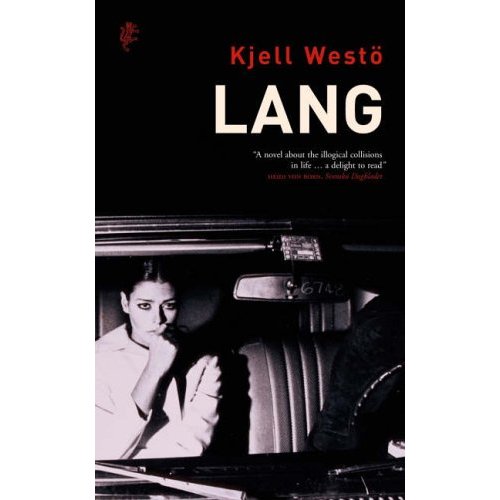
My wife and I have this discussion about TV cop shows: I can't stand it when there's a lot of "soap opera" about the cops' private lives. That's why I like Law & Order and don't like NYPD Blue. And it's why I don't like a certain kind of novel, whether it aspires to noir or not. Too much "soap opera" impedes what Paul Cain referred to in the title of his classic (and classically depressing) A Fast One. The best noir progresses inexorably toward its conclusion. Kjell Westö's novel Lang starts out great: The narrator, an old friend of the Lang of the title, is woken up in the middle of the night by a panicky Lang who needs to borrow a shovel. Great, I say to myself, this has the ring of violence and also comedy--maybe this is another Getting Rid of Mister Kitchen (see earlier posts). But alas no. This is that dreaded sub-genre, the literary thriller. Simply speaking those words condemns the novel, in my lexicon. Too many "art" novelists think they can write a crime novel and when they do, it comes out baggy or full of "soap opera." Westö's Lang mentions the novelist Joyce Carol Oates favorably (while disparaging his girlfriend for reading Bridget Jones's Diary instead). But Westö's novel is a bit too much like an Oates novel, arty perhaps, but not much of a thriller. The novel is in fact a mystery-woman novel of the sort pioneered by Lawrence Durrell in his Justine. Lang's lover, Sarita, has mysterious secrets that make her, at her core, unavailable to Lang. But the real mystery is why she would indulge this pretentious asshole (a novelist and talk-show host) as much as she does. Westö does make fun of his character as a pretentious bore, and he distances the narrative by having a narrator who is a friend, assembling the story from notes that Lang sends him from prison (the end of the shovel incident being foretold in the nature of the narrative). There are also several interesting or comic literary conceits (the letters from prison, not presented directly but referred to by the narrator, recall Humbert's prison confession in Lolita; and the narrator includes a review of his own earlier work written by Lang--a highly unfavorable review). That's all very clever, but how much of the back-and-forth sexual relationship and mysterious former husband do we really have to sit through before the tale of the shovel comes back into the foreground. Writers of art novels do periodically think they can write noir, without realizing that the genre is note a mere finger exercise that they can toss off, or a genre without its own imperatives into which they can simply pour their usual literary interests. The effective crime novel is an art of its own, entertainment perhaps (like the Bridget Jones that Lang disparages though to me an entertainment of broader concerns and interests); But not an entertainment that is simple to imitate. Westö is a Swedish-speaking Finn, part of a linguistic minority within a very distinctive culture--I was hoping for more from his contribution to the crime novel. Next, I'm reading a Finnish language crime novel--maybe that one will be better (and I'm not saying anything about the conclusion of Lang--if anyone cares, leave me a note and I'll add something about it.

Sunday, June 25, 2006

Allan Guthrie and one comment on Derek Raymond


A couple of readers have mentiond Derek Raymond's Department of Unexplained Deaths or "factory" novels, and that they're being reprinted by Serpent's Tail (more kudos to Serpent's Tail). I should have gone into some detail about Raymond, but it's been a while since I've read them. A good excuse to go back--my memory is that they're noir to a depth that is almost surreal. I just read Allan Guthrie's first novel, Two Way Split, and it has a surreal side, too. The complex, fragmented narrative has a secret lurking at its center, revealed in the denouement. Even before that secret is revealed the narrative has a weird movement that contributes, rather than retards, its motion forward as well as its noir atmosphere. When the secret IS revealed, the novel tips into a milieu that has only been hited at earlier--has anyone read Jim Thompson's asylum comedy, The Alcoholics? It's a wild and funny surreal noir comedy, and Guthrie's first novel takes a step in that direction, as well as a step in the direction of Thompson's more straight noir novels. The sequel is much more straightforward, but still a pleasure--while Two Way Split is perhaps a more distinctive accomplishment. Check out Guthrie's extensive website, Noir Originals, which has a great deal of information about other authors as well.

Tuesday, June 20, 2006

Stuart MacBride and a more general observation


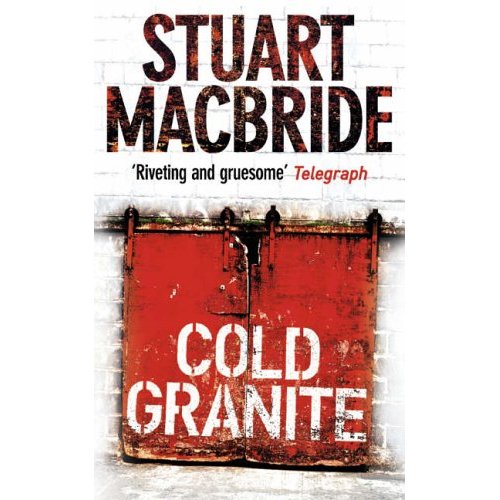
I'm reading Stuart MacBride's Cold Granite (at a reader's suggestion) and not quite done yet. But since I'm not doing plot summaries anyway, I'm going to go ahead and post (since I'll be away from my computer for a few days). Reading Cold Granite is kind of like watching a very good cop movie or TV series, really more Joseph Wambaugh than Thomas Harris, even though the novel deals with a serial killer situation. MacBride keeps careful control of point of view, only leaving his main character's perspective for the occasional preview of a crime scene. That control is a key to the success of MacBride's approach, which is both light and dark, comic and menacing. And, like Wambaugh but unlike even McBain, MacBride captures the flow of personalities, events, non-events, irrelevant occurrences, and false leads that can make a cop story both fun and revealing (not just about cops but about the larger social setting). Cold Granite is set in Aberdeen (the Granite City, apparently) and the setting is gritty and wet (the author all but apologises to the citizens of Aberdeen in an foreword). But the focus is on personality, which allows the comedy to develop naturally (again, as in Wambaugh--though no one would describe a Wambaugh novel as "noir," I think, and MacBride does come closer to the topic of this blog). I'm looking forward to more of MacBride, when I can get my hands on the later novels. One thing about Cold Granite is that it seems to be catching the detectives in mid-series, as if the reader has known about some of the back-story that comes out in little bits through the book--it's an effective device to lure the reader into a series novel without indulging in the kind of "mythologizing," a la, for example, the first episode of the Lone Ranger (if any of you readers remembers that, or if it's still circulating somewhere in the ionosphere). You feel as if you know these characters already.
The general observation is more of a question--I've been thinking about gratuitous, sadistic violence after reading Simon Kernick's novels. There's one passage, a kind of throwaway character analysis that Kernick does a lot, in which a man casually tortures another man with a hot steam iron. The torture is not essential to the novel, just to the character description, and somehow the sadism is more pointed, more sadistic than if it were part of the main thread of the story. Though there's certainly a lot of violence in noir fiction, is there a place for such casual sadism?

Friday, June 16, 2006

Couple more by Simon Kernick

I promised a couple more UK novels before going back to the Continent, and here are a couple by Kernick--but there's one more UK work (from Scotland) still in my pipeline before we move on to Finland: Stuar Macbride was recommended to me by one of this blog's readers, and I've gotten hold of a copy that looks very tantalizing. But first, as they say: Simon Kernick has 5 novels out now, I think, but I've only read through #3. I reported on #1 earlier, but here I'll just say a few words about The Murder Exchange and The Crime Trade, two almost unbelievably complicated cops-and-mobsters stories. Kernick uses a first person narrator, one of his detectives, for some of the narrative and third-person for others, and in the case of The Crime Trade this device leads to what I would consider a flaw--the annoying withholding of information. Of course, all "mystery" writers withhold information. But when Kernick follows an undercover cop, in great detail throughout the novel and withholds a large piece of his life and character from the reader, I feel a bit betrayed. The Murder Exchange is, I think, a better novel with a (for sure) bigger payoff in the fast and violent conclusion, but it is even more complicated than its sequel--Kernick relies on an Afterword to tie up all the things he hasn't been able to deal with in his narrative. Kernick's novels have a lot to like, and there are frequently very funny and very violent passages (often at the same time), but so far all of his novels have alternated these parts with long longeurs, to my mind, and the novels could have used some judicial editing--they're a bit too long as well as too complicated, and I tend to lose interest in the repetitious dialogue that he has to indulge in to keep the details of the plot in the forefront of the reader's mind.

Saturday, June 10, 2006

Cathi Unsworth and what's next


I'm going to talk about a couple more UK writers (the one shown here is the U.S. cover, which I prefer to the original, for a book I've been saving for a while) and then it's back on the international circuit, with two writers from Finland (one writes in Swedish, the other in Finnish), a Cuban, and more. First, The Not Knowing, by Cathi Unsworth, another estimable noir novel from Serpent's Tail. TNK includes an English version of Southern Gothic, like Thomas Hardy crossed with Deliverance (or maybe Daniel Woodrell): at the heart of the novel is a novel-within-a-novel that Unsworth's heroine, Diana, takes seriously as a crime novel, though it's really more "wretched of the earth" kind of stuff. The set-up is that Diana works for a new magazine, Lux, that deals with crime fiction, music, and the culture scene (particularly the scene around what she calls "psychobilly," a marriage of punk and rockabilly that sounds fascinating (I need to do some research and find which bands or what scene she's portraying here--anybody have any ideas?). As the novel gets going, there's a spectacular murder of a filmmaker who's just made a splash with an updating of the great British gangster films of the 50s (and its success has spawned a craze for the style of the Kray twins). The texture of this aspect of the novel is wonderful--Unsworth is able to move back and forth from the film world, to publishing, to the pubs frequented by the musicians, and it's all great fun. Diana is likable, though she falls more into the role of victim than active agent or investigator (kudos to Unsworth, though, for not setting her up as an amateur detective, England is already crawling with those, to judge from the mystery lists). Also to Unsworth's credit is that the denoument doesn't involve any transformation of her heroine into a kung-fu master (mistress?) or any hero-on-a-horse--the conclusion arises from character rather than cliche. But the false heart of the novel, for me, is the novel-within-a-novel--I just can't accept it as seriously as the characters in the novel do. I'd rather be hearing more about some of the minor characters, such as 50s gangster-film star Niall Flynn, whose career was resurrected by the murdered filmmaker's success, or Detective Linehan, who is merely sketched in here, but seems likable and intimidating by turns, a good combination for noir. I'd read another book by Unsworth, though, and hope she fulfills the promise of this first book (apologies for my caveats--maybe it's just me).

Friday, June 09, 2006

Allan Guthrie


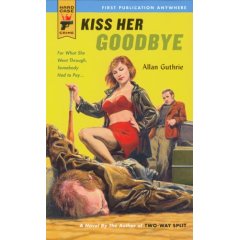
After Allan Guthrie posted replies to a couple of my questions, in earlier posts of this blog, I felt compelled to seek out his novels. I just read the first one I got my hands on, Kiss Her Goodbye, which is apparently his second novel. On the basis of this book, I'll definitely keep looking for the other one, Two-Way Split. People claim that what Ian Rankin writes is "tartan noir," but Guthrie's Kiss Her Goodbye is much more the genuine article--a real throwback (and in some ways a respectful updating) the original noir fiction, the pulp novels of the 50s. Hard Case Crime, the publisher, has recognized this relationship with a noir-pulp homage cover, by pulp paperback master Chuck Pyle. The big difference between Rankin and Guthrie is that Rankin seems always (or at least frequently) to reach for crimes that lead "up" to the middle class, to the government, to the power structure. Noir originally dealt primarily with the criminal class, working class, street life of society. Think of Jim Thompson, James M. Cain, or that pulp classic (by a British writer, I believe) No Orchids for Miss Blandish by James Hadley Chase. I should write a separate post about Miss Blandish, but suffice it to say that this book is exactly the Southern white trash pulp novel that Faulkner originally intended his Sanctuary to be, before his literary sensibility took over, obscuring the very pulpy events by bringing in his larger aesthetic and social concerns. There may be some sort of moral lurking in Miss Blandish, but it's primarily a guilty pleasure. Guthrie's novel is a bit more than that--though it's a fun read too. Kiss Her Goodbye is about the criminal class, but he doesn't patronize or caricature his characters. They never act or talk like cliches. And though his plot is very straightforward, it moves along at the logical pace of his characters' lives, emotions, and motivations. And in spite of the heavy weight of family drama, pain, and death, it's also a funny book (not in the burlesque fashion of Bayswater Bodycount, but in an organic way, appropriate to characters who would not want to be taken any more seriously than they take themselves. I'm looking forward to Two-Way Split. One further point--Guthrie finds a way to solve one of the vexing problems of all crime fiction these days--the cell phone. Nothing is more boring than transcribing people's phone calls--but how do you move people around and get them in face-to-face encounters these days when it's so easy to just call them on their mobile. And how do you maintain suspense and surprise about where people are and what they're doing when most folks would just get the phone out of their pocket and call to find out. Cops can claim (as Simon Kernick cops do in his Murder Exchange) that they'd rather surprise people face-to-face to see reactions, etc. But what about civilians? Guthrie gets his hero so mad that he throws his phone across the room, smashing it to bits. Then he's too busy, in this fast-moving novel, to get another one. Problem solved, and he has to run all over Edinburgh to find people and to find out what's going on.

Wednesday, June 07, 2006

More Ken Bruen (and maybe the last reviewed here)


Before I make some comments on Ken Bruen's most recent novels, I want to thank those who've responded to some of my recent questions. You've reminded me of a couple of writers by whom I've only read one book--particularly Charlie Williams and David Peace. I can't remember why I stopped after the first Peace novel--I need to go back and have another look. Charlie Williams is a very dark and very funny writer, but his first novel was enough for me, for a while. Still, I'd highly recommend anyone who likes noir, crime, or black humor to run (don't walk) to get hold of something by Williams. Now to Bruen--I'm going to make some comments about The Dramatist first, then come back and edit this post with some comments on Vixen (so last year! in terms of Bruen's output--there's another in this series due out this summer, Calibre). The Dramatist is the most recent of the Jack Taylor/Galway private eye books. Bruen churns these out according to not a formula but a sensibility or an atmosphere, carried forward (seemingly effortlessly and endlessly) by the author. Up to the end, I think the Dramatist is the best of the Taylor novels (and the next most recent, dealing with the famous Magdalen Martyrs, the worst). Taylor is less self-flagellating, sober, and honestly trying to connect with people. The plot (as always with Bruen) is really secondary--the results of his investigation come late and without much punch. The point of the books is travelling the hard road (the Calvary road, almost) of Taylor's journey through Galway and other Irish towns. But the ending to The Dramatist (don't worry, I won't give it away) ruins the whole thing for me. One reviewer at Amazon extols the ending for its sadness--in fact, there's a character who seems to exist in the novel only to die senselessly, and thereby send Jack careening off the water wagon and back into the bottle and his pal, despair. That senseless grasping for the maudlin effect makes me go back and re-evaluate the other characters and events--and in that re-evaluation I'm forced to regard all of the characters as mere props to provide Jack with a reason to fall back into the sewer where he was at the beginning of the series. I'm afraid I won't be able to follow his progress in and out of that sewer any more. The virtues of Bruen's writing are all still here--in particular his references to other noir writers, a gracious and helpful benchmark for his own writing--but have gotten a bit repetitive. And, as in some cases before, Bruen is writing so fast (and not getting the editing or fact-checking that he really needs) that he's not getting his facts right. In earlier books, he has misspelled the noir authors' names, and in these recent books he refers to Oz, the HBO show, as an "Australian prison drama." Oz is about Oswald State Prison, in the U.S.--and why is Bruen referring to it at all if he's that unfamiliar with it? And why is the editor/publisher not catching that kind of mistake? Bruen is endlessly creative, in the sense of generating lively text seemingly ad infinitum, but not so creative in the sense of giving the reader new experiences. Vixen has the typical Bruen virtue or limitation, depending on your point of view, of being a quick, brief read. And Vixen is part of what is to me Bruen's best series, ensemble-police-procedurals featuring a group of cops surrounding Brant, a hard man whose taste in fiction runs to Ed McBain, in homage to the inspiration for this series. But where McBain's 87th Precinct novels are at their heart humanistic, liberal, and sympathetic to the trials and tribulations of his cops and even the general public, Bruen's series is deeply cynical, sarcastic, and anti-humanist. Also a lot of fun--there's lots of wise-cracking and politically incorrect attitude on everyone's part. The plots meander around in the fashion of Elmore Leonard's best books--twisting and turning according to the characters inner needs rather than any imposed plots. The police work is brutal and not very intricate. The speed of Bruen's writing is a virtue in this series, reinforcing rather than undercutting the focus on character rather than events and (given the ensemble character of the series) not dwelling too much on the self-loathing that some of these characters possess in almost as large a dose as Jack Taylor. But unlike Taylor, these characters may be struck down again and again, but they keep on going, like Beckett's characters, with resignation and humor rather than succumbing totally to the drugs and booze that they do, indeed, imbibe.

Irish-canadian-austrian noir novel

About as international as it can be while being set in one small region, John Brady's Poacher's Road is by an Irishman living in Canada writing about Austria. Brady, known for his Minogue novels set in Ireland, has started a new series featuring Probationary Gendarme Inspektor Felix Kimmel, whose beat is small-town Austria in the south of the country, near both Graz and the Slovenian border. Internationalism is a theme of the novel too--international crime (smuggling in particular) in the new Europe. Brady's novels are not known for ratiocination or even so much for solid policework, though he does focus on policework. His novels are about talk, the flavor of speech and the networks of communication, ethnicity, and family that the talk both reveals and attempts to conceal. Poacher's Road is primarily a long, oblique conversation between Kimmel and a Kripo detective who is both exploiting Kimmel and helping out his career. The solution to the mystery aspect of the book is almost secondary, as is the plot. But then in noir fiction, the plot and the resolution of a mystery are not the primary elements--noir is about surface effects and the depths that they reveal. Put another way, noir is about interactions among the inhabitants of dangerous streets, and the unpleasant realities of the society that is the larger environment of those streets. Most noir is conducted in narrative (first or third person), though, rather than conversation--narrative of violence, first person voices or interior monologues of varying degrees of despair or resignation (noir not normally being the cheeriest or most optimistic of genres). Brady, though, gets the indirection of real conversation just right--concealing as much as it reveals, revealing impressions, emotions, and facts slowly, as if in negotiation among the participants. And his dialogue is embedded in the region, particularly noticeable in the Irish novels--here he puncuates the English dialogue with phrases from Austrian rural dialect (followed by the character saying the same thing in English, which ought to be irritating but is surprisingly effective--perhaps since dialogue, if realistic, is repetitive anyway). This novel may be hard to get--only available in Canada at the moment--but it's worth the trouble, as another example of a very talented writer's work.

Wednesday, May 31, 2006

Another English writer: Simon Kernick


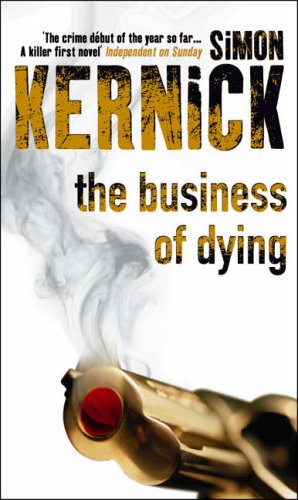
Simon Kernick has 3 novels out, in the U.S., and a couple more in the U.K., but I've just discovered his work through the first of the novels, The Business of Dying. Kernick seems to be doing a quasi-series, in the same way as Deon Meyer--running characters but not the same hero (and in Kernick's case, not the same point of view), as well as doing at least one stand-alone thriller. The Business of Dying is a first-person narrative about a crooked cop: I won't go into too much detail about the structure, since there are a couple of surprises I wouldn't want to deprive anyone of--speaking of that, I don't usually read the plot summaries on the book cover if I can avoid it. I think they ruin the flow of a narrative by (sometimes erroneously) creating expectations outside the narrative's own flow. For the same reason, I don't do plot summaries here, for the most part. Kernick seems to be playing with point of view--one novel in the series shifts from one first-person narrator to another and the third novel is evidently in the third-person in at least the third novel in the series. Without a running hero, the first person is probably hard to maintain--getting into the head of a different character every time, while maintaining the same setting and some of the same characters, sounds a bit difficult, not to speak of gimmicky, in the way of Rashomon (it will be interesting to see whether the novel that does shift point of view falls into that). But back to The Business of Dying, Kernick's novel starts off with a bang (literally) and goes along pretty well for a while, but it gets repetitive and slow toward the middle third. I think the problem may be that he never really made me care much what happened to any of the characters. The main character here (and evidently also in one of the later novels in the series), Dennis Milne, turns out to be very talented or very lucky in tight spots and fights, and as such he's a bit reminiscent of Parlabane in Brookmyre's novels--but not as funny or engaging. By the time the plot picked up again in the last third, I'd almost put the book down as a lost cause. But I'm glad I didn't--when the pace picks back up, there are considerable rewards in excitement and even comedy, along with lots of corpses. A good read, but I'm reserving judgment about Kernick, overall, until I've read one or both of the subsequent novels.

Tuesday, May 30, 2006

English noir: an annotated list, part 1


I focus mostly on noir fiction in translation, meaning I don't deal with English-language novels very often, but I posted a few comments on Scottish noir the other day and got some good feedback and suggestions. So I thought I'd start a list, with some comments, of the English crime fiction that I've liked. In no particular order:
Bayswater Bodycount, by Graeme Gordon: I really liked this one, about a street war between Palestinian and Jewish gangs in London, with a bunch of violent little-people thrown into the mix. I keep waiting for the 2nd novel from Gordon, billed as Barking Mad, but I guess after a number of years of being promised, this one is never going to happen.
Bayswater Bodycount was published by Serpent's Tail's Mask Noir series, edited by John Williams, and actually anything published by them (British, international, or U.S.) is good--avoiding the middle-class-cliches of genre mystery fiction in particular.
Ken Bruen--multiple titles. I liked the early novels (the Mas Noir ones) and the White trilogy, but Bruen is a real text machine, the books just keep coming. I think the volume of his writing is outpacing his ideas, because, to me, the newer books, particularly the ones set in Ireland, are affected and repetitious. Although they've gotten rave reviews here in the U.S., so who knows, maybe I'm wrong. He certainly has a distinctive voice (albeit sometimes seeming a bit too much like J.P. Donleavy).
John Milne: I think he only has three, maybe four titles, but they're all good--another down-and-out detective-hero, but done very skilfully.

Mike Ripley: I liked the first Angel novel I read, but after a while, they get a little tiresome. They're of very even quality, it's just that I got a little tired of the narrator's voice.
Lauren Henderson: I like her crime fiction, although her work was veering toward romance even before she turned to the "chick-lit" genre in her more recent work. Her first three or four crime novels had great titles (Dead White Female, etc) and a smart-ass narrator that was very likable.
Liz Evans: Not my cup of tea. Too much a series franchise, not enough substance. Same for Emer Gillespie. Same for Stella Duffy, though she's better than the other 2. I don't know why I like Lauren Henderson and not these other "Tart Noir," to use the phrase she and Duffy cooked up, it's just that she seems to have a more original voice, less of a genre series shtick. Or is it a "guy thing" that's keeping me from seeing the greatness of these female crime writers? But I think Denise Mina is a lot more original, does that do anything to keep me from being a sexist pig?
John Harvey: All of the books are well written, but I can understand why he retired the Resnick series--how far down the melancholy-unto-despair road could the character go before he either committed suicide or dragged himself out of his rut and got on with his life. But the 2 Resnick novels dealing with the Polish thief were very good, on all levels.
John B. Spencer: I've tried a couple of his novels, but I can't get into them--something cliched or stilted about them. Same for Paul Charles.
Carol Anne Davis's books are certainly dark, but they're really character studies, and the characters don't have much to recommend them.
Maxim Jakubowski: I know he's done good anthologies, but his noir fiction is just like his porn--very artificial.
Russell James: I've liked the ones I've been able to get my hands on--very cinematic, as I remember.

Charles Higson: he's gone on to do the "official" James-Bond-as-a-kid novels, which is a shame, because all of his earlier books are readable and one is a downright howlingly funny black comedy--Getting Rid of Mister Kitchen. Go read that book, and the others, too, if you have time--but that one is a wonder.
Bill James: I think I've dealt with him elsewhere--very strange and funny, but repetitive if you try to read a lot of them in a short time.
Julian Rathbone: Of course.
More later--and please leave notes with your suggested readings and additions to this list.

Saturday, May 27, 2006

Jo Nesbo, The Devil's Star


The Devil's Star, by Norwegian crime writer Jo Nesbo (blogger evidently doesn't support the slash that's supposed to be through that second "o" in the author's name) is a first class thriller and police procedural. It is a long book, but it's crammed with material, and if you think you have figured it out, just keep going--every time the book seems to settle into a comfortable genre, it changes ground again and the reader is off to the races. There are a couple of points where the plot is a bit sketchy, and one or two spots where it's even a bit difficult to see what has happened, but the thrill of the ride is worth a few bumps. Detective Harry Hole is even more down and out than the typical, classic noir hero. He has hit bottom and is only kept on the force because it's a holiday weekend and everybody else is on vacation. A grisly murder in an apartment's shower turns sinister when the murdered woman is discovered to have a red, star-shaped diamond inserted under her eyelid, as well as a finger cut off. More murders, diamonds, and stars accumulate, as well as an offer from Hole's nemesis (a detective that Hole is convinced murdered a female detective, perhaps in a previous book not yet translated--the plot has the feel of something being revisited) si suspiciously friendly, offering Harry an ambiguous job that sounds suspiciously like a vigilante operation. But Harry sobers up long enough to get serious about the case, and to yearn for the girlfriend that kicked him out. All the characters are believable and complex, and the Oslo setting is densely portrayed. Of all the police procedurals I've read recently, this one was the most involving, the most satisfying.

Scottish (or tartan) noir (in part)

There are too many writers of noir fiction in Scotland, and they're too diverse, to sum up in a single article. There's Peter Turnbull (police procedurals of a high standard by a former social worker who knows the streets, novels set in Glasgow if I remember correctly); Ian Rankin (my interest in him is growing, due to several recommendations from writers like Deon Meyer as well as a couple of pretty good BBC series made from his books--though when I read them the first time around, his novels, set in Edinburgh, didn't engage me much); Denise Mina's bleak novels of an underclass dependent on anti-depressants; Christopher Brookmyre's thrillers (the best of them are perhaps too funny to be really noir); Val McDermid is Scottish (don't know if she still lives there, though), and her novels are certainly very dark; then there's Douglas Lindsay, whom I haven't read (hard to find in U.S.) but I hear he's "darkly funny," as they say; and there's the series (several books anyway) by William McIlvanney, featuring Jack (I think that's his first name) Laidlaw--and these are the most purely, classically noir novels set in Scotland that I know of (though I'm for some reason usually less interested in organized crime villainy, very prominent in these books, that individual criminals).
There's also a large crop of mystery novels set in Scotland, more of the cosy or middle-class mystery variety than noir, going back many years--in comparison to the noir novels listed above (and their ilk) this stuff is very Nancy Drew, to me--Alex Gray or Simon Brett, for example.
What do you think? Have I missed any "real" noir novels of Scotland? Let me know--and let me know what you think about Douglas Lindsay--should I be investing in the overseas shipping to get his books?

Thursday, May 25, 2006

South African noir fiction


South African crime fiction is bracketed by two writers who started out as crime reporters, James McClure and Deon Meyer, but other than that fact the two writers and their novels have little in common. McClure is English, writes in English, and is basically a satirist. His crime novels pair up a white cop and his black sergeant, in the age of apartheid. One lives in a house, the other in a dirt-floored shack. Their interaction is strictly determined by law and custom. Their creative misuse of that law and custom is the basic premise of the series (which is overtly racist, in a satirical manner, and also sexist, but without the benefit of satire). These characters cannot survive the end of apartheid: the author suggests, as a reason that his series did not continue, that both will die in the turmoil and retribution surrounding the pre-reconciliation days: neither side is able to appreciate the characters' contribution in dealing with people regardless of apartheid, and both will take the rap for propping up the system by upholding the law in a corrupt and unjust society. Three novels by Wessel Ebersohn follow a Jewish medical examiner through the thickets of crime in a criminal society, but the bleakness of the outlook (perhaps a pessimism that the society would ever change) casts a pall over the plots. Another writer who coped with the culture by lampooning apartheid in its heyday, also in English, was Tom Sharpe, who went on to write academic comedies once he returned to England (after being kicked out of South Africa)--Sharpe's two South African novels are technically speaking police procedurals, but in fact are riotously funny travesties of life in South Africa. If satire and comedy were the only means of dealing with the realities of apartheid, noir fiction may be one of the best ways of dealing with the harsh realities (and possibly the high hopes as well) of post-apartheid South Africa. Two writers, both based in and writing about Cape Town, one of the most beautiful cities in the world and, despite a high crime rate, one of the safer cities in the country. One of them, another English speaker, is Michael Williams, a writing teacher whose writing is paradoxically a bit wooden. His best book is Hijack City, which pairs a younger white detective with a black mentor. Williams's portrait of racial realities in the new Cape Town, but the portrait is accurate even though the author's point of view is a bit self-righteous or politically correct. More interesting and even more accurate in catching the tone of the new reality is the work of Deon Meyer, an Afrikaans writer whose work is a fascinating window on a new Afrikaans point of view. Dead Before Dying, actually his first novel, has just arrived in the U.S., following Heart of the Hunter (actually published 3rd in its original language and in England) and Dead At Daybreak. The novels are marginally interconnected but in fact independent, not a series. In Dead at Daybreak, detective Mat Joubert is a wreck, his wife has died, he has a new boss who's a bureaucrat more than a cop, and he can't drag himself out of the bottle. His current case, through which he'll have to prove himself to his new boss, concerns murders committted with a pistol that has a long heritage in the old South Africa, and Joubert has to confront his own pain with that of the grieving families of the murder victims. But there is considerable humor as well as "tourism" in this glimpse of crime and redemption in the new South Africa. In Dead at Daybreak, former cop Zatopek van Heerden is hired as a private investigator to find the missing will of a murdered antique dealer, and in alternating chapters his own story, leading up to his partner's death, his guilt, and his leaving the force, is told. This book is more skilful perhaps than the first novel, but both stand up very well. The third book, Heart of the Hunter, concerns a reformed Xhosa assassin (whose story overlaps with van Heerden's in this book and the previous one), on the run across the country. Heart of the Hunter indulges the author's love of motorcycles, and it's a thriller plus road movie that gives a fascinating panorama of South Africa--but to me the thriller plot is less interesting (less "noir" maybe) than the 2 cop stories, though the portrayal of a black hero (even if by a white writer) is an interesting development (something similar occurs in one of the Wallander novels by Mankell, but the author is ultimately interested in another of his geopolitical plots rather than in the black character (Afrikaaner nationalism, Russian intelligence agencies, and an international plot with "high stakes"). Meyer's book is more authentic, concerning South African and his Xhosa her, but I guess Heart of the Hunter is more myth-making than noir fiction, and though the myth is told in an interesting way it's finally a bit too heroic to quite fit in the classic noir genre. But its success has brought us American editions of the first 2 books by Meyer, and we can hope others will follow (I can't quite tell if there are others already published in Afrikaans that are awaiting translation--does anybody know?).

Wednesday, May 24, 2006

Luca di Fulvio and The Mannequin Man


The Mannequin Man, recently published in English by Bitter Lemon Press, is a baroque, operatic crime novel something like the novels of Carol O'Connell, or perhaps a much longer and more lushly written relative of Massimo Carlotto's crime novels. But unlike Carlotto's or O'Connell's books, which are firmly rooted in the Padua and New York of the real world, Luca di Fulvio's novel is set in an unnamed city that's maybe Genoa, or a parallel Genoa. This placed but placeless quality of the setting is of course not new--the 87th precinct novels of Ed McBain are one example. A more recent one is the vaguely North European setting of Borkmann's Point (see earlier post). But The Mannequin Man is wordier and more "mythological" than either, without quite being a Gothic novel, its central serial killer not quite a Hannibal Lecter. So there is a realistic, police procedural core to the story, obscured though it may be in the melodrama of the central love story, between the detective at the center of the narrative and the primary female protagonist/victim. There are lots of heaving breasts (large ones) and a hero trying to "save" their lover by abandoning her. There are also grand narrative metaphors, such as a garbage strike slowly burying the city under mountains of rubbish as the murderer increases the level of evil in the story, and an anthropological theory that broadens the significance of the story of a crime into the story of the human race. That's a lot of weight for a crime story to bear, even an operatic one, and di Fulvio's novel just manages, in spite of its substantial length, to keep the story moving without quite succumbing to the overheated romance-novel elements of the plot and the writing. The flaw I find at the heart of the narrative is that the killer speaks in two voices (as in Nesser's Borkmann's point) for the first half of the novel, under his actual name in his "daytime" life and without a name in his secret life of the night. In the second half of the novel, these two voices join and the narrative follows the killer more openly. But the split in the first half of the novel still feels like a trick. It's not really my taste in "noir," but then neither is Carol O'Connell--so don't let me stop you from experiencing the distinct pleasures of this "compelling" story, to use a word that is itself a bit overheated. On the other hand, I'm halfway through Jo Nesbo's The Devil's Star, which has a plot that might have been equally overheated (drunk cop jolted out of his alcoholic stupor by a serial killer right out of Twin Peaks) but is instead solidly grounded in Oslo and in a terse language that moves the tension-filled story forward (though this book is also very long) easily and with excitement. And a point I will return to later is that the point of view is more carefully controlled by Nesbo than by di Fulvio or Nesser--the narrator dwells in the consciousness only of the central character and what could be called "witnesses," both literally and figuratively, leaving us to discover the killer (and the plot) along with them rather than having it served up openly (as with di Fulvio) or with an element of sleight of hand (as is more the case with Nesser's least-likely-suspect).

Friday, May 19, 2006

Chinese and Southeast Asian crime/noir


There are actually a few crime series set in China, but only one genuine Chinese noir (translated into English) that I know of. Two series set in China are Qiu Xiaolong's Death of a Red Heroine and its sequels and Lisa See's Flower Net and sequels. Both series have 3 volumes now, I believe, and both are by Chinese-Americans and were written in English. Of the 2, Xiaolong's is the more immersed in China and in a particular city, Shanhai. See's novels follow a Chinese detective whose lover is American, and who has spent time in the U.S. And Xiaolong's books are more strictly police procedurals, rather than thrillers, and as such a persistent theme is the interference of the political realm into the world of police, crime, and justice. Wang Shuo's Playing for Thrills, on the other hand, is genuine, full bore noir from a Chinese writer. A caution, though: It's literary noir, in the vein of Japan's Ryu Murakami or Kobo Abe, but with a much livelier style than Abe. Very dark, funny, breezy, but the crime aspect is only a device to get things moving. There's also a movie version of Playing for Thrills. In Southeast Asia, there are noir or noir-esque novels from Singapore (Gopal Baratham's Moonrise, Sunset, which is a gloomy portrait of the city-state but from an author who can't stay gloomy very long--so it's lighthearted in a funny way; and Hwee Hwee Tan's Foreign Bodies, which has an oddly religious theme that undercuts the noir aspect of the story of the sometimes draconian justice system in Singapore). There is a good bit of Korean noir on film, but the only fiction I know of is the series by Martin Limon, who exploits his knowledge of the U.S. presence in Korea in his novels about American M.P.s dealing with crimes in and around U.S. bases. Soho Press published the first couple of Limon's novels and are now publishing the Colin Cotterill novels about Cambodian crime, from the point of view of a pathologist. Personally, I have not found the Cotterill novels very interesting or entertaining, and Cotterill is attempting the very difficult task of writing as an outsider from an insider's point of view. John Burdett's novels about a Bangkok policeman who also runs a brothel (there are 3 of them now), though, make Cotterill's novels look better--Burdett strives to create a Buddhist pimp who works for a corrupt police department, but along the way he makes the exploitation of women in the Thai sex trade seem a trivial matter, the "girls" love what they do and make lots of money and that's the end of it. And the voice of Burdett's character/narrator is a stream of repetitious, self-justifying cliches about Buddhism, prostitution, and even murder. Plus the books are too long. Send me a note if you think I'm wrong about Burdett, who chose Bangkok as a good locale for a crime series, rather than writing from intimate experience of the place--a new kind of colonialism, perhaps. I don't know of any Vietnamese noir, though the country and its history, interlaced with U.S. history, would seem to make Vietnam a great place for noir fiction. There's always Graham Green's Quiet American, but that was a long time ago.

Tuesday, May 16, 2006

Gianrico Carofiglio, A Walk in the Dark

Carofiglio's second legal thriller is now in English. The novel is set in Bari, in the Puglia region of southern Italy, and "stars" a not-very-confident defense lawyer whose private life is a bit less of a mess than in the first novel. Most legal thrillers don't really fit in the "noir" category (and I must admit I'm not very fond of legal thrillers in general). But Carofiglio's books depart from the genre in significant ways, just as they depart from the conventions of the mystery. A Walk in the Dark is not really a mystery at all, certainly not a murder mystery (though violence and dead bodies are part of the story). The only revelation at the end deals with who the book is actually about (something that many readers will have figured out before then). Like many noir novels, Carofiglio's books deal with the darkness at the heart of society and in the hearts of many of its citizens. The melancholy but not tortured character of Guerrieri, the narrator and main character, is a bit lighter than the normal noir anti-hero, but he is an anti-hero nevertheless, and the situations with which he is forced to deal (because of his clients) is certainly dark enough. His stock-in-trade clients are petty criminals, providing income for Guerrieri by being repeatedly arrested. In some senses he has a kinship with Rumpole, but without the jokiness, or perhaps it is his usual clientele that has something in common with that of Rumpole. But Guerrieri becomes increasingly involved with his more desperate clients (an African immigrant unjustly accused in the first novel, see my earlier post on Italian noir) and in this case an abused woman. His normal melancholy and legal ineptness dissolves through the course of his involvement, and he becomes a powerful, though not always effective in the sense of the hero-on-a-white-horse of the usual hero of legal fiction. In the end, what remains is a sense of Guerrieri's personal growth (unlike some series characters, he is changed by the experiences of his narratives) and a sense of the unpleasant realities of dealing with other people, and of the unjust and unfeeling layers of contemporary society. Plus these books give a glimpse of a part of Italy rarely seen in fiction, much less crime fiction (and for me, gaining some insight into new places and new populations is a driving force in my interest in international noir fiction).

Saturday, May 13, 2006

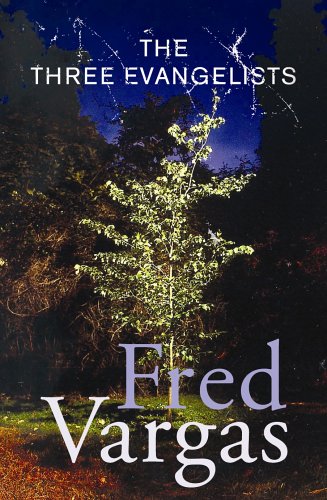
The Three Evangelists, by Fred Vargas


Fred Vargas is the pseudonym of a French woman who is a historian and archaeologist. Her profession shows through more in the recentloy translated The Three Evangelists than in her earlier detective novels (see earlier posts here) which were odd, a bit mannered, but more conventional than the new one. Her writing is typically Dickensian, attributing a very specific personality profile to each character and continuing to emphasize that profile throughout the novel. In The Three Evanvelists, the three characters referred to in the title (Mathieu, Marc, and Lucien) are historians of, respectively, prehistory, medieval, and "Great War" eras. They rent a house, each taking a floor that is an archaeological stratum based on their historical periods (Mathieu on the ground floor, and so forth). And the personalities of each are defined by their era of study: Mathieu a primitive, etc. But Vargas employs these perhaps too consistent characteristics in a comic vein that never becomes irritating, and the comedy never overwhelms the story, which builds slowly and inexorably to a violent conclusion. And no one in crime fiction today can top Vargas's "mcguffin" in this novel: a tree that appears with no warning or explanation in a former opera diva's back yard. The story of the tree is in some senses more compelling than the murder plot, and has certain characteristics of Poe's detective stories, perhaps a nod to the inventor of the genre. Vargas's novels are comic without being funny, in the sense that she moves characters around in a narrowly defined artificial world with more purely authorial intent than realism, as well as the sense of her narrowly defined and rigidly maintained character portrayals. Vargas is working in a genre that might be called satire (though there's no clear object being satirized, other than the modern world). As such, her novels may be an acquired taste. I must confess that I found her first two novels a bit peculiar, stylized in almost the way that Jacques Roubaud's "Hortense" novels, which are anything but noir though based on a kidnapping story. Roubaud is concerned with literature, not crime, and that can't be said of Vargas--her tales compel the reader with atmosphere, character, and narrative, rather than cleverness, as is the case with Roubaud. But there is enough stylization to make a comparison with Roubaud apt. Nevertheless, these perhaps very French novels are an interesting counterpoint to the much more realistic crime novels of Dominique Manotti, Jean-Patrick Manchette (whose 3 to Kill is a wonderful revenge story) or Chantal Pelletier (more of a purely genre writer).

review of classic european noir, 3 Dutch, one French, one Swiss

With this post, I'll begin an overall review of some classical European noir and detective fiction--really just an opinionated list of the best of Europe. Beginning with the Netherlands, for no good reason (I just spent a few days there). Amsterdam has been fruitful territory for Bantjer and Janwillem van de Wettering (with detectives Grijpstra and de Geer), plus the Van der Valk novels by Nicolas Freeling, who is English not Dutch. I think Bantjer's novels (I think I have his name right, but can't find anything to verify it right now) are pulp. A bit of fun but not even worth reviewing, in my estimation. I'm not myself a big fan of the Grijpstra and de Geer novels, but they do demand to be taken seriously, in all their peculiarity. Van de Wettering's writing is based on the characterizations of his two detectives, and on the underlying buddhist perspective of one of the detectives and of the author. For me, the plots are engaging the the interplay of the detectives is a bit distracting. There is something distracting about Freeling's stories, too, but I think it's in the style of the writing and in the plotting. Freeling's novels strike me as being written quickly and without revision, in the model of Simenon, one of the undeniable inventors of the detective and noir forms. Simenon wsa known to write his many, many novels rapidly and according to the advice given him by Colette: leave out the adjectives. The lean, quick prose moves the novels along with few distractions, but allows for two flaws in his works. One is that he often reverts to the already, in his day, hoary gimmick of solving a plot by gathering the suspects all in a room and getting them talking. The second flaw is that a kind of "master narrative" flows through all of Simenon's fiction, a family drama in which the blame for murders and other problems often lies with a mother, or at least a woman. Some of the writers who admittedly stole much from Simenon (Ed McBain, Sjöwall and Wahlöö) gain in range in power by not succumbing to that kind of personal psychology and canned plot devices. One other classic crime novelist who is only now getting into English is Switzerland's Friedrich Glauser, three of whose 1930s-era Sergeant Studer novels have been published by Bitter Lemon Press in the UK. Previously, only Friedrich Dürrenmatt's short crime novels were the only Swiss crime stories to be translated (as far as I'm aware) and, to me, Dürrenmatt's novels are not very satisfactory as noir--he's really concerned with dramatizing ideas (of an existentialist sort) and the stories don't engage much as character studies or crime stories. Glauser, on the other hand, is completely convincing as a crime novelist, but I find Studer to be a bit too plodding, and the stories a bit dated and provincial. What do you think?

Wednesday, May 10, 2006

Point of view in noir fiction

I'd like to throw a question out concerning point of view in current crime fiction in the noir genre. Looking back at the classic noir, point of view was, it seems to me, tightly controlled: commonly first person narratives but even if in the third person, the point of view was confined to a limited consciousness--mostly the main character, with occasional forays into other settings outside that person's presence, either in the authorial voice or the consciousness of another character. In this way, the classic noir both conceals the "solution" to the mystery or the perpetrator of the crime but also tightens the atmosphere in the service of tension in the narrative. Lately, in for instance the novel Dead Horsemeat that I just reviewed, the consciousness is collective: the point of view shifts from one character to another. Without counting, I'd say there are about 10 different heads that the narrative gets into, relating what the character sees and thinks. The more splintered point of view is perhaps a reflection of our contemporary consiousness itself--we see society (and even ourselves) as splintered, kaleidoscopic. The "solution" of the plot is revealed gradually as these points of view converge in the climax (or sometimes don't). There are of course plenty of first-person narratives in the mystery genre, more broadly speaking--I recently read a couple of Liz Evans novels, very much in the first person, told from Grace Smith's limited point of view. But as with Evans's books, the first person today seems to convey a cuteness or cleverness that shifts the work out of noir into a more "cozy" genre, even when the novel is in an urban setting. Is a first-person noir detective story possible today? Of course it is, there are always exceptions to any general tendency that can be spotted. But I think that the kaleidoscopic narrative (difficult though it can sometimes be to sustain, and irritating as it may be once you start noticing that the narrator is in everyone's head, but concealing something from the reader nonetheless) is a more accurate representation (as well as more like cinema narrative) of reality today.

Tuesday, May 09, 2006

Noir from France: Dead Horsemeat, by Dominique Manotti


No picture available at the moment: I'll add it later. I've been waiting impatiently for Dominique Manotti's Dead Horsemeat for several years, since reading her excellent police procedural Rough Trade when it first came out in English. Manotti places her procedurals into carefully constructed historical milieux: Rough Trade occurs in the middle of an immigrant workers' strike in the clothing trade (the original French title of the book refers to the dark Sentier, the rag trade district). Dead Horsemeat uses the student rebellion of 1968 and the fall of the Berlin Wall to bracket a story about drug trafficking, prostitution, horse trading, and corruption in high places. Manotti's chief detective, Daquin, is openly gay (a major factor in Rough Trade, less central here), giving him an edge as an outsider within the close community of the drug squad in Paris. A new member of the team is brought in to provide expertise in the horse-racing scene, and the crew works diligently through a complex plot evolving from the horses to drugs to pressure from government officials. Manotti is one of the few crime novelists who has, even in translation, her own style. She uses the present tense, clipped phrases, and tense dialogue to create a fast-moving story with the flavor of the streets. Rough Trade was a revelation, and if Dead Horsemeat doesn't quite measure up, it's only because the first novel created such expectations for the second. But the links to recent French and European history provide a grounding in a broader context that makes Dead Horsemeat resonate even more than Rough Trade (which was itself very resonant) in our own world, almost two decades down the line since Manotti's tale. This one is Very Highly Recommended! And if you haven't read Rough Trade, get it asap.