Saturday, April 07, 2007

uppsala noir


Kjell Eriksson's latest crime novel featuring Uppsala detective Ann Lindell is coming out soon in the U.S. The previous one to be translated into English was The Princess of Burundi, which I reviewed here not so long ago--I liked it a lot. Princess is a "collective" crime novel in what seems like a Swedish tradition, with the whole detective squad as major characters, along with numerous working class characters. The new one, The Cruel Stars of the Night, is a bit different. Lindell was on mternity leave in the previous one and now that she's back on duty, she takes up more space and the other cops get less. Plus the crime this time is more involved with the university side of Uppsala's town/gown divide. Where Princess was more sociological in character, Stars is more psychological. Two strains flow through the novel: the investigation of the murders of three old men whose lives seem unrelated and the case of another old man who has gone missing. That latter thread of the plot is told mostly through the eyes of his daughter. The psychological aspect of the novel takes a while to get going, but once it cranks up it will involve the reader effectively. And Eriksson is a bit more to my taste than some of the new Scandinavian wave of crime novels--he's more naturalistic than some others; in comparison, Nessser is more mannered, Marklund more genre-driven. Ann, a single mother, copes with some of the same family problems as Marklund's Annika, but Ann is by far the more likable of the two. Of the other Scandinavians, Eriksson probably has more in common with Karin Fossum of Norway. The translations are evidently being done out of order, and there are several references in Stars to previous cases that sound interesting (Princess is the third or fourth in the series and near as I can tell Stars comes a couple of books later in the series). I hope the publishers in their wisdom will commission translations of the other books previously published in Sweden. Though I liked Princess better than Stars, Eriksson is one of the best of the Scandinavian crime wave.

Tuesday, April 03, 2007

Mediterranean Noir conference

I just noticed that Europa Editions is sponsoring a series of panels and readings on "Mediterranean Noir" at the end of April. Here's the url: http://www.europaeditions.com/news-show.php?Id=203

Swedish noir(ish) crime fiction: Liza Marklund


Liza Marklund has used (apparently) a remarkable process for the development of her series featuring star reporter Annika Bengtzon of the fictional Stockholm tabloid newspaper, Kvällspressen. The Bomber was released first, around the turn of the millennium (a bit before in the original language). The Studio 6 (or Studio Sex, or Studio 69 as it is normally called now--the Swedish title is a pun, since the Swedish word for 6 is sex). Studio 6 is a "prequel," providing the background for Annika's criminal past, her employment at Kvällspressen, and her rise to the peak of her profession. Then Paradise provides another link in the development of her career prior to The Bomber (as well as a social theme that Marklund has developed in nonfiction, the exploitation of women). And now Prime Time completes the circuit, leading up to and providing hints about the plot of The Bomber. Prime Time has some elements typical of the mystery genre, more than noir (13 people at a country house, one dies and the rest are suspects--you know the drill; plus there's a murder at the beginning and no real threat to anyone in the rest of the plot). Marklund has been extraordinarily thorough and careful about providing her heroine's backstory. A mere hint of a trip to Korea in the first novel (The Bomber, first in order and last in sequence--you have to pay attention to keep this straight...) is substantiated in some detail in Prime Time, as well as the history of her friend Anne Snapphane's career in broadcast journalism, and Annika's sometimes troubled home life, etc., etc. It's fun to see how it all links up, but it's time now for Annika to move forward (her life story is getting little tedious). Annika's exploits rely on her job as a reporter--she never shifts into amateur-detective mode. That's a positive element in the books, to me, but it also limits the story to what a reporter can dig up or drag out of the police (though Annika conveniently has unique access to a top cop). And you have to be interested in (or have some tolerance for) the politics of the newsroom and the news business, since there's a lot of that in all the books (particularly in Prime Time, which has both the TV news and tabloid newspaper as primary focuses of, respectively, the murder plot and Annika's life). A reviewer on the Amazon site complains that Annika is a too all-capable to be believable, but I don't really find her annoying in that way. She's lucky in her occasional physical encounters with the crime-doers, but at the same time none of her opponents are master criminals or superheroes. Most of her characters, good and bad, are flawed, upwardly mobile Stockholmers--and that's perhaps the strength as well as the uniqueness of her books in comparison to the other entries in the current Scandinavian crime wave (and perhaps a limitation from my perspective, since her world is really too middle class to be the proper zone of "noir"--she always fits more neatly into a "mystery" category, as I mentioned above with respect to the new book). She may encounter sleazy Stockholm occasionally (especially in the first two books, chronologically speaking: Studio 6 and Paradise), but she's mostly working in professional circles rather than sleazy bars, etc. My complaint with Prime Time is mostly with the final resolution (Annika is perhaps too intrusive and too clever to take the role she does in the denouement; it's almost as if Marklund couldn't figure out any logical role for Annika at that point, so she just stuck her into the situation). Plus her home life is a bit too much of a soap opera to me (my wife says it's characteristic of my taste that I like the Law & Order type of TV series--focus on the crime rather than the detective's private lives). But I enjoyed catching up with Annika, and bringing her story up to date. I went back to The Bomber to check out details (and would like to see the movie versions of Annika's stories that are being made by Colin Nutley, but they're not available in U.S.-standard dvd formats, apparently). But I'm most curious about where she goes from here...

Wednesday, March 28, 2007

K.O. Dahl--new Norwegian noir.


A blurb on the back 0f the newly translated The Fourth Man, by K.O. Dahl, compares the novel to the classic noir of James M. Cain. The comparison is apt, especially since Dahl's book is basically a love story, as many of Cain's were (Dahl's novel also has something in common with the movie Body Heat, which is in its turn a take on Cain's work. I don't know how many of Dahl's books there are featuring his dyspeptic duo of Oslo detectives, Frølich and Gunnarstrand, but this one is focused on Frank Frølich, the younger of the two. Dahl takes a logical tack in turning the format of the police procedural in a noir direction: he makes his detective an outsider by showing him in disgrace or disrepute in any case. Jo Nesbo takes another tack with his detective, Harry Hole, by making him an alcoholic mess. Frølich may in fact be better company than Hole, though I'm still a big fan of Nesbo's work. Dahl's novel is also more compact than Nesbo's, which are on the massive side. Dahl takes several other elements of the genre (besides the Cain-ian love story and the cop-outsider), including a twisty plot and a cynical attitude toward wealth and property. It's a fast-moving plot told in a much more metaphorical and adjective rich style (not for Dahl the famous advice of Colette to the young Simenon: "cut out all the adjectives"). It's engaging and well written, and a more classic version of noir than most of the current Scandinavian novels.

Saturday, March 24, 2007

Swedish crime novel: The Glass Devil


I've read the three crime novels by Helene Tursten that have been translated, all of them police procedurals featuring Inspector Irene Huss of Gothenburg (Göteborg). There are plenty of dark and terrible crimes (in the case of the new The Glass Devil, a brutal triple murder, hints of Satanism, pedophilia, etc) but Inspector Huss herself seems to have no dark side to her character. She's always troubled by the darkness in the killers she confronts, has nightmares about the crimes, but her homelife is untroubled, her relationship with her co-workers mostly no problem. Her fellow detectives are less well developed, but except for some alcoholism and taciturnity, also pretty much untroubled characters. In that sense, Tursten's novels are more like 87th Precinct novels than true noir (also the case with several of the other current crop of Scandinavian crime novels in translation, particularly the series by Åke Edwardson and perhaps also the one by Liza Marklund). I've enjoyed the books, but they have a sunnier quality than some of my favorites among the new Scandinavians, such as Jo Nesbo. In the new novel, Inspector Huss interviews the co-workers of a murdered parson and his family, tries to get an interview with the sole surviving member of the family (a daughter who has moved to London), runs down leads based on Satanic symbols left at the scenes of the crimes, and generally follows police procedure down lots of blind alleys without finding any motives and few clues. If you like procedurals, all of that is fine. My biggest problem with the book is one inconsistency in the plot: One of the few pieces of physical evidence that the police find is planted by the murderer to put them on a false trail--but just as the police follow that false trail, the killer gives himself up saying that they're getting too close to the truth. But the form of the confession is unique and there are still a couple of surprises (one interesting and one a bit cute) still to come after that dénouement. So I have a few quibbles but it was still an enjoyable read and I'll be watching for more of this series. I still have a few more new Swedes to get through, including K.O. Dahl's first and the newest one by Marklund (plus a couple of Irish crime novels and the new Vicki Hendricks)--lots to look forward to!

Wednesday, March 21, 2007

Fruttero & Lucentini

Does anyone remember the crime novels of Carlo Fruttero and Franco Lucentini? They remain bestsellers in Europe, but only one was published in the U.S. (The Sunday Woman, translated by William Weaver in the mid-70s, was promoted as a literary novel rather than a crime novel, if I remember correctly--possibly because of the translator and the publisher, Helen and Kurt Wolff). Another title, An Enigma by the Sea, was in print in the U.K. for a while, and a third was promised there but never published. It's difficult to see why these novels have not been a success in English. They're hardly noir, in any traditional sense. They're light and frequently funny, depicting the interrelationships among a group of middle-class Italians in difficult circumstances and various cities. The Sunday Woman is set in Turin (of which we get a significant tour in the novel), and deals with murder (of course) but also sexual pursuit and attraction. The conversation between the detective and the leading lady is funny and true to life, as is the attraction between them (not Bogart and Bacall stuff, more comic and real). There are also gay lovers, hot pursuits through a city market, and langorous conversations in hillside villas. The Sunday Woman is long out of print, but still easy to find second-hand (it must have had a large printing in its first edition, plus a mass-market paperback was done, also in the 70s). Enigma by the Sea deals with a murder among a group gathered together in a country house, but the dynamic is much the same. The novels are charming and addictive, and worth going back to read again. If you're looking for shoot-em-up action, you'll find them frustratingly slow. If character and setting are what you're interested in in a crime novel, they're unsurpassed. I long for more of them to be available in English, since I have little hope of polishing up the little Italian I know enough to read them in the original...

Tuesday, March 20, 2007

The other igi heitman novel (by Pernille Rygg)


Igi Heitmann, Pernille Rygg's main character in two crime novels (The Butterfly Effect and The Golden Section) set in Oslo, Norway, is one of the most distinctive and thoroughly "present" of all noir characters. The novels are complex and allusive, and not written in easy or transparent language. Rygg's style is often indirect, almost stream of consciousness and with oblique shifts in direction. In the 2nd book, several pages of discussion of threats against women from Igi's point of view go by before you realize that she's in the middle of being beaten by a couple of thugs. And after this passage, another aspect of her writing arises: her use of an extended rhetorical image to evoke Igi's situation and her state of mind. And the milieu of Oslo is not simply described, each setting within the city is so particular in its metaphorical presence that each has an emotional resonance: each setting is so sharply evoked that it becomes a participant in the story. Sometimes the indirection of Rygg's prose reminds me of Henry James (though without the moralism and long, long sentences of James). In the midst of this complexity, the novel can be quite funny. There is one (sort of) gang fight that is a (sort of) rumble between Pakistani gangsters and gay s&m clubsters--as comic as the gang war in Graeme Gordon's hilarious but violent Bayswater Bodycount. And Igi's insight into modern society, the crime at hand, and her own life and mind is extensive, and she's a complex character, worth spending time with. Don't expect a straight line from one chapter to the next, though. As the first novel dealt with occultism and sex games, the second deals with psychology and art. And as the first novel revolved around Igi's recently deceased father, the new one revolves around the rest of her family: her transvestite husband (much more fully realized than in the 1st book, along with his female alter ego, whom Igi seems to think of as an intruder into the family circle), her mother and stepfather, and especially her young daughter (Igi discovered her pregnancy at the end of the 1st book). But Igi is no stock character as a mother: she's a bit jealous that the toddler is more attached to her father than to her mother, but she's not wracked with guilt about it. She's desperate to protect her daughter at times, but still not overprotective. The daughter, even, is a real character, with her own quirks but without caricature, as might have been the case with a more genre-bound novel. Rygg's text is poetic, but her feeling for the crime victims is real and believable. She has no official stake in the mystery (one murder suspect is a patient--Igi is now a practicing clinical psychologist--and another is a woman Igi meets with in looking into the circumstances of the first crime). And wrapped around all of this is a well-evoked artworld, with its own jealousies and personalities, the world of urban-revival real estate with its own relentless logic, as well as a capitalist coterie that is interested in art, murder, and Igi for its own reasons. The Golden Section is a complex tale, told in poetic style, and develops Rygg's fictional world further than The Butterfly Effect did. As far as I know, there are no more Igi Heitmann novels, even in Norwegian, but I can hope for more, and more translations into English, some time in the future. There was a gap of some years between the first 2 books, and the time was well spent--if it takes Rygg a few years to produce another crime novel, the result will likely be even more interesting than the first 2.

Thursday, March 15, 2007

Saskia Noort's The Dinner Club


I trust some small presses for their consistently high quality international noir fiction. Bitter Lemon, from the U.K., is one of them (others are Serpent's Tail, Europa Editions, and a few others). So I had no hesitation about buying a copy of Saskia Noort's new crime novel from the Netherlands, The Dinner Club, which has been available for a while in the U.K. The blurb on the back of The Dinner Club compares it to Desperate Housewives combined with Patricia Highsmith. Highsmith is the more apt comparison, since what Noort's circle of friends shares with the Desperates is a suburban setting and lifestyle--but Dinner has none of the cuteness that mars the Desperates. Another comparison noted on the book cover is with Nicci French, the pseudonym of journalists Sean French and Nicci Gerrard. To me, that's not much of a recommendation, and I would probably not have ordered the book without a) the Bitter Lemon imprint and b) the Dutch setting. I've already reviewed or mentioned a few Dutch crime writers or writers who use Dutch settings (Nicholas Freeling, Baantjer, van de Wettering, and Håkan Nesser, whose novels are set in a fictional country that is as much Netherlands as it is Denmark or any other North European country). The Dinner Club is not much like all those: the story develops slowly, and for the first half it seems hardly like a crime novel, more like a suburban-housewife novel of a more general sort, like Maeve Binchy's books, for example. But the menace builds, more slowly perhaps than in a Highsmith book, but just as inexorably. In the end I enjoyed the book (I read it on the intercity train over the past 2 days). The point of view is very controlled, almost claustrophobic, confined to the mind of Karen, the main character. Some of the other central characters are skilfully defined, but others are mere sketches, even some of the essential characters. The plot is carefully constructed and geared for a final surprise revelation (a surprise for Karen, at least, since there is plenty of indication of who the murderous plotter is)--and surprise is not, actually, a Highsmith-ian characteristic. The action sequences in that final surprise are actually a weak point in the book--necessary for the plot but at odds with the atmosphere of the rest of the book. What is happening? Basically, Karen and her husband move out from Amsterdam to a commuter suburb for all the usual reasons, but she becomes frustrated with the unfriendliness of the village natives. She ultimately falls in with a circle of women who are all transplants from the city, but share little else in common. When there are two apparent suicides in this circle and their families, Karen (and a police detective) become suspicious and start to look for conspiracies, to the ridicule of Karen's husband and the rest of the circle, to the extent that she is ultimately ostracized (adding to the paranoid atmosphere). As I said, I enjoyed it without being quite seduced by it. I'd probably read another of Noort's books, for the same reasons I read this one, but it might not be at the top of my list.

Sunday, March 11, 2007

Scandinavian tsunami, and others

The flood of Scandinavian crime novels continues unabated. Are there more crime writers than ever before in Sweden and Norway (especially those 2) than ever before? Or have they only just started translating them. I'm just starting the second Pernille Rygg novel, The Golden Section, but that one's actually several years old. Rumors of new Scandinavians include Helene Tursten (I actually have that one already), Nesser, Fossum, Indridason, K.O. Dahl, and Kjell Eriksson (I'm looking forward to that one especially, since I especially enjoyed The Princess of Burundi--there's a new Liza Marklund but it's hard to get in the U.S. and I haven't been motivated enough to order it via intercontinental shipping). And can a new Nesbo be far behind (though his books are pretty long, maybe the translation takes a while). There are a few non-Scandinavians I'm also looking forward to: including Gene Kerrigan, Fred Vargas, and Saskia Noort (I've got those piled up on my end table) plus not-yet published titles by Deon Meyer from South Africa, Vicki Hendricks (OK, OK, this is supposed to be about non-U.S. novels, but Hendricks is great, and her publisher is in the U.K.--does that count), Alicia Gimenez-Bartlett of Spain, Jean-Claude Izzo from France, and Carlo Lucarelli from Italy (the next chapter of his wonderful fascist-era series). Plus there's a new book from Japan just out (The Hunter, by Asa Nonami). I haven't heard anything about any more translations from Dominique Manotti, but I can always hope.

Inger Frimansson


Some writers who turn to crime fiction after having a career in another genre or in mainstream fiction turn out what might be called "professional" novels that are incidentally crime novels. Elmore Leonard is an exception--his earlier career was in Westerns, and his crime novels, while throughly professional, have a casually written air, almost as if they were transcribed rather than composed. One example of professional, though no less enjoyable for that, fiction is Inger Frimansson's recently translated Good Night, My Darling. Frimansson's book also contrasts with the previous Swedish novel reviewed here, Mari Jungstedt's Unseen. Both novels turn on revenge for events experienced much earlier, in school. Both feature girl bullies. Both include substantial flashbacks. And both are "collective" novels, a term I've been using to describe stories told from multiple points of view, i.e. with the focus split among a number of characters. But Unseen is a procedural, a roman policier, and that structure dominates the plot. Good Night, My Darling is instead a thriller, I suppose--without the overlay or grid of police activity. And the atmospheric, slowly building composition takes shape in more poetic language than is typically the case with the policier (and the language of Unseen is typical of the genre--a plain language that I happen to appreciate in contemporary writing--not Hemingway-esque or even Simenon-esque, but still straightforward). Frimansson's first book in English is not overwritten, by any means, and perhaps resembles Ruth Rendell than any other prominent writer in English that I can think of. But there's also quite a bit of Patricia Highsmith, and even a taste of Beat Not the Bones, the amazing jungle adventure/suspense novel by Charlotte Jay (an adventure hinted at from the novel's first words occupies a large chunk of narrative toward the end). There's not an early murder to solve, there's a building sense that something bad is going to happen, and a slow revelation of bad things that have happened in the past, things that foreshadow or even determine what is happening in the book's "now." One of the pleasures of Frimansson's book is a more complete picture of a certain suburban slice of Stockholm than has so far been shown in most contemporary Swedish crime fiction. This isn't urban Stockholm--it's the city's boundary with nature. Stockholm is built on a lake, and is at the edge of an archipelago, and nature is important to even urban Swede's sense of themselves. The denizens of this novel dwell at that not-quite city and not-quite rural zone, and nature invades the main character's house, in the form of a tame bird that is not the usual parrot, parakeet, or canary. These characters are not cliche Swedes, though--several of them have non-Swedish forebears (the main character, Justine, has a French mother, who died when her daughter was 3). And the characters range in age from the remembered primary school kids of the novel's past to a paralyzed old woman in a rest home--as well as a moral range across numerous shades of gray. No one in the novel is guiltless, but all are sympathetic. My only quibble with the novel is that at the end, Justine's character seems hardly capable of some of her actions, regardless of her substantial motivation--but that ties her to Highsmith's characters, in fact, since Highsmith's violence often far exceeds the apparent capacities of the characters who perpetrate it. I'm pasting in a cover from a recent Swedish paperback edition because the American cover isn't up on the web anywhere yet--I may come back and paste in the American one later.

Saturday, March 10, 2007

Cobblestone: A Detective Novel


Occasionally I like to take a look back at an older novel that is remrkable in one way or another. One of the most remarkable is Cobblestone: A Detective Novel, by Peter Lengyel, a Hungarian writer better known for science fiction than detective fiction. But Cobblestone is and is not a detective novel. It's a massive story of the beginning fo the 20th century, ranging across Europe but centered on a pursuit through Budapest's streets and brothels: a master detective pursuing a master safecracker. And at the same time it's a meta-novel taking Hungarian history from the end of the 20th century back to the beginnings of the universe. Not only are there layers and layers to this tale, there is also a sudden shift at the middle of the novel that is unlike anything else in any other novel, detective or otherwise--I won't give it away, but it is either a masterstroke or the most irritating device ever attempted in fiction. But back to the detective story, the tale is a fascinating mosaic of the underworld of Budapest, as well as a fantastic heist story. It unreels like at atmospheric movie, but it is decidedly a novel, not really filmable at all. If anyone's interested, I can give more details. It's not easy to find, but it's not out of print.

Friday, March 09, 2007

The last Vazquez Montalban


In the couple of years before his death, Manuel Vazquez Montalban brought out one last Pepe Carvalho novel, The Man of My Life. In a novel that circles around several women (a couple of them returned from earlier novels), the author violates the logic of one of Carvalho's most scanadalous habits: burning books. In this last book, the previous novels come back in the form of those two women and in the reminiscences they narrate and provoke. Most of the novel is actually taken up with discussions of Catalan nationalism and post-nationalism, Satanism, Catharism, and so forth. Vazquez Montalban seems to be taking stock not only of his own work but also of the nervous and more or less paranoid currents of the new Europe. One thread of the book does involve a murder that Carvalho is supposed to be investigating, but his cursory search for the killer is frustrated not only by the powers behind the killing but also by the constant distractions that sideline the detective: food, philosophy, love, and memory. None of the Carvalho stories are straightforward--they're about texture and thought and politics, food and sex and violence (usually institutional more than individual). The Man of My Life is the least straightforward, though, and the most thoughtful. This book is essential for anyone who has enjoyed Carvalho's exploits and mannerisms, but not the best place to start on an investigation of this quirky and brilliant Catalan crime writer.

Thursday, March 08, 2007

From Sweden: Jungstedt's Unseen


Unseen, by Mari Jungstedt, came out last year in the U.S., but until recently it escaped by attetion somehow. It's a police procedural that has inevitably been compared to Henning Mankell's novels but is actually quite different. It's another of the "collective" novels that have been coming out of Sweden: as with Åsa Larsson's novels of the far north of Sweden, Jungstedt's story of Gotland (an island in the Baltic just off the Swedish coast) has a central character that only occasionally takes center stage. That alone takes this police procedural away from Mankell territory (his detective, Kurt Wallander, is at center stage all the time, except when--usually later in the books--the killer is at the center of the narrative). Jungstedt's detective, Anders Knutas, is in many ways less well defined than several of the other characters, including the best friend of what is thought to be the first victim of the novel's serial killer (and the journalist who befriends her). A woman is killed with an axe, along the shore after a violent argument with her boyfriend. Then another woman is killed on her way home from a bar, where she had flirted with a stranger. And as the victims pile up, there's no thread linking them. The collective, split point of view works very well in carrying the story forward step by step, withough anticipating too much of what's to come. But there are two flaws, to me, with the book. The killer's voice periodically interrupts unnecessarily--I would have been happier with the book if I'd simply skipped those passages (conveniently italicized). I might actually try that exercise if I read the book again. And a more substantial flaw is that the ending is both sketchy and cliched. After proceeding at deliberate speed throughout, Jungstedt feels it necessary to kick into such a high gear at the end that it's difficult to visualize what's happening (except that we've been over this particular high-stakes, high-tension ground so many times that the film almost runs in our head without the author's help). There are a couple of uniquely Swedish twists--such as the consequences of the novel's final death (something that readers not already conversant with the mores and the correctness of Swedish police novels may find a bit startling). I won't say more because I don't want to risk inserting any spoilers. Unseen was good, if not perfect--better in some ways than either Helene Tursten or Åke Edwardsson (two other prominent competitors for the other-than-Wallander detective spot) and I'd recommend it--and I'd definitely read any further translations from her work (I think there is a German tv movie of at least one of her novels, with more forthcoming--Swedish detectives on Gotland speaking German, no doubt, just as Donna Leon's characters speak German in the Venetian setting of the German tv adaptations of her work).

Saturday, March 03, 2007

Swedes just keep coming, plus an old UK noir


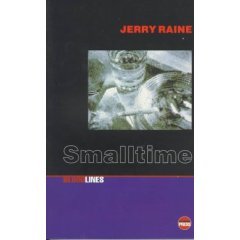
New Swedish noir just keeps coming. There's a newly translated book by Inger Frimansson that I've ordered (it's officially coming out in April in the U.S.) and I just discovered Mari Jungstedt's Unseen, which I've started (but barely). Both come highly recommended. In the meantime, I picked up a copy of Jerry Raine's '90s Smalltime and read (or re-read) it--when I picked it up I couldn't remember whether I'd read it or not, when it was new or newer, and I still can't say for sure. I have a sneaking suspicion that I started it and couldn't finish it. I'd like to hear other people's opinions about Raine, because his next couple of books (Frankie Bosser Comes Home and Slaphead Chameleon) sound like just the kind of noir that I like, but Smalltime is irritating in a lot of ways. The setting is fine--a corner of London suburbia--and the characters are effective, as layabout working class types. But the language is very flat and the plotting is slow without offering any compensation in texture or detail. It's not that the characters or plot are unbelievable, it's just that none of the aspects of the novel seem to add up to much, and the language is so plain-spoken that it has hardly any life. It's not hard-boiled "tough-guy terse" language, it's just so straightforward that you barely sense any author behind it. It is, to be fair, a first novel--and as such it accomplishes its goals in getting the characters through their paces all the way to the end. But it's hard to care about anything in the book, and the occasional comic touches seem added on, not growing integrally out of the situation, just something Raine thought of and added in. Please--any thoughts? Should I go ahead with the next two? And to be honest, I have a smiliar problem with another Do-Not Press author, John B. Spencer. Any thoughts on him?

Saturday, February 24, 2007

Leif Davidsen's Euro-Noir thriller


Or Noir Euro-thriller. Lime's Photograph is a few years old now, but it's a pan-European political novel that avoids a lot of the flaws that, in my opinion, mar the thriller genre as a whole. First, it's a first person novel, with Peter Lime (Danish emigre living in Spain, paparazzo and former leftist) occupying the center of the tale. And although geo-political concerns are aired (those of the post-Wall, EU world we still live in today), Lime isn't walking up to Prime Ministers or one-handedly preventing an international assasination. He takes a damaging photo of a Spanish official in a sexual tryst on a private beach, gets harassed by the police, approached by the Danish security service, and his personal life is wrecked. I won't give away any more of the plot, but it's about Lime in the context of the new Europe, not about kings and presidents and prime ministers. Davidsen is a silled and careful storyteller. The events unfold in a leisurely way (the paperback is 375 pages, plenty of room for the tale and its convolutions to unfold). The focus is on Lime's personality as it suffers and responds to events, as much on the plot (though plot is not stinted, there's plenty of story). I don't know of any other single novel that so carefully and effectively portrays at least 4 nations in the new world order (Spain, Denmark, Germany, and Russia). The passages of action (more necessary for a thriller than other genres within the noir landscape) are effective without overwhelming the rest of the story. The ultimate resolution explains the many threads that have gone before. And the reader's passage through the whole journey is most enjoyable.

Friday, February 23, 2007

A Corpse in the Koryo


Storytelling (and novel-writing) isn't really about revealing "what happened," it's really much more about delaying the telling. What keeps the reader turning pages is the pursuit of the plot, not the revelation of it. James Church, in his new noir crime novel of North Korea, A Corpse in the Koryo, knows that truth all too well. The book reads less like a crime novel than a spy novel, with the concealments, double-crossing, internal disputes among agencies, and final twists. The blurbs compare the novel with Philip Kerr's Berlin Trilogy (now a tetrology, actually) and the like (novels that use the police procedural to open up a closed society to the reader), but "Corpse" is more like Le Carre in many ways. Yes, it does open up a closed North Korea, validated by the pseudonymous author's professional experience there. But it's less about daily life in that country than about inter-agency strife. The protagonist, Inspector O, has plenty of noir attitude, but he's pulled this way and that by seemingly unrelated (even irrelevant) incidents and stories all the way through--like Marlowe, perhaps, is often pulled away from the main track, but in a way there is no main track visible in "Corpse," until close to the end. As I said above, Church has delayed that revelation of what's happening--not a problem, but more a spy maze than a noir one. And O is curiously open in his disdain for the power structure--though the portrait we occasionally glimpse of that country seems to be one that wouldn't tolerate that in a policeman--but that is explained in the story , in O's "protectors" within the system). And the citizens that populate the novel seem less desperately deprived than we are led by the news to believe about the citizens of that country (a member of that select group, the "axis of evil")--but again, the citizens frequently turn out to be hardly "simple citizens," again a factor making the book seem more like a spy novel. I guess it's not hard to tell that this is a book I admired more than enjoyed. I don't want to put other readers off--it's a fine story, and I'd read a sequel--but I hoped for something different, a book that Church evidently did not set out to write, rather than the one he did. A word about cover art--I've seen a number of books lately that don't utilize that aspect of a book terribly well (as evidenced by some of the ones I've reproduced here)--but A Corpse in the Koryo has a particularly good cover, for which the publishers should be commended. It has a great graphic quality and at the same time expresses a lot about the country it depicts.

Monday, February 19, 2007

A Spanish detective in Argentina


I read several of Manuel Vázquez Montalbán's detective novels some years ago but never got addicted to the series. The plots are usually beside the point, and discoveries are often not made by the detective but simply stated in the narrative--the texture of the novels are far more important than the plots, which are devices for the exploration of the dark side of the modern world. On the strength of Andrea Camilleri's fondness for the novels, as well as the homage offered to Vázquez Montalbán in the "novel for four hands" by Paco Ignacio Taibo II and Subcomandante Marcos, I picked up what is evidently the second-to-last in the series, The Buenos Aries Quintet (the last is The Man of My Life, recently available in English). Private detective Pepe Carvalho is asked by his uncle to find a son who was a victim of the "dirty war" in Argentina 20 years previously and has been in exile in Spain ever since. The son belatedly decides to look for a daughter who was taken from him (when his wife was killed) and illegally adopted --disappeared as effectively as those murdered by the military government of those years. Off to Buenos Aires, reluctantly at first, Pepe is separated from his regular crew and his usual fare (food being a big part of this series). His new crew of damaged Argentinians who are more interesting than the regulars (to me, anyway). Carvalho repeatedly tells people that all he knows about Argentina is "tango, Maradona, and the disappeared." But as I mentioned above, the plot is not a straightforward (or even crooked) line from the assignment to the solution. We figure out where (and who) the daughter is long before the detective, and when she's found the novel takes little account of it. Much more important are the numerous ancillary tales and the main personalities (particularly Alma, everyone's love interest in one way or another) and the flock of auxiliary characters, who together draw a portrait not only of the conflict of left and right in Argentina but also the webs of conflict, deceit, and misery in the world at large. The text is full of tangos and poetry, food and sex, disguise and death. In an odd way when the novel reaches its most crescendo in a burlesque, macabre banquet among the members of the former (and still powerful) elite, The Buenos Aires Quintet reminds me of another big, baggy, overpopulated and satirical novel, Thomas Pynchon's first book, V. And as in V, the pleasure in reading Vázquez Montalbán's book is in going with the flow of the looping, overlapping stories as they reveal contemporary life, a troubled nation, and a vital people.

Monday, February 12, 2007

Irish noir thriller by Gene Kerrigan


There are some writers who seem natural, as if words simply flow freely into finished form: Elmore Leonard, maybe; and there are some writers whose work is professional, well structured: Henning Mankell, perhaps. But there are others who are both natural and professional, some of them coming from a journalistic background, like Gene Kerrigan from Ireland or Deon Meyer from South Africa. Kerrigan's first fictional book, Little Criminals, has both a seemingly careless plot, as meandering as Elmore Leonard's--but at the same time it has a tight overall structure so that at the end of the book, everything seems both inevitable and aesthetic. Little Criminals takes one of the pulp-iest plots in all of crime fiction, the same story as that masterpiece of the cheap paperback trash of early noir, No Orchids for Miss Blandish, a book I've mentioned before: the kidnapping gone sour. But Kerrigan uses the pulp-y plot in the service of a portrait of the post-Celtic Tiger, Euro-centric, urbanized Ireland of today, in all its consumerist, un-quaint glory. Nobody in the book is entirely likeable, but it's a book you shouldn't pick up unless you're willing to stick with it for a while--Kerrigan will build up the tension until you have to keep going, you won't ba willing to stop. And just when you think you know what's coming, he takes a non-pulp sideroad into an intimate portrait of small town life, integral to the plot and at the same time affecting without descending into bathos. Yet the ending has something in common with No Orchids for Miss Blandish, a hollowness within the relief of the resolution, a desperation that comes only partly from the awfulness of the things that the characters have experienced. If you think I'm making too much of what is after all a crime novel well within the noir and pulp traditions, reconsider after you've read Little Criminals--this is a terrific book. I've ordered the sequel, but it doesn't seem to have been released yet.

Tuesday, February 06, 2007

A new Swedish noir-policier-mystery


Åsa Larsson runs a big risk with her new (new in English anyway) The Blood Spilt, the sequel to last year's Sun Storm (which I reviewed at the time). Like the earlier book, Spilt deals with a damaged lawyer from Stockholm who returns to her family home in Kiruna, in the far north of Sweden, near Finland and Lappland (the Lapps call themselves Sami now). And like the previous novel, this one begins with and centers upon the murder of a priest. The risks that Larsson runs are in simply duplicating the plot of a successful crime novel, in becoming pigeon-holed as the author of "religious noir" or some such thing, and in creating a sense that she is simply repeating herself, with nothing else to say. But Rebecka Martinson, the damaged Stockholmer in both books, is changed now, changed by the experience of the first book (not so common in series novels). She is poised at the precipice of a new life (and she's pretty negative about her old one). The priests, too, are very different--the founder and central preacher in an evangelical cult in the first, the parish priest in the Swedish national church in the second (as in England, the king of Sweden embraced Protestantism and created a national church, Lutheran in Sweden's case, but unlike in England the church has lost its government subsidy--one of the topics of The Blood Spilt. It is as if Larsson set out to show that it's not only the far fringes of organized religions that foster rivalry and hatred. On that subject, one of the comments I've had on this blog asked whether the Swedes are obsessed with religion, given the number of crime novels translated from Swedish dealing with the subject. Like most of Europe, Sweden is almost completely secular--but there are two strains of religion (those in Larsson's two books) that go back over a hundred years--the conformist and the nonconformist or fundamentalist. And in rural or small-town Sweden (the setting for Larsson's novel as well as those by Mankell that deal with religion, including the first with Linda Wallander as a main character), religion is far more important than in the cities, as is true in other developed countries. But back to Larsson, The Blood Spilt is in several ways better than its predecessor--the collective aspect remains (the point of view, always in the third person but focusing on an individual's perspective) shifts between Rebecka, the two cops who carry over from the first book, and several townspeople in the circle around (or in opposition to) the murdered priest--who is in this case not only a woman minister, not so rare in Sweden but not entirely embraced by the townspeople, but also a feminist. The Blood Spilt is more of a feminist novel, in fact, than any other recent crime novel that I can think of (that's a positive assesment, not a criticism). Larsson's novel is very atmospheric, regarding a small town in the far north as well as the enclosed world of this particular small town on its own and as it represents small town life everywhere. There are no absolutes here, in spite of the liturgical "mcguffin" of the book: neither the townie nor the villagers have the high ground, neither the irreligious nor the pious, neither the villagers nor the wolf (herself a central character). The novel is primarily texture and ambiguity, in fact--the plot moves forward glacially (again, that's not a criticism--it progresses like another Swedish book I admire, Kerstin Ekman's much longer and more oblique Blackwater. Larsson measures up to the ammbitions of Ekman's literary crime novel, without sacrificing the pleasures of the more direct (and shorter) genre of crime fiction. I may have some more to say about The Blood Spilt as I mull it over, and if anyone wants more of a plot summary let me know. Suffice it to say that it's a novel savored with pleasure rather than read at breakneck pace in an attempt to get to the final resolution.

Sunday, February 04, 2007

China according to Chief Inspector Chen Cao


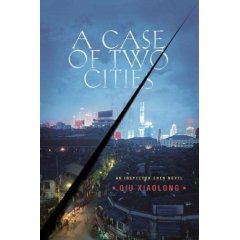
Qiu Xiaolong's new novel about crime in Shanghai, A Case of Two Cities is, on the one hand, open and straightforward almost to the point of callowness; on the other hand, it is completely ambiguous and unresolved. Those opposite reactions are a natural result, perhaps, of dealing honestly (as much as is possible) with contemporary China. The title is itself a bit misleading: the story begins in the city of Fujian, then moves to Shanghai, then on to Los Angeles and St. Louis (not coincidentally the city in which the author resides (he teaches at Washington University). As usual, there is a lot of poetry in the text, and a lot of reference by the characters to precedents in Chinese history, legend, and literature. Every decision, evidently, is referred back to the millennia of China's past, rather than to a direct analysis of the situation currently at hand. That constant referenceis added to a certain stiffness of language (perhaps an equivalent for a more formal "style" in Chinese language and culture, as compared to the West). Together, the history and the stiffness give these novels a texture completely different from the usual noir fiction, or even the typical mainstream mystery: neither the cops nor the Triad mobsters talk like Mike Hammer or th denizens of a Jim Thompson book: formality and indirection reign. There's also a good bit of flirtation between the sexes in the new book, though Inspector Chen remains almost without sex drive, so moral and careful is he. All of these comments might be taken as negative criticism, but the new book is almost as effective as a story as the first three in this series--and at least as effective as a portrait of today's socialist-capitalist-corrupt China. I found myself pulled along by the story, while at the same time frustrated by the brittle texture of the interrelationships among the characters (a number of whom are brought back from previous installments, including the U.S. marshall who was a sort-of love interest for Chen in an earlier book. A corrupt official who has fled to the U.S. has left behind a web of corrupt connections, and Chen is assigned by a high party official (still active though technically retired). Chen decides that those at the center of the group are too powerful to be approached directly, so he takes an indirect approach, interrogating those at the periphery--with disastrous results (his actions are revealed to those he is investigating, and a former friend of his is murdered). Then his investigation is seemingly derailed by another assignment, related to his career as a poet and translator--an assignment that will take him out fo the country, to the U.S., as the leader of a literary delegation. Int he process, mucch more is revealed about the state of business and politics in today's China, as well as the intricacies of relations between Chinese and American professionals.

Tuesday, January 30, 2007

Political noir


I read several of Paco Ignacio Taibo's earlier crime novels (featuring the sometime detective Hector Belascoaran Shayne) some years ago and then lost interest. Taibo's detective stories aren't so much "noir" as satirical and magic-realist. The author is using the detective form to comment on politics and contemporary life in Mexico and beyond. But I was curious about his most recent crime story since he co-wrote it in alternating chapters with a real-life revolutionary, Subcomandante Marcos of the Zapatistas still fighting in the Chiapas region of Mexico. Marcos's chapters are suprisingly comic (as well as tendentious and political, more what you would expect). Taibo's chapters are as comic as we might expect, but also political and critical. Both halves are "metafiction," drawing in authors and characters from beyond the novel's world--particularly both Spanish writer Manual Vazquez Montalban and his Barcelona detective Pepe Carvalho (Vazquez Montalban, also a poltical novelist using the crime genre satirically, died recently and The Uncomfortable Dead is in part an obituary or hommage). As metafiction, magic realism, politics, and satire, this "novel by four hands" is not that satisfactory as noir fiction, but its politics are actually very much in line with noir: the neo-liberal bad guys of The Uncomfortable Dead are the same as the evil developers of Chinatown and numerous noir novels and films. The novel ends not with a victory over evil but with a partial revenge against the evil that the authors see as permeating society as a whole. If a couple of bad guys are removed from action, it's only a drop in the ocean of evil. Belascoaran turns from murdering one bad guy to playing head games (or subversion, perhaps) with numerous unidentified "Moraleses", Morales being the protean bad guy or guys of this book. I can't say I'm motivated to go back and catch up with the other tales of Belascoaran (though in spite of its tendentiousness I enjoyed this book), but I am motivated to go back to the novels of Vazquez Montalban (who also inspired the Montalbano novels set in Sicily)--more on that series later.

Older Scandinavian noir and some upcoming titles


While waiting for several new releases of European noir in translation and a new Qiu Xiaolong novel about Shanghai, I went back to reread a Norwegian noir novel called The Butterfly Effect, by Pernille Rygg. I wanted to see whether it might be worth seeking out the second of Rygg's novels about sort-of private detective Igi Heitmann, and couldn't remember the first one all that one (other than that it had some passing resemblance to Smilla's Sense of Snow, a novel I didn't care much for). The Butterfly Effect actually has a VERY superficial resemblance to Smilla (a clinical/scientific setting for part of the book, a young female central character, the Scandinavian setting). Rygg's Igi Heitmann, though, is a believable character rather than a magic-realist cypher. Not that Igi has your everyday problems, unless you're a failed scientist whose detective father was just killed, whose first client apparently committed suicide, and whose husband is flagrantly gay. Igi goes up against the power structures of the psychiatric establishment, the police force that crushed her father's professional hopes, and the financial power of the developers raping the city of Oslo (according to Rygg). More Chinatown than Smylla, in other words. But at every stage, the narrative is low key, Igi is three-dimensionally human, and the story is tragic but believable. I've sent for a copy of the second Igi book, The Golden Section. Meanwhile, upcoming reviews here include The Uncomfortable Dead (co-written by Paco Ignacio Taibo II and Subcomandante Marcos, the spokesman for the Zapatista revolutionaries in Chiapas, Mexico), the aforementioned Qiu Xiaolong novel, a couple of Irish police procedurals, and new translations of noir fiction by Åsa Larsson, Helene Tursten, and some other surprises.

Sunday, January 14, 2007

Scottish noir (literary) fiction


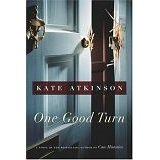
I guess one reason I didn't connect with the Rebus novel (by Ian Rankin) that I was reading last week was that I was simultaneously (and coincidentally) reading another novel about Edinburgh, Kate Atkinson's One Good Turn, a sequel of sorts to her earlier Case Histories. One Good Turn is an amalgam of a literary novel and a crime novel--there are repeated references to Matryoshka dolls in the book, setting up the notion that the intertwined stories in the book are nested like the dolls. But in fact, the plot is more like a snake eating its tail, a looping of twined narratives whose interrelationships only become obvious at the very end. It's as if a bunch of characters from literary and popular novels (Maeve Binchy comes to mind, or maybe Alice McDermott) find themselves plopped down in Edinburgh amid a series of violent acts growing from the road rage incident at the beginning of the book. With a good crime novel (or a good novel) there can be a sense of elation at the end, an emotional release with the completion of the circle or the resolution of the story. Though Atkinson doesn't quite wrap everything up in a neat package, she does deliver that kind of literary satisfaction--without stenting on the crime story, the noir elements, or the considerable humor with which her story is laced. One Good Turn is a big step forward from Case Histories: more complex, more coherent (once you get to the end of the book), and more satisfying--plus the humor is more overt, inducing not just smiles but laughter. And One Good Turn is also a step up from the average crime novel (without condescending to the genre). Atkinson shows us why reading about crime is so enjoyable: we're reading about ourselves at our limits--the limit reached when our actions and desires are taken to their ultimate conclusions.

Thursday, January 11, 2007

Having trouble with Ian Rankin again


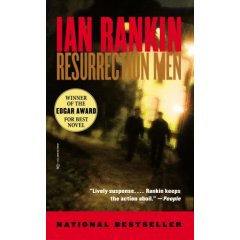
Can somebody help me, regarding Ian Rankin's novels? I repeatedly see blurbs for his books that describe them as "noir" or dark thrillers in any case. But I'm currently reading Resurrection Men, to see if I like Rankin's books any better than I did early on in his career--but I don't. Am I reading the wrong ones? Do I have false expectations? I've seen a bit of the 2 different BBC series about Detective John Rebus (two very different actors in the part, the most recent far the more accurate about the character), and they're OK. In fact, the novels read like a TV movie. Plenty of to and fro, but not much insight or emotional investment--I don't really care about the characters or what happens to them, nor about the investigation (I like police procedurals, when they're well done, but the Rebus books hardly seem to be about procedure--Rebus is more often relying on his "connected" informants than doing anything on his own. I originally had a hard time with Rankin because I was reading Peter Turnbull at the same time--and his Glasgow was a lot more interesting to me than Rankin's Edinburgh. Turnbull is more interested in ordinary people--Rankin is always getting involved with the top brass and the big gangsters. Turnbull's background as a social worker coming out, perhaps. But Turnbull's reputation seems to have faltered and Rankin just keeps going and going. So help me out--am I just wrong? Is there any point in my finishing Resurrection Men?

Monday, December 25, 2006

Olen Steinhauer: noir or formula?


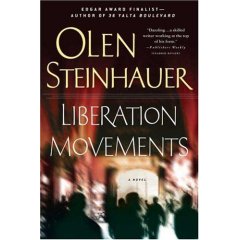
I'm looking for some opinions about Olen Steinhauer. I've been reading his recent Liberation Movements, and it fits into a nexus of other "international noir" books that I've read, in several ways. Like the works of Swedish author Håkan Nesser's Van Veeteren novels (such as Borkman's Point, reviewed here in 2006), Steinhauer's novels are set in a fictional country (in Nesser's case, it's a vaguely "north European" nation, somewhere between Holland and Sweden, in Steinhauer's, it's an East European nation under Communism). That fictional country thing had kept me from reading Steinhaier before--I prefer to get a glimpse of a real city, a real place, in reading crime fiction--that's one of the principles on which this blog is based, actually. Like the Berlin trilogy of Philip Kerr (there's a 4th novel now), Steinhauer is exploring life under a totalitarian regime under which he never lived. But for me, Steinhauer's unnamed country is not as believable as either of the above--and for me, his portrait of the "evil of Communism" has a kind of American triumphalism about it. In this latest novel, he doesn't just show the shoddiness of the classic Trabant automobile of the East, he feels he has to show a public plaza littered with them. In fact, in East Berlin, on the one occasion when I visited the Communist East, there were plenty of Trabants--all running, all parked in an orderly fashion in the public squares. There's plenty of misery and horror to portray under Communism without taking cheap shots at something you don't have personal knowledge of. In fact, Trabants are a sort of collector's item in the East now--Communist nostalgia, I guess. I'd like to hear your opinions about Steinhauer's fictional country in these novels. The books are well enough written--constructed fairly tightly--except that he feels it necessary to use an X-files plot element, extra-sensory perception (in particular, precognition), to work out the kinks in his plot. It also seems to me that his characters are not so fully drawn as Kerr's (I have the same complaint with Nesser, but Nesser's characters are at least not Communist stock characters, which some of Steinhauer's are). Steinhauer's novels are, I guess, more thrillers than noir--is it too much, then, for me to expect the fatalism (embodied, one hopes, in well realized characters and plots) that is a hallmark of noir? In any case, instead of that kind of fatalist, dark tale, Liberation Movements seems to be a brittle tale of evildoers and unfortunates--a melodrama, in other words.

Wednesday, December 20, 2006

dark polish novel (maybe not "noir")


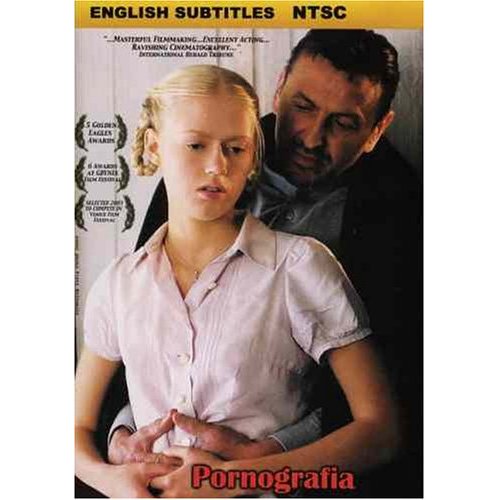
I mentioned a Polish novel of the 1960s in my previous post: Witold Gombrowicz's Pornografia. Pornografia has the bare bones of a "cozy" mystery plot: in the waning days of WWII, as the Nazis are retreating across occupied Poland, two friends (Witold and Frederick) travel to another friend's country house. They become fascinated by two adolescents, one the daughter of the house, the other a young orphan (a boy of about the same age as the daughter) who is staying with them. The group travels to the nearby home of the daughter's fiancé's family, and while there, the fiancé's mother (a devout Catholic) shows a strange fascination for the atheist Frederick. But in the evening, while the mother has gone to the kitchen, there are the sounds of a struggle, and the group finds the mother stabbed to death and a young interloper with stab wounds and bite wounds. The matching stories of the interloper and a kitchen maid suggest that the mother of the house attacked the interloper with a knife, and bit him savagely, before he got the knife away from her and killed her. But enough mystery surrounds the event to puzzle the most astute detective. Did she attack him? What was the boy doing in the house?
But the cozy plot disappears in a haze of another plot, this time a thriller closer to the spy genre: The group does not turn the murderer over to the police--they imprison him in the house and then return with him to the previous country house. And then the partisans demand that Witold and Frederick carry out the assasination of a traitor. From there, the plot goes further off the rails, according to a logic that is alien to either of the genre plots--a logic fully prepared for from the first pages of the novel. Whereas in the usual mystery or thriller, the fiction mimics life more or less adequately, in this novel life imitates the genres, more or less adequately. Gombrowicz is a "thesis" novelist, though of a peculiar and comic sort. He wants us to examine the structures (genres, even) through which we make sense of life as it comes at us day by day. What he is after is close to the "moral" of an existentialist novel of previous decades, such as might have been written by Camus or Sartre. Or perhaps a "nouveau roman," such as might be later written by Robbe-Grillet (who also did detective stories, of a sort). And the thesis is overlaid with the atmosphere of eroticism (and violence) implied by the novel's title--albeit a very (very) peculiar, second-hand eroticism also related to Gombrowicz's thesis (which has to do with youth versus maturity). This is an important book, one of the key accomplishments of the mid-20th century, by a writer with much to add to 20th century philosophy and art. The genre plots are not looked down upon, they are a simple structure on which to build the language and the thesis that are the writer's concern--but without which there is nothing he can say. In other words, this book is philosophy-as-story, or story-as-philosophy. There is no linear "meanning," only a portrait of our time, through the twin lenses of the mystery-thriller and Gombrowicz's own unique point of view. And, believe it or not, there's a recent movie version of the story, which I've ordered but haven't seen yet...

Sunday, December 10, 2006

Philosophical noir from Italy


Andrea Canobbio gives the alert reader a clue about his intentions in The Natural Disorder of Things when he gives one of the characters, a Polish gardner with a literary background, a name that is a composite of the two great Polish philosophical novelists and playwrights, Gombrowicz and Witkiewicz. The murder plot of Canobbio's novel is a McGuffin (do I have that spelled right?) in reverse--not a seemingly casual element of a story on which Hitchcock (it's his term) hung a mystery plot for a movie, but a plot on which Canobbio hangs an existential inquiry. The novel is not an allegory, something that will reveal the author's systematic philosophy, an approach that Canobbio shares with the equally oblique Polish authors I mentioned. Canobbio's approach isn't symbolic allegory but a maze--specifically a garden maze that might be constructed by the garden designer at the center of the novel--but a maze with no center and perhaps no exit. Claudio Fratta witnesses a murder that might be called "overdetermined," to use a word from the Poststructuralist philosophers (the man that Fratta has been watching (for reasons we don't learn until later) is essentially killed twice, by being run over first by a van with unrevealed drivers and then by a car driven by a woman with whom Fratta becomes obsessed. The novel progresses in events that will only be explained in later passages, as if a maze is being followed blindly or an onion is being peeled. The revenge demanded by Fratta's family after being bankrupted by a predatory lender, the affair between the previously solitary Fratta and the woman (who becomes his client), the man who is possibly (and possibly not) her husband, Fratta's brother and nephews, and Fratta's neighbor and his dogs, bred to have stripes (in particular a striped Doberman)--all these elements intertwine not to solve the initial murder but to precipitate a mirroring event that to some extent resolves Fratta's life, or at least brings him to the end of a chapter. The novel can be frustrating in its herky-jerky progression, and is perhaps too much a drama of ordinary life (rather than a crime story per se) for many fans of noir. But it has prodded me to pull out Gombrowicz's "thriller," Pornografia, which I'll report on as soon as I've re-read it. I'm looking for other suggestions, if anybody has some--as I'm in a dry spell for reading that's relevant to this blog. There are a number of books being translated for publication in the spring of 07, but not much new is available right now. Maybe I've missed something, though--any suggestions?

Tuesday, November 28, 2006

Tartan noir with a heart of gold, sort of


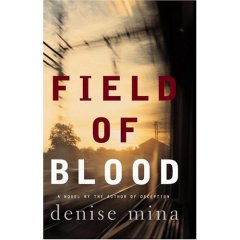
Denise Mina's new novel, The Dead Hour, is the most purely noir novel she's written, and one of the most purely noir novels I've read recently (other than that other Scot, Alan Guthrie, whose 2 novels so far are pure throwbacks to the pulp heyday of noir). Is it something in the air up there? But at the heart of Mina's noir world there beats a doggedly optimistic heart, instead of the depressive, alcoholic, desperate soul at the center of most of noir fiction. Her heroine, cub reporter Paddy Meehan, is struggling to be a subject not an object, as she put it, and her feminism as well as her career struggle are carried on with a determined air that is comic in intention rather than in result--Mina is not making fun of Paddy's optimism (or her weight problem), she's using it to build a 3D character, lust, atheism, family loyalty, professional determination, and poor choices all included. Paddy's positive attitude is at odds with the overall noir atmosphere, at first glance. But it is Paddy's character, in all its ordinariness, that makes this novel work as "pure noir"? And why do I say that about this book and not the previous Paddy Meehan novel, Field of Blood? The separate strains of the new book are each bloodier than the other, and each grounded in working class reality rather than in the family drama of Field of Blood. The Dead Hour reminds me of a Swedish crime novel: not the obvious comparison with that other "intrepid reporter" (that phrase actually occurs in The Dead Hour, in a comic way) in Liza Marklund's novels, but with The Princess of Burundi, because of the milieu of a small town, which is what Mina's Glasgow seems like here, including a mechanic who is involved personally in the crimes. I'll say it again: it is the ordinariness of Paddy and her milieu that make the novel work as noir--Marklund's heroine is practically a superhero by comparison, and the crimes she investigates are big. The implications of Paddy's investigation are big, bigger than the police are willing to investigate, but the actual events, bloody and violent as they are, are the stuff of urban reality rather than thriller fiction. The escalating crimes, the sense of threat experienced by several characters, and the guilty dread of one ordinary person (not Paddy in this case, but an addict) who is forced to kill a thug in a particularly gruesome way, all add to a classic pulp plot, raised oddly to another level by Paddy's personality--because she's not a cliche (though the plot does contain a few of those). And the "real Paddy Meahan," a bigger factor in Field of Blood, plays an important role here nonetheless, in a small cameo with consequences for the story rather than an intertwined sideshow, more the case with the earlier book. I have to say I was surprised by how much I liked The Dead Hour.

Saturday, November 25, 2006

Beginning of Kate Atkinson's detective "series"

When I saw reviews of Kate Atkinson's new novel, One Good Turn, featuring a detective named Jackson Brodie, I picked up a copy of the first book about this character, Case Histories. I'd read a "postmodern" novel of hers before, Emotionally Weird, which also includes a detective character, named Chick, in her "metafictional" universe. Emotionally Weird is funny, clever, and effective as a novel or an essay on the novel, but it's not crime fiction. Case Histories is and is not crime fiction. It reads like a cross between the "serious" fiction of a novelist like Anne Tyler (with close focus on quirky characters, their families, and the misery therein) and an English cozy mystery--with an overlay of the urban noir novel. Brodie's detective work is essential to the development of the plot, but hardly on center stage most of the time. It seems to take him a very long time to get started on his investigation of the 3 intertwined "case histories." He never gets around to one of them, the solution to which is right in front of him. Case Histories is not as much about crime as about emotional ties and about the destructive behavior of some people who should be nurturing those ties. But its not a book about misery, it's about coping, and there's a liberal dose of wit to leaven things. One Good Turn sounds, in the reviews, like a combination of Case Histories and Emotionally Weird, taking the complexities of Jackson Brodie's first appearance to a new level. I'm looking forward to it. Anybody have any comments about Atkinson, Jackson Brodie, or "serious" novelists venturing into crime fiction?

Wednesday, November 22, 2006

Word about "young adult" novels

Maxine recently added a comment to my post about Denise Mina, saying that she'd heard that Mina's new series about Paddy Meehan, cub reporter, was being packaged as a "young adult" novel. The story of the first novel (and evidently the second) certainly fits that category, as a coming-of-age story in personal and professional life. But that's also the case with Liza Marklund's series, at least in the first two novels and really all along as Annika, her own cub reporter, rapidly climbs the career ladder. Both series are perhaps a bit dark for the young adult category, though books for children can certainly be very dark. In terms of genre fiction, I think of science fiction as a whole as fitting neatly into the young adult category (possibly because I read science fiction when I was a kid and a teenager, and haven't been able to read any of it since, except maybe Phillip K. Dick and Alfred Bester). But the "noir" genre seems as a whole too world-weary for the young adult category. Maybe that's why Mina's Paddy Meehan might fall into the genre--in spite of a bleak setting (both her city and her family), Paddy is ultimately pretty optimistic.

Kernick and Harvey--briefly


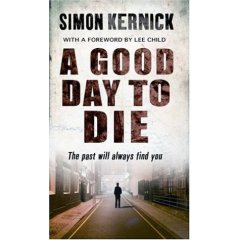
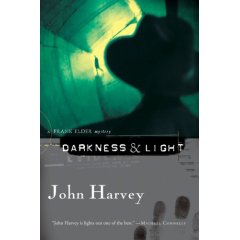
I've been looking forward to Simon Kernick's new book, A Good Day to Die, because in it he resuscitates his murdurous ex-cap Dennis Milne, his most interesting character so far. I also picked up the newest John Harvey, Darkness and Light, featuring his post-Resnick detective, Frank Elder (as usual, Resnick has a cameo). Both books were disappointments. The Kernick novel has all the elements of a good read, but it somehow drags even through the fast and violent scenes (of which there are many, as usual). The denouement is predictable, a cliche really. And the narrative is very repetitive, between recapping the plot and Dennis's constant soul-searching. The Harvey novel is also pretty dull. The plot itself is interesting enough, but I could never really get interested in any of the characters. Elder seems a pale echo of Resnick, though it seems we're in for more of him, if the preparation for sequels in the last pages is any evidence (preparation that involves finding an excuse for an ex-cop to be constantly brought back into investigations--in spite of his often-stated desire to be left alone in his Cornish retreat). Darkness and Light just plods along, professionally written but slow even for a police procedural. All in all, this has been a disappointing week of reading.

Wednesday, November 15, 2006

a bit more on Haas, plus Denise Mina


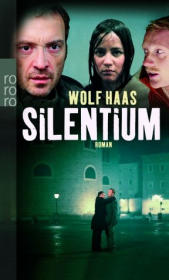
I realize that there was a bit more I intended to say about Silentium, the film made from Wolf Haas's detective novel of the same name. Silentium capitalizes on several aspects of Austrian culture (and specifically that of Salzburg, where the story is set): music festivals, tourist overlooks (a mountain precipice above the city), and the Catholic church. I already dealt with the latter in the previous post, but the use of both other elements (tourism and music festivals) is as important (and as mordantly funny) as the story's sly references to the church.
But on to other things. On the occasion of the release of Denise Mina's second Paddy Meehan novel, I finally got around to reading the first in the series, Field of Blood. One of the unique and interesting aspects of the book is Mina's use of the narrative of "the real Paddy Meehan," a figure whose biography is explained somewhat, along with the author's relationship to him, in an afterword. Paddy the second, the young aspiring journalist, is in many ways the sister of the main character in Mina's first series, the Garnethill trilogy (but without that character's history of abuse--or overt abuse anyway--the abuse of children by well meaning families is a major theme of the new series). Paddy's story is a bit a coming-of-age novel, a bit of Glasgow local color, and a bit the intrepid cub reporter tale. But Mina is very skilled at creating the characters and through them, and the "real Paddy Meehan," she manages to hold together all these elements in a compelling story (a bit more direct and a bit less obliquely Gothic than the Garnethill books).

Friday, November 10, 2006

Wolf Haas and Austrian noir


Every now and then there's a chance to get a glimpse of the "crime culture" of other countries and languages, things not normally available in the U.S. and in English. The currently touring 2006 European Union Film Showcase includes Silentium, a film made by Wolfgang Murnberger from a series of novels by Wolf Haas featuring Brenner, a seedy private detective played in the film by the sad-eyed, scruffy Josef Hader. The film is very dark, very funny, and full of references to films (North by Northwest, Butch and Sundance, and on and on), religious imagery, and twists on crime cliches. There's a car chase in the spiral driveway of a parking deck that is marvelous and dizzying. At one point, the hallucinating Brenner becomes a "player" in a foosball game, a very well done, very funny, and at the same time horrifying bit of film. The religious imagery is mostly Catholic and mostly very funny (hard to describe without coming off as blasphemous--satire is often hard to describe without losing the bite. This little glimpse of Haas's fiction makes me hungry for more of what my lack of German makes inaccessible--I can only hope for another film showcase or future translations. I highly recommend this series (film or book, though I only have experience of the former) to those who can read German, those with access to Zone 2 DVDs, or especially to those looking for translation projects.

Wednesday, October 25, 2006

More on Wallander and novels out of order

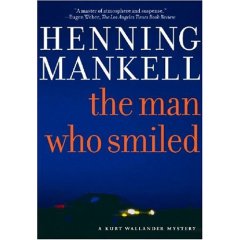
With regard to the recent publication of The Man Who Smiled, which was actually the 4th novel in Henning Mankell's crime series about Kurt Wallander in Ystad, Sweden, we had some conversation about why so many of the Scandinavian crime novels are arriving in English out of their original sequence. Before I started The Man Who Smiled, I went back to the previous novel, The White Lioness (the 2nd novel published in English, though it was the 3rd of the novels), which I hadn't read since it was new, and then I continued with Sidetracked, the novel that follows after The Man Who Smiled in the original sequence. That's a pretty big dose of Mankell in a relatively short period of time. And doing that has reinforced my impression that the novels, effective though they are, are also very formulaic--almost as much so as the paintings of Wallander's folk-artist father (always a sunset, with or without a grouse). The rhythm of the novels is determined by the lack of evidence in the police investigation--the cops are spinning their wheels for half or even more of the book. Usually, the criminal makes a few "cameo" appearances (though that's not the case with The Man Who Smiled, and the criminal conspiracy at the heart of The White Lioness is much larger than a cameo, in terms of the amount of the narrative it occupies. Reading the novels close together emphasizes that the stories are narrated rather than dramatized. That is to say, even though there's plenty of dialogue, most of the text is description of Wallander's thoughts, summaries of events or discussions not directly narrated or described, and details of the painstaking investigation. For those of us (myself included) who are addicted to the procedural as a form, the Wallander books can be very satisfying. But the formula can get a little old with frequent repetition--the appeals to the dead mentor, Rydberg; the hated press conferences; the use of dates at the end of chapters as a dramatic device. There are, of course, also references to things that happened (in the detective's private life as well as previous investigations) before--but these have a "reality effect," reinforcing the realism of the story in the same way as the endless back and forth through the streets of a small town in Southern Sweden do. But, to make a comparison, the novels of Mankell's Swedish compatriots Maj Sjöwall and Per Wahlöö perhaps used their own formula in a more supple way. The formulaic elements in the S&W books had to do with the character of the detectives, the comic elements of the series, and the running portrait of the welfare state gone to seed (also a running element with the Wallander books). The only irritating element of the S&W formula that I can remember (and I recently read through that entire series one after the other, all 10 books, without getting tired of them--it's like a very long movie) is the constant use of the chief detectives name as a whole: it's always Martin Beck, never Beck or Martin (except in other characters' dialogue) or even Inspector Beck. Just Martin Beck again and again (but perhpas a minor irritant). The S&W books are also shorter, so there's less formula called for (and more plot) per page. The procedural elements of both series are quite prominent, very important to the structure (and the pleasure) of the books. Wallander will definitely do, in the absence of S&W's Beck, only brouht back to life in a Swedish TV series that has gone beyond the original books (which has also happened with the Wallander series in 12 or so films not based on the books). But at the same time, the comparison makes me nostalgic for that great series, and regretful that there are only 10 (I know, I know, the authors never planned for more than 10, but if Wahlöö hadn't died young, meybe...).

Tuesday, October 17, 2006

New-ish Wallander novel, and translations out of order


Maxine posted a response to one of my recent entries, complaining about translations of crime novels that are done out of order. The recently published The Man Who Smiled, by Henning Mankell, is a case in point. This was actually the 4th of the Inspector Wallander novels, between The White Lioness and Sidetracked. And in fact, the second novel in the series, Dogs of Riga, was also translated out of order. The excellent Swedish TV films taken from the series also appear to have come out out of order (and with the plots of the books intermingled and changed, so that events from one book appear in a film taken from another one, etc.). All this is very confusing. I'm assuming that publishers in the U.S. and U.K. want to either capitalize on what they think is a better book later in the series, or perhaps to characterize the series in a way that the next one in line doesn't quite do (for instance, Dogs of Riga is a sort of thriller rather than a police procedural per se, though the procedural form does dominate that book as well). Even more irritating, to me, is the practice of starting the translations in the middle of a series, perhaps leaving the early books untranslated or published as if they were "prequels." By the way, Liza Marklund is apparently responsible for her series being out of order: Studio Sex (a salacious title taking advantage of the Swedish word for six) is a prequel to The Bomber, her "Stockholm Olympics" novel--she's filling in the backstory for her character. But back to The Man Who Smiled: this novel stays more tightly focused on the police investigation than any other Mankell novel except the first, The Faceless Killers. When the investigation plods, so does the novel; when the cops go back over the same ground again and again, so does the narrative. So if you like the police procedural (and I do) then you'll like this entry in the series. If you prefer a more straightforward crime plot, or entry into the mind of the criminal, then this one is not for you. The only glimpse beyond the detective's point of view (though there's a 3rd person narrator) is at the beginning (as is usual with Mankell's books), when an old man who is afraid flees what it is he fears in his car, is mysteriously killed--though the police afterwards think he died in an accident. Wallander is lured back from the brink of retirement (more on that in a minute) by pleas from the dead man's son that it could not have been an accident--but Wallander only answers the plea when the son is himself murdered (unmistakably this time). The clues lead to a powerful man who is mostly (and effectively) offstage. Though the ending is perhaps just the reverse--the final confession is a bit stagey. But overall, it's an effective novel in following how the truth is uncovered when we are all sure who the killer is, but not how he can be proved guilty. One aspect of the Wallander series that is typical of Scandinavian crime novels generally (and distinctively) is the law-abiding and even politically correct quality of the police detectives. Wallander is shattered by an event in the previous novel, in which he killed a man (clearly necessary but nonethelss guild-inducing for Wallander). He worries about drinking and driving (a theme going back to the first novel) and other social crimes. In fact, the Scandinavian fictional detectives seem to be the most socially responsible of all crimem heroes or anti-heroes. I guess it's so ingrained in the culture that the chain-smoking, heavy-drinking noir detective is not possible in the context of Scandinavian culture (except in the case of Harry Hole, Jo Nesbo's Norwegian detective, who is so spectacularly alcoholic that he is the aggressively anti-social exception).

Friday, October 13, 2006

Emigre Noir: Kerr, Limon, and Giovinazzo


There is a distinct genre of crime fiction that I'm calling "emigre noir" but might just as well be called "tourist noir." The writer may be American or English, but the detective (usually) and the setting are European or Asian. Sometimes the setting is evoked in an interesting way but the writing or the story aren't quite true or compelling (Colin Cotterill's Southeast Asian series, as well as the Bangkok series by John Burdett, the Aurelio Zen books by Michael Dibdin, and the Venetian novels of Donna Leon fall into this category, to me), sometimes everything is evoked beautifully but the novel is more a mystery or a "cozy" than noir (much as I like Magdalen Nabb's series, and as gloomy as her hero is, they really fall into this category).

But occasionally the milieu and the story are both evoked within a dark, noir sensibility. Philip Kerr's Berlin Noir trilogy starring Bernie Gunther, former cop and now a private detective in the Nazi era, are now joined by a sequel, "The One from the Other," that extends Kerr's insight, that the perfect setting for noir is WWII Germany, into the postwar years. This time the settting is mostly Munich, with excursions to Vienna (another perfect city for noir) and the German countryside--all devastated by war. We may see what's coming before Bernie does, but the plot is nevertheless full of twists and turns. The survival of Nazis into the postwar economy is the topic, as well as rapacious capitalism (always a part of the Nazi picture, after all). Bernie is hired to verify that a war criminal is dead, so that his wife can remarry, but soon he's in the thick of personal tragedy and professional disaster. It's hard to say more without giving something away--suffice it to say that Bernie's narrative is always full of the wisecracking, smartass repartee that is a throwback to classic noir film. If you like your noir in that vein, and sometimes I do, this one is Kerr at top form.
Martin Limon's series about George Sueno, American MP in Korea, always keeps to the ground that Limon knows firsthand, the military base and the surrounding Korean community of entrepreneurs (mostly bars and whores). In the Door to Bitterness, Limon uses a hackneyed plot (gun and badge stolen from cop) to explore the difference in cultures between the GI and the surrounding Confucian/Korean culture of the family. The cliche of the basic plot takes a bit away from the story, but the logic behind it is satisfying and convincing.

Last but not least is the closest of my current crop to being tourist noir. Buddy Giovinazzo takes the New Jersey mob on a trip to Berlin, where they try to muscle in on the largest construction site in the world, Potsdamer Platz after the fall of the wall. It's a great idea, and mostly it works. Tony, Giovinazzo's hero and narrator, is an enforcer who lands in the middle, between the Turks and the Russians who are trying to control the construction projects, as well as the Germans of both Eastern and Western varieties, and even his own uncontrollable psycho partner. The writing sometimes slips into "writerly" excess, with metaphorical language that is a bit too much, but another of Giovinazzo's devices works surprisingly well--Tony slips with no warning into the story of his life leading up to this assignment, and the result is a cinematic style that well suits the material. He predictably and tragically falls for a German girl that he really should not be attracted to, against the background of hyperviolence that he finds himself reacting to simultaneously with callous disregard and newfound distaste. The mob novels I deal with in this blog are typically of the non-U.S. variety (such as the various crime families in Izzo's densely portrayed Marseilles), and it's refreshing in an odd way to get the good old Sopranos-style mob in an exciting new venue. I haven't enjoyed a mob novel this much since reading Jim Cirni's Long-Island mob books. Although Cirni stays within comic distance of reality, and Giovinazzo veers off into a kind of satirical fairy tale by the end of the book.