Saturday, May 06, 2006

Sun Storm, by Åsa Larsson


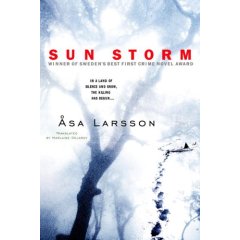
Åsa Larsson's Sun Storm keeps the reader unsettled: every time you think that the plot is settling into a cliché, Larsson provides a twist, not just to startle but to keep the story full of both tension and realism. The book is not a police procedural, but a policewoman is a prominent character and her investigation, along with her colleagues, is central to the book (without providing a resultion to the plot). The central character is a lawyer forced into investigataing a murder, somewhat like Liza Marklund's intrepid reporter, constantly being thrown into the middle of a murder. But whereas Marklund's character is implausibly skillful in getting out of tight spots, Larsson's Rebecka Martinsson is simply a woman with a past, caught up in the intrigues of a small town that she thought (and hoped) she had left behind forever. The setting is also intriguing--the far northern town of Kiruna. The main thread of the plot Iand of the book's atmosphere) is religion--specifically a uniquely Swedish brand of revivalist/fundamentalist Christianity of the "crystal cathedral" sort. The lure of a "cult" of that sort for ordinary people and also for a certain kind of psychopath is a key theme of the book--but Larsson skilfully avoids demonizing the religiosity of the church at the center of the plot by using a former convert, Rebecka, as her main character. The Lappland environment recalls a wonderful novel by Kerstin Ekman, Blackwater, that is also a crime story--albeit one that is extended by language and narrative far, far beyond (in page count and content) it's "McGuffin," to use Hitchcock's term for the event that drives a crime story. Ekman's novel is heavy sledding (little pun, please forgive me, given the snow everywhere up there in Lappland) unless you get wrapped up in it--if you do, it's a fascinating portrayal of difficult relations among Swedes, Lapps, and leftover hippie-dropout-types in a local commune. Larsson's novel, far shorter than Ekman's, doesn't present any hurdle of that sort and moves along much more quickly, with more tension. But Larsson's language is also rich, her evocation of the far north equally involving and vivid, and her resolution, though more in line with a thriller perhaps than Ekman's, dramatic rather than melodramatic. All in all, we can thank the current Scandinavian crime boom (started off, presumably, by the success of the Wallander books) for making it possible for English speakers to read a book as good as Sunstorm, and if the book blurb is to be believed, the sequels that Larsson is producing. One thing that is evident in this book as well as several others I've read recently is a casual violence against animals, used as a dramatic device. In the case of Sunstorm, this particular plot device is a weakness, a cliche even--a flaw in the book that is the only really off-putting aspect of the novel. In some other cases, the violence against animals is more integrated into the structure but more "on-screen" and harder to take. Is this a theme that anyone else has noticed in contemporary crime fiction?

Sunday, April 23, 2006

Yet more new Swedish noir in translation

Borkmann's Point by Håkan Nesser is the newest of the current crop of Swedish crime novels to reach the U.S. market. But Nesser's novel is a bit different from the others. The setting is not Sweden, not exactly anyway. The beat of Detective Van Veeteren, Nesser's central character, is an unnamed European country that is something like the Netherlands, or perhaps coastal Denmark. Or maybe coastal Sweden. In a way, Nesser has staked out the territory of "new Europe" for his detective, giving himself considerable leeway in controlling the setting (but losing the anchor of a real city, one of the things I go to international noir fiction for).
Nesser's novel is a puzzle, solved in the "least likely suspect" mode, perhaps more a straight mystery than noir fiction. But the inability of citizens to rely on the justice system for justice, a dark sensibility, and the oddly disorienting fictional world bring the novel close enough to noir to be considered here. The narrative has considerable drive, though the investigation is not very systematic, as police procedurals go. Van Veeteren's self confidence echoes (distantly, fortunately) that of Poirot. On the other hand, the family problems of several of the characters give a "reality effect" in amassing detail surrounding the characters' lives. And the progression of murders, and of the detectives' efforts to catch up with the murderer, are the primary sources of that narrative drive. To me, this novel is not quite as interesting as Eriksson's Princess of Burundi, but he avoids what I see as a flaw in the Wallander books--a tendency to reach for global conspiracies in the resolution of local crimes. And it's fascinating to see Nesser build up a circumstantial, believable world from scratch. Plus the explanation of the book's title is interesting and completely unexpected...
Synopsis: A drinker is stalked and murdered, with an axe, in the woods on his way home from a bar. Obviously this is not the first novel in this series, becuase there is some unfinished business between the star detective, Inspector Van Veeteren, and his son, who is on parole and the two are at the beach together. No more explanation is offered, since the detective is immediately called away to the nearby town of Kaalbringen to deal with the axe murder. In Kaalbringen he meets the police chief, Detective Chief Inspector Bausen, and detective Beate Moerk, plus several other less well delineated detectives (Moerk and Munster both occupy the narrator's attention nearly as much as does Van Veeteren--Moerk is in fact a fully realized character, at least in the first half of the novel). Eventually, they're joined by Van Veeteren's trusted lieutenant, detective Munster. The two victims, a business man and a vagrant, seem to have nothing in common. Then another man is discovered when his girlfriend returns to their apartment--the axe is still buried in his back. The twists and turns from there on follow a familiar pattern, and there is what I consider to be a flaw in the point of view--the killer speaks, giving the reader details of his motivation, and the character who will eventually be revealed to be the killer also speaks, separately and in the voice of his "daytime" character so to speak, with no mention of the motivating compulsion that we know from the killer's monologues. So there is a blatant attempt to fool the reader, and these two voices are not really reconciled in the conclusion.

Friday, April 21, 2006

More new Swedish noir by Kjell Eriksson

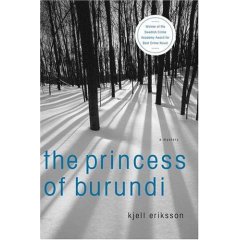
Kjell (pronounced "shell," I believe) Eriksson's newly translated The Princess of Burundi (I should really start crediting the translators: Ebba Segerberg did a great job with translating this one from the original Swedish) is one of (probably the best of) a new crop of Scanidinavian crime novels hitting the shelves in the U.S. and U.K. this year. This is another "collective" novel of a sort, since none of the detectives in this police procedural dominate all the others. There are a couple of characters who come forward, though, as well as some of the families of the principals in the crime. There is no Sherlock Holmes who solves the crime by himself--on the other hand, it is less of a self-consciously social novel in the sense I use the word "collective" with respect to The Beast (see earlier post on that Swedish novel). Eriksson's detectives work in Uppsala, the famous Swedish university town, and there is a subtle variation on the "town and gown" theme that is as common in crime novels as in "mainstream" fiction (since Lucky Jim at least). The class boundary is here clarified by exposure to, and participation in, crime, and the line is drawn in an effective manner by Eriksson. Detective Ann Lindell (whose role here suggests that she may be a more prominent figure in others in this series not yet translated) remarks (with regard to the cultured detectives of a certain genre of crime fiction) that the cops she knows are not cultured, not great readers (see my comments on Garcia-Roza's detective Espinoza). She comments that her crowd is perhaps better at what they do because they are closer in class, taste, and education to those with whom they most often work, the perpetrators and victims of crime. Another of the detectives, Berglund, comments at the early stages of the investigation that "Solving a crime was a matter of discerning a pattern...and in that way this man and his context, his part of town, his expressions, gestures, and language were a part of the answer," and that when confronted with the puzzle that a crime represents for him, the investigator must put together "the pieces of the puzzle, the puzzle of the town..." These comments get to the heart of what makes a crime novel "noir," and also what makes crime novels (and to me, particularly the international ones) so interesting. To be effective, a "noir" writer must get to the heart of a city, and also give a certain amount of the surface detail, the "map" of the city. Eriksson's book is not a travelog, though--his characters have the pessimism about society and about the bureaucratic realities of policing that make "noir" noir. If I find one flaw in The Princess of Burundi, it's in the plotting--especially of the ending. Without giving too much away, I hope, I found the solution to this puzzle a bit unsatisfying, not in the way the book ends but in the revelation of the criminal's identity. It seems almost as if the author had originally designated one character to be the murderer, and then decided that wouldn't work--so he came up with the most similar character he could as the perpetrator. Still, the plot moves forward without any other artificial contrivances, and the conclusion has a genuine inevitability and pathos. This is a good one.

Tuesday, April 18, 2006

Brazil's Luiz Alfredo Garcia-Roza

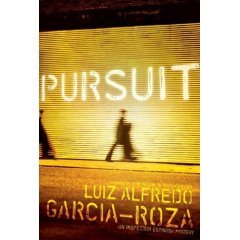
The fifth of Luiz Alfredo Garcia-Roza's Rio de Janeiro crime novels featuring Chief Espinoza is now in English--a good occasion to review the whole series (The Silence of the Rain, December Heat, Southwesterly Wind, and A Window in Copacabana). On the face of it, this is a series I should like--even want to like. The setting is exotic and interesting, and there are the elements of noir (a bleak portrait of modern life in general and the particular setting, corruption in the police force, jarring crimes, poverty and despair). Plus the tone is fairly light (given the material), allowing for a certain dry comedy. But I just can't seem to get into the series--they are not novels I can easily imagine going back to again and again, as I would do for some other series. The plots are intricate and turn on believable events that are integrated into the society in which they happen. In fact the plots are the main interest of the series, because there is little character or interaction among characters. Espinoza is a writer's idea of a policeman--he's obsessed with books (his no bookcase bookcase--made entirely of books--is a feature in all the books). He cares little about what he eats but the novelist is careful to talk about what he's eating--and since Espinoza is not all that particular, the meals are usually pretty boring (in contrast, for example, to the meals of the main characters in the novels of Spain's Montalban or Italy's Camilleri). None of the other characters have much personality, other than a few colorful characteristics. The other cops are either routinely corrupt or, in the case of Espinoza's few trusted lieutenants, simply not corrupt--they have no other personality (though Garcia-Roza does give them little snippets of life outside their work). The text is very "narrated," rather than growing integrally out of the setting or the characters. Garcia-Roza is present in every word. I've been tempted to refer to the novels as like Doyle's, since there is a puzzle character (but no similarity in methods between Holmes and Espinoza). The novels seem almost parable-like--tempting me to compare them to Kafka (though the tone is much lighter in Garcia-Roza). I think perhaps they are simply too self-consciously literary, as are the novels of, for example, Cuba's Leonardo Padura, whose detective is a frustrated writer--but Padura's novels are full of telling detail about life in Havana, life in Cuba, life in the modern world. And the characters are (though in some ways just as cipher-like as Garcia-Roza's) colorful in interesting and believable ways, ways that further the stories. In the end, I still want to like Garcia-Roza's novels and will probably look at any new ones (in the library--I don't think I'll buy them any more), but I don't find myself wishing that the translator would hurry up...

Thursday, April 13, 2006

A Swedish "Beast"


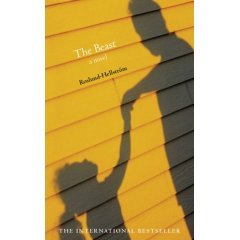
The Beast by Anders Roslund and Börge Hellström is a "collective" novel of the sort attempted by certain novelists in the 20th century--not focused on a single hero, but shifting among a kaleidoscope of characters (in this case a couple of policemen, several prison guards, a pedophile murderer, the father of a young girl, a group of Swedish rednecks, and assorted other characters. Their stories (told in the 3rd person) are intertwined until all the threads ultimately come together, with several twists that take the plot beyond that of the average crime novel, in an ultimately not-unexpected ending. Rigosi's Night Bus (mentioned in an earlier post) has a similar intertwined structure, but whereas that novel is a rollercoaster of a comic thriller, The Beast is an all-around indictment of a society whose limits and ethics are tested by the strains of a child molester's exploits and their awful aftermath. Most of these characters are damaged (and the one flaw I would find in the novel is that the "back story" of a few of the characters molested youth is a bit overdone), and none come out of the novel without further damage. But the novel is compelling, and the technique is carried off almost flawlessly--collective novels are often tedious and unfocused, but this one is driven and tightly wound. One aspect of noir fiction that is seldom plumbed by current authors is the thinness of the veneer of civility in an entire society, rather than a narrow spectrum of an enclave such as the criminal underworld. The Beast does plumb those depths, convincingly and tensely.

Sunday, April 09, 2006

Helene Tursten's The Torso suffers from a couple of problems with respect to the noir tradition (or anti-tradition, as may be). The first is one I mentioned in my last post, a certain woodenness in the language that I would (without any evidence) attribute to the translator. The woodenness reflects some aspects of the Swedish language--for one thing, if you translate some Swedish swear-words more or less literally, they sound pretty mild, so that in this translation, the main character (detective Irene Huss) says things like "Yipes" when we would (in American or even more so British spoken language) expect "Fuck." I can't exactly fault the translator in respect to instances like that, but I might hope for a livelier equivalent to Swedish expressions like "djävlar," which literally means "devils" and is short for "a thousand devils," but is used more like "damn" in English. The other problem is one that Tursten shares with the better-known books of Henning Mankell--a reflection of the "political correctness" of Swedish culture. In one of the early Wallander books by Mankell, the main character is devastated by being caught for driving under the influence, hardly the cause for much soul-searching in non-Scandinavian crime fiction. Tursten's police squad, and in particular detective Huss, seem inordinately shocked in The Torso by fairly straightforward kinky sex, and a bit self-righteous about smoking and other non-sexual sins. Still, these attitudes of the Swedish characters are believably contrasted in The Torso with more worldy attitudes of the Copenhagen police detectives who figure in this novel prominently. Overall, I found The Torso to be pretty effective as a noir-ish police procedural, and actually fun to read (except for the annoyances mentioned above), though there's one more flaw I could mention--that old cliche the "snuff film" makes a guest appearance here. Fortunately the plot doesn't turn on that mythic video genre, but on a more gruesome and believable genre of serial killers, involving necrophilia. On balance, then, I wold recommend The Torso, which in some ways is better than the Wallander books, if you think like I do that the morose Wallander is getting a little tiresome--if Huss's family life is a little too sunny, perhaps some of the other Scandinavian crime novels coming out this spring will prove to be a better balance. The next novel I'll be dealing with, The Beast, by Roslund and Hellström, is not a police procedural at all, so it will likely be either a contrast or (even better) an antidote to the various excesses or failings of these more prominent (in the U.S. anyway) Swedes.

Wednesday, April 05, 2006

More Scandinavians

Had a reply to my recent post on (mostly) male Scandinavians: "Asa Larsson - Sun Storm (Apr), Anne Holt - What Is Mine (Jul) and Liza Marklund - Prime Time (Sep)." I don't think of Marklund as "noir," more of a mainstream thriller kind of thing. Still, it's another female voice in the stream of Scandinavian crime fiction that's coming out now. I don't know Larsson but look forward to that and to the Holt. The new Tursten novel (The Torso) has some of the same problems as her first novel in English--due to (I presume) the translation. The text is a bit wooden in English, but the novel's forward movement is only impeded a bit. More later--I haven't finished the book yet.

Saturday, March 18, 2006

New Italian noir from Giampiero Rigosi


The newly translated Night Bus by Giampiero Rigosi (from the UK's Bitter Lemon Press) is a wild ride, a combination of Pulp Fiction and the Pink Panther. The story, with a large cast of characters, is told in short blackouts that weave the strands of the plot around and around, tightening the chararcters in the web that Franz, a bus driver who is perhaps the only innocent in the whole lot, sees in the streetmap of the city of Bologna that he navigates on his bus route. Night Bus should actually come with a warning label--Rigosi is so good at keeping the story (and the suspense) going that the book is hard to put down. I actually could not pick it up and start reading unless I knew I had a substantial block of time to give to it. At every turn, a new complication or twist pops up to keep the story going at its breakneck pace. It's obvious that Rigosi is a skilled writer, and that his aims are above the level of pulp, but he never condescends to the reader or the genre. As dark as the story is, and as many corpses as do pile up, the comedy remains at a high level. And while you may think you see a particular resolution coming, Rigosi manages to keep surprising the reader by avoiding plot cliches that are irresistible to most mainstream thriller and mystery writers. I regret that it will take a while to get any further novels from Rigosi translated, and that we're at the mercy of boardroom decisions about whether and when we'll see any more at all (maybe I should brush up on my Italian). But for now, Night Bus is one of the best noir thriller's I've read in a long time, and clearly the best of Bitter Lemon's fine list of translated noir fiction.

Friday, March 17, 2006

noir, crime, middle class, Serpent's Tail

Quote from Pete Ayrton, publisher of Serpent's Tail Press, on their Mask Noir series (published in Jacket, no. 4, July 1998--an online magazine): "The crime list has really taken off since we last talked. It started with the whole P. D. James controversy. P.D. James gave this interview to the World Service of the BBC — which, you know, you’re not meant to listen to in the UK. It went out at 3.30 or so in the morning, broadcast for Latin America or somewhere, and she made the point that the middle classes were the suitable subject for crime fiction because the working classes didn’t make moral choices. Regardless of what one thinks of what she said, it certainly led to a loud and controversial debate over the nature of crime writing, who are its protagonists, who are its natural subjects. And obviously there is a recognition that the UK is changing as a society, it’s becoming multi-ethnic, whole hierarchies are disintegrating and contemporary crime writing has to reflect this changing reality of contemporary British cities. And the literary traditions of the cosy, the rural inspector, no longer seem adequate for the genre to cover the reality of British life." This is a reference that I've mentioned before, regarding P.D. James's incredible statement. Comments?

Thursday, March 09, 2006

upcoming scandinavian, italian, french, more

Just a hint of what's coming out (and what will be appearing here in the near future):
Arnaldur Indridason (Iceland): Voices
Tonino Benacquista (France): Framed
Luca Di Fulvio (Italy): The Mannequin Man
Gianrico Carofiglio (Italy): A Walk in the Dark
Matti Joensuu (Finland): The Priest of Evil
Jo Nesbo (Norway): The Devil's Star
Dominique Manotti (France): Dead Horsemeat
Anders Roslund (Sweden): The Beast
Giampero Rigosi (Italy): Night Bus
Kjell Eriksson (Sweden): The Princess of Burundi
Fred Vargas (France): The Three Evangelists

This is a sudden glut of novels that I've been either waiting for their publication dates or have just discovered while foraging through Amazon, Amazon.co.uk, and Bookfinder. Is there any significance to the fact that only 2 of the authors are women (and both of those French)? Manotti and Vargas (that's a pseudonym) are the 2 among this group. Though there are a number of women working in the noir tradition, these are the only ones in this crop. Of course there's also Helene Tursten's The Torso, which I haven't included but will be out this summer (from Soho Press), so maybe this is a very small, mostly male window on noir...

Tuesday, March 07, 2006

noir can't outdo reality sometimes

In Atlanta, in 1987, a hit man carrying a "delivery" of roses shot a socialite twice with a 9mm pistol in a Buckhead (upscale in-town suburb) townhouse when she answered the door to accept the flowers. The estranged husband's trial is going on in Atlanta right now. The husband, who was moving to Florida, asked the trucker who drove the moving van to "take care of" his wife. The trucker says he didn't believe the husband was serious until he got $12,500, half of the $25,000 the husband had offered him, in the mail. So the trucker picked up a bartender and a stripper in North Carolina, drove to Atlanta, bought the roses, and told the bartender to go to the wife's door posing a delivery man. He says he heard two shots and the bartender came back to the car sprayed with blood. I don't know how they caught the trucker, but he got 20 years after agreeing to testify against the husband. They've never caught the bartender and have no evidence he existed except for the trucker's statement. This is as close to a noir or TV crime show plot as reality gets, but no matter how hard they try, the writers and the TV shows just can't make "murder for hire" seem as tawdry as the reality (plus the fact that it took from 1987 to 2006 to bring the husband to trial isn't reflected in the TV shows, though in noir fiction sometimes the timeline is more accuate).

Thursday, February 23, 2006

Leonardo Sciascia


The NYRB Press is bringing back into print the translations of Leonardo Sciascia (a gift to the reading public). Sciascia had a few mainstream hardcover publications in the U.S. in the 60s, and there was actually a mass-market paperback of one novel (retitled as "Mafia Vendetta"), and then Godine published The Day of the Owl and Equal Danger together as one of their "Double-detective" books (collector's items now, I think).
But the new editions are very nice--NYRB Press does a good job with their reprints (the U.K. editions that were the only source for One Way or Another and The Moro Affair, and some of the others for a long time were cheaply printed and aged very quickly).
Vintage has had the wisdom to keep the collecction Open Doors in print for some time (the last of the books to become available in English, but the one most constantly in print lately). Having the Sciascias available again raises the tone of the genre. And gives me an excuse to go back and read them again, and report on them here.

Wednesday, February 22, 2006

a little break while waiting...

Hello everyone...anyone? I'm taking a break from posting to the blog while waiting for a crop of new international noir titles to come out this spring. There will be new books from Indridason, Vargas, Manotti, etc., etc. Anyone have suggestions for other new things that should be seen and read by all noir freaks?

Thursday, February 09, 2006

Algerian noir


There have been many attempts to do a "literary" version of the crime novel/roman policier/noir fiction. Most of them fail as crime novels, because the literary concerns overwhelm the genre considerations. Yasmina Khadra's crime trilogy (Morituri, Double Blank, and Autumn of the Phantoms) is the rare case of writing that succeeds on both literary terms and the requirements of the crime novel. And in addition, this is the only (as far as I know) genuine contemporary Arabic policier or noir. Khadra is well-placed to perform this magic act. His character, Superintendent Brahim Llob, is both a copy and a writer, and his writing ultimately gets him in trouble (in a neat bit of postmodern metafiction) in the last novel. Khadra (the name is a pseudonym) was an army officer and a writer whose writing got him into trouble in spite of the false name, and he's now in exile in France (the novels were written in French).
The result is a dark glimpse of the nightmarish situation in a terror-torn Algeria of the 1990s, with fundamentalist murder squads roaming the streets (those squads provide the plot of the 2nd of the 3). There is also considerable corruption and decadence in the scene, and the combination of the two extremes catches Llob and the other (few) hones people in the novels in the middle. Llob, who has sent his family into the country away from the violence (at least possibly away from it), is a doomed figure, struggling (though not without his own violent impulses) against disorder and inhuman violence.
The last of the 3 novels has almost no plot (the first novel centers on a kidnapping, the second on a brutal series of murders). Llob is being persecuted by the police as well as his usual enemies among the decadent Westernized urban elite and the mostly faceless terrorist marauders. As he bounces through this horrific landscape, his few safe havens (literal and figurative) are stripped away and melancholy is the mood throughout. The lack of plot might be off-putting for someone who picked up Autumn of the Phantoms without first reading the other 2 in the series, but as a capstone to the trilogy, the indirect, disordered quality of the novel is perfect. The Llob novels are together a major accomplishment in the crime genre and in the literature of the post-colonial era.

Tuesday, February 07, 2006


Is there anything more classically "noir" than urban street warfare between ruthless gangsters and amoral cops? Add in snappy dialogue and an ending that resolves nothing, and the formula is complete. But what if the dialogue is howlingly funny? Can that be classic noir fiction? Bill James's Harpur and Iles series has a certain resemblance to the work of P.G. Wodehouse, whose work has been compared to classical pastoral poetry. In a hermetic world that is ultimately idyllic, the seemingly troubled events ultimately have no consequences. Wodehouse's world is the ultimate light comedy: weightless, funny, satirical (but only lightly so). James's world (set in a fictional city in the south of England) is equally hermetic, and there are equally few consequences (or at least few changes in the status quo, since there are plenty of corpses that result from the action) but otherwise Wodehouse's lightness is turned into darkness or heaviness (depending on your metaphor). The dialogue between detective Harpur and his superior Iles is almost not dialogue at all: they talk past one another, each indulging in heavy irony and macho one-upmanship. The sexual innuendo spares no one, not even Harpur's teen and pre-teen daughters, who may (or may not) have a thing for Iles, depending on which part of the text you listen to at any particular time. James has invented a dialect as well as a world and once you enter into both, the ride that you are taken on is great fun. James ultimately dismembers the police procedural, the thriller, noir fiction, and any other genre of the crime novel that you can mention, but without stinting on all the elements of each.
Totally within the strictures of series-based crime fiction, James offers something quite different: deconstructive fun of a high literary standard (without sacrificing readability and comedy) much as Wodehouse did in the context of the indescribable genre that he created himself. The only problem with James's Harpur and Iles novels is that there are so many of them (21 to date, at least in their U.S. publication) the experience begins to wear on the reader. On the other hand, there's no need to go back to the beginning--the new one is a great deal of fun even if you have not read any of the earlier ones. Though to my mind the most successful one of all is the almost Shakespearean Astride a Grave, the 8th, which avoids some of the repetitious gang warfare of recent volumes and also is the closest to classic noir structure (though no less funny than the best of the other Harpur and Iles novels). This series is unique.

Thursday, February 02, 2006

Massimo Carlotto and Jim Thompson

The latest of Massimo Carlotto's crime/noir novels to be translated is The Goodbye Kiss. The first two (see earlier posts) are in a series about club owner/private detective "Alligator" in Padua, but Giorgio, of The Goodbye Kiss, is not in that series (though there is an alligator, very early in the novel). Alligator and Giorgio share a background in radical Italian politics (as does the author, and Giorgio shares a good deal of the author's life story, including a time spent in exile after fleeing prosecution in Italy for a political crime, eventual return to Italy, prison time, and ultimate "rehabilitation" under the law. But The Goodbye Kiss is an old-fashioned noir thriller like those of Jim Thompson (and a little like the more recent ones of George Pelecanos, except that Pelecanos's heroes are never as amoral and ruthless as Giorgio). Like Thompson's novels, this one has less a plot than a sequence of events that follow one after the other. And like Thompson's novels, this onesequence demonstrates a descent, murders leading to murders and suspicions leading to the necessity of more murders. But Giorgio is so unlikable that his increasing difficulties in his effort to reach a stable life in Italy seem beside the point. He only seeks the illusion of stability, while having every intention to live as ruthless a life, dominating the women around him in particular, as ever. The ending is less a conclusion than merely a pause in this career. On the positive side, Carlotto's novel is carefully placed in the context of Italian politics, particularly the violent political events of past decades. To look upon the bleakness of this novel's story and it's "hero" as positively as possible, one could say that the author has portrayed the realities of a heartless postmodern Italy, with its turbulent politics replaced by rampant greed and self-interest. Maybe it's too much for me to ask for a little more entertainment, even of the pulp variety such as Jim Thompson would have provided, along the way.

Sunday, January 29, 2006

japanese noir


One of the pleasures of reading mystery and noir in translation is getting a glimpse of other cultures. In spite of the globalization of culture (and literature) there is still a strangeness to crime in other places, a difference in the atmosphere of the streets and the motivation of the criminals. Japanese noir is a glimpse into a culture that is particularly "other" in many ways. Miyuke Miyabe's first novel in translation, All She Was Worth, examines the particularities of Japanese notions of identity (particularly with respect to gender) and debt. The structure of the novel is a pretty straightforward investigation (albeit by a policeman who is not working officially). Miyabe's second novel to make it into English is Shadow Family, whose structure is a "one act play," as one of the characters remarks. The first several chapters are all indirect narrative, just a set up for the main event, which is a long, detailed presentation of an unual, theatrical interrogation scene. Ed McBain did this sort of thing occasionally in the 87th Precinct series, but this version more extended and with particularly Japanese sensibilities. But the major premise of the novel regards Internet identity, and the complex possibilities are really only touched on by Miyabe. The strains inherent in the Japanese family, and the consoling illusion of an "ideal" online family are examined in detail, but the gender-bending opportunities of online identity are not even suggested. Still, the novel is an interesting glimpse into dark corners of ordinary life in Japan. Out, by Natsuo Kirino, is a much darker vision of life (particularly women's lives) in the Japanese working class. Out displays the mundane lives of its characters, but with dark humor and open sexuality (elements missing from Miyabe's work). Out is a bit cartoonish but not necessarily in a bad way. It's a striking experience of the underside of another culture. An even darker ride is Ryu Murakami's In the Miso Soup, whic h takes the reader along on a guided tour of the Japanese sex trade. Murakami's earlier books in English, the amazing Almost Transparent Blue and the more straightforward Coin Locker Babies, are contemporary fiction more than they are noir per se. In the Miso Soup is very much in the noir tradition, from a peculiarly Japanese point of view. It is funny, very (VERY) dark, and has a more distinctive narrative voice that is much livelier than the narrators of Miyabe's books. Speaking of voice, there is frequently a stilted quality to the translations of Japanese mystery novels. That is true with Miyabe and Kirino (though not with Murakami, whose prose may be more global in some ways), as well as with some otherwise excellent mystery/noir novels by Akimitsu Takagi, including the excellent Tattoo Murder Case, whose considerable sensational elements are dampened a bit by the stilted quality of the English prose. These translation problems may be the result of the very different structures of the two languages in question, and present only a small hurdle to the enjoyment of these novels.

Tuesday, January 24, 2006

one more John Brady

The latest Matt Minogue novel from John Brady is Islandbridge, available only in Canada as far as I can tell, from McArthur & Company--Chapters/Indigo's website has it. Islandbridge is much concerned with the transformation of Ireland into a European crossroads, no longer isolated from the "traffic" of all sorts that characterizes the contemporary "noir" environment. Brady's language is, as always, a major focus--anchoring the story and the sentiments about modern Ireland in a regional "sound" of voices and accents. Dublin is also a visual presence, not a sentimental pubby Dublin but a real, embodied city. The threads of the story begin 20 years in the past, with a bleak encounter between a young garda and a couple of thugs, father and son. In the contemporary plot, Minogue steps away from the more administrative tasks that are his current assignment (typified in a lampoon on the stereotypical Powerpoint presentation) to follow his former colleague Tommy Malone into a maze of corruption and violence that will ultimately engulf another of Minogue's colleagues. The ending is a bit odd, leaving the reader to infer not so much what has happened as what will happen, in whatever subsequent novel Brady has in mind. In fact, the plot hinges on guilt and threatened violence more than on overt action. The result is a compelling novel, a very dark but complex pattern of voices, desires, disappointments, and private disasters.

Friday, January 13, 2006

australia and noir


Garry Disher has evidently published a number of novels in Australia, including some crime novels yet to be published in the U.S. His two procedurals published stateside so far, Dragon Man and Kittyhawk Down, combine an ensemble cast a la McBain's 87th Precinct with redneck noir a la Danlel Woodrell's Arkansas noir novels. Kittyhawk Down, published recently, mines the redneck noir vein very effectively, with side plots that are very dark and very violent, though with a comic sensibility. The main narrative threads, featuring homicide detective Hal Challis plus a couple of female cops and a couple of male cops, are as much taken up with the trials of the cops' personal lives as the murders they are investigating. The splintered focus and diverse plots of these procedurals are very effective and entertaining, if you like McBain, Sjowall/Wahloo, etc. And if you like Woodrell (or Scott Phillips for that matter) the country town aspect of Disher's "peninsula" setting is vivid and enjoyable. Altogether worth the trip, and there's evidently at least one more in this series headed for U.S. publication. Speaking of Australia, the Shane Maloney novels, of which there are five now, I think (only 4 published in the U.S.) are very effective urban/comic/political novels. Maloney's portrait of local politics in Australia is very sharp. Of the presumably numerous Australian crime novels, only a few others have made into the noir lists of U.S. publishers. There are a couple of John Dale novels dealing with the urban underworld (very deep in the underworld), plus Caroline Shaw (whose Cat Catcher was published by Serpent's Tail some years ago). Shaw's detective is one of those almost-amateur female detectives that the English do so many of, but this Australian variant is a bit darker and grittier, plus the animal angle is handles without the cuteness of so many U.K. or U.S. cat-related mysteries (Shaw's detective specializes in finding pets, and only tangentially in human investigations). More Aussies out there in the world of noir? Let me know, please.

Sunday, January 01, 2006

more on Irish noir


Ken Bruen's newest Jack Taylor novel is The Magdalen Martyrs, and illustrates the attractions and some of the limitations of his version of noir fiction. Bruen's current series has some peculiar qualities, not the least of which is his tendency to quote other writers in the historical and contemporary noir genre. But his own writing is more Charles Bukowsky than James M. Cain, and in the tradition of Bukowsy, the narrative voice can be fascinating and bleakly poetic. Jack Armstrong is a very self-conscious boozer and druggie, a loser who frequently brings grief to those he loves (or even just associates with). I keep stating that from my point of view, noir writing has to have a social conscience to really qualify as noir, and Bruen's Jack Taylor is really too self-absorbed to reflect consciously on his environment in any effective way, and Bruen's writing is itself too self-absorbed to bring any social consciousness into the narrative at the authorial level. The attempt to link the narrative to the horror of the Magdalen martyrs, enslaved by nuns in Galway in the early and mid-20th century, is the weakest part of the novel Bruen names for them. Bruen's earlier "White Trilogy" was much more in the noir/police procedural vein, and both very dark and very effective in drawing a portrait of contemporary London and (tangentially) Ireland. Bruen's earlier work is interesting but wildly uneven: Rilke on Black is a tantalizing literary take on crime fiction and the literature of the underworld, sending me out looking for other Bruen novels. But Hackman Blues and Her Last Call to Louis MacNeice were disappointing. Bruen seems to be a text machine, churning out novels quickly and giving the impression of not planning or editing much. The considerable charm of the Taylor novels lies principally in the flow of the narrator's voice, and not in the plot or structure. A much more richly constructed version of Irish noir can be found in M.S. Power's Children of the North, a kaleidoscopic trilogy on the so-called Troubles in the recent history of Belfast and Northern Ireland. At times, Children of the North reminded me in its complexity and skeptical intelligence of Ford Maddox Ford's great No More Parades, but in a very contemporary vein and with a rich sense of the tragedy and comedy of recent events in Ireland (and like another novel on the troubles, The Psalm Killer by Christopher Petit, the more you look into actual events, the novels have an eerie quality of being both actual news and prescient clairvoyance). Power's other novels, such as I've been able to find so far, are a bit disappointing, being of smaller scope in terms of both history and literary ambition. But all three of the Children of the North novels (and the massive novel that they collectively become) are strikingly dark, even cynical, as well as being vastly entertaining.