Wednesday, April 25, 2007

De Luca trilogy, part 2


Carlo Lucarelli's 1940s-noir series featuring Detective De Luca began with Carte Blanche and now continues (in English) with The Damned Season. Where as the first novel (or novelette, since each of these books is barely over 100 pages) dealt with De Luca's experience in a corrupt, decadent, and fading Fascist Italy, and ended with De Luca on the road attempting to escape from Allied troops that might not have any sympathy for a cop in the political squad, The Damned Season deals with De Luca on the run and hiding under false identity papers. He quickly falls under the control of a small-town policeman who represents the Partisan, anti-Fascists who are taking over control as the Fascists flee north along with the Nazi troops. De Luca was caught in the web of the politics and influence in Rome in the first book, but still had some scope for independent action. Here, he has lost his independence completely. The local cop doesn't know who he is, but knows he's a carabinieri or policeman from Rome, enough to sentence him to death. But the cop, who has little investigative exprience, is using De Luca to solve a murder case, and the solution to the mystery threatens to make things worse for De Luca as the case reveals the fault lines of the Partisan takeover. Who's in charge changes, but how business is conducted doesn't. This series, brief as each novel is, is very dark, brooding even, and no one escapes the misery and fear that envelopes everything. The brief prefaces, explaining the source of the author's interest in and information about the Italian police of that era, are essential to understanding what's going on. In a sense more palpable than in most crime novels, the author's starting point informs and expands the reader's experience of the books. My only complaint is that as short as the novels are, I wish that they could have been made available in English at the same time, or at shorter intervals. I'm impatient for the next installment--less to see what happens to De Luca than to see how Lucarelli's insight about the professional policeman at the core of his story plays out in the era of the re-imposition of state power over the near anarchy of the society depicted in The Damned Season.

Friday, April 20, 2007

Fred Vargas's Adamsberg


The style of French author Fred Vargas is similar to the investigative style of her detective (Jean-Baptiste Adamsberg): intuitive rather than logical. Looked at from a logical perspective, some of the plot elements in the new Vargas translation don't make much sense. But readers who appreciate Vargas's work will be swept along in spite of the illogicalities, since what makes the books distinctive and enjoyable is Vargas's language and her characters (which can verge into caricatures that are used for both comic effect and plot advancement). Wash This Blood Clean from My Hand is the book's title (originally titled Sous les vents de Neptune--and one my ongoing peeves with the publishers of crime novels in translation is their persistent habit of giving the books titles that don't relate to the original titles; the practice can, as in Vargas's case, make it difficult to track down exactly which books have been translated, and in what order they were originally published). Vargas, as is well known now, is the pseudonym of archaeologist Frédérique Audouin-Rouzeau, whose twin sister is a painter who uses the name Jo Vargas. The new book has a plot as gothic as the two previously translated Adamsberg books (which dealt with werewolves and the plague, among other things): the detective is struck by fits: he is either having a breakdown or being possessed. What has set him off is a series of reminders of a killer from his past whose murder weapon is a trident (and who died 16 years previously). Adamsberg has a family connection to the killer, who skilfully frames others for his murders: one of those framed was the detective's brother, when both were young. The family connection and the fact that the serial killer is dead complicate Adamsberg's conviction that the same man has killed again, and the killer is now pursuing the detective, in France and in Canada (where Adamsberg's team has gone on a forensic training course). Vargas always richly laces her narratives with incidental characters that are Dickensian in their characterization and their function, and this book is no exception. What is most inviting about these books is the rich texture created by these characters and by the detective's non-linear mind. Neither noir nor cozy, the Adamsberg books inhabit a sort of alternative universe (such as the world evoked in Jack O'Connell's excellent and very different novels), a world with its own internal consistencies that are not bound by simple logic or reason. To enjoy them, the reader will need to abandon him/herself to the rules of that world, and once that is accomplished, the rewards of this atmospheric and frequently funny series can be appreciated.

Friday, April 13, 2007

Irish noir


There's a boom (or boomlet anyway) in Irish crime fiction lately. I reviewed Gene Kerrigan's wonderful Little Criminals a while ago, and I just finished his Midnight Choir, which is a great book--not as much fun as the first novel, but deeper. More on that in a minute. The noir-est Irish crime writer up to now was Vincent Banville, whose detective-on-the-edge novels have just been joined by his brother John's first crime novel (written under a pseudonym, Benjamin Black). There are also two novels (very bloody, I hear) by the playwright Declan Hughes. There are some others, too, that I'll get to sooner or later (as well as the excellent John Brady, whose novels are a bit less noir than the current crop). Midnight Choir is structured much like Little Criminals: there is an incident that serves as a frame, with intro and coda for the novel as a whole; events and phrases pop up with no explanation but are brought into the reader's knowledge of what's going on gradually; there are numerous strands of the plot that come together only gradually. In Midnight Choir, the character development is accomplished so carefully and gradually that the portraits of several key characters are only complete at the very end. In fact, the whole novel is more an examination of character than of incident. The process that the author leads us through is carefully and skillfully constructed and the language is straightforward but doesn't give away much. Much of what's going on is between the lines, and that indirection makes the awful concluding events less shocking than inevitable (events that in less skilful hands would be shocking indeed, even repulsive). Few crime novels are as well written as this, and few as ambitious in scope and depth.

Tuesday, April 10, 2007

Swedish crime tour

I just heard that Kjell Eriksson, Håkon Nesser, Inger Frimansson, and Helene Tursten will be on tour in the US/Canada from April 17: NY, Toronto, LA, San Francisco, and Seattle. That's a good portion of the Swedish crime wave: something to watch out for!

Saturday, April 07, 2007

uppsala noir


Kjell Eriksson's latest crime novel featuring Uppsala detective Ann Lindell is coming out soon in the U.S. The previous one to be translated into English was The Princess of Burundi, which I reviewed here not so long ago--I liked it a lot. Princess is a "collective" crime novel in what seems like a Swedish tradition, with the whole detective squad as major characters, along with numerous working class characters. The new one, The Cruel Stars of the Night, is a bit different. Lindell was on mternity leave in the previous one and now that she's back on duty, she takes up more space and the other cops get less. Plus the crime this time is more involved with the university side of Uppsala's town/gown divide. Where Princess was more sociological in character, Stars is more psychological. Two strains flow through the novel: the investigation of the murders of three old men whose lives seem unrelated and the case of another old man who has gone missing. That latter thread of the plot is told mostly through the eyes of his daughter. The psychological aspect of the novel takes a while to get going, but once it cranks up it will involve the reader effectively. And Eriksson is a bit more to my taste than some of the new Scandinavian wave of crime novels--he's more naturalistic than some others; in comparison, Nessser is more mannered, Marklund more genre-driven. Ann, a single mother, copes with some of the same family problems as Marklund's Annika, but Ann is by far the more likable of the two. Of the other Scandinavians, Eriksson probably has more in common with Karin Fossum of Norway. The translations are evidently being done out of order, and there are several references in Stars to previous cases that sound interesting (Princess is the third or fourth in the series and near as I can tell Stars comes a couple of books later in the series). I hope the publishers in their wisdom will commission translations of the other books previously published in Sweden. Though I liked Princess better than Stars, Eriksson is one of the best of the Scandinavian crime wave.

Tuesday, April 03, 2007

Mediterranean Noir conference

I just noticed that Europa Editions is sponsoring a series of panels and readings on "Mediterranean Noir" at the end of April. Here's the url: http://www.europaeditions.com/news-show.php?Id=203

Swedish noir(ish) crime fiction: Liza Marklund


Liza Marklund has used (apparently) a remarkable process for the development of her series featuring star reporter Annika Bengtzon of the fictional Stockholm tabloid newspaper, Kvällspressen. The Bomber was released first, around the turn of the millennium (a bit before in the original language). The Studio 6 (or Studio Sex, or Studio 69 as it is normally called now--the Swedish title is a pun, since the Swedish word for 6 is sex). Studio 6 is a "prequel," providing the background for Annika's criminal past, her employment at Kvällspressen, and her rise to the peak of her profession. Then Paradise provides another link in the development of her career prior to The Bomber (as well as a social theme that Marklund has developed in nonfiction, the exploitation of women). And now Prime Time completes the circuit, leading up to and providing hints about the plot of The Bomber. Prime Time has some elements typical of the mystery genre, more than noir (13 people at a country house, one dies and the rest are suspects--you know the drill; plus there's a murder at the beginning and no real threat to anyone in the rest of the plot). Marklund has been extraordinarily thorough and careful about providing her heroine's backstory. A mere hint of a trip to Korea in the first novel (The Bomber, first in order and last in sequence--you have to pay attention to keep this straight...) is substantiated in some detail in Prime Time, as well as the history of her friend Anne Snapphane's career in broadcast journalism, and Annika's sometimes troubled home life, etc., etc. It's fun to see how it all links up, but it's time now for Annika to move forward (her life story is getting little tedious). Annika's exploits rely on her job as a reporter--she never shifts into amateur-detective mode. That's a positive element in the books, to me, but it also limits the story to what a reporter can dig up or drag out of the police (though Annika conveniently has unique access to a top cop). And you have to be interested in (or have some tolerance for) the politics of the newsroom and the news business, since there's a lot of that in all the books (particularly in Prime Time, which has both the TV news and tabloid newspaper as primary focuses of, respectively, the murder plot and Annika's life). A reviewer on the Amazon site complains that Annika is a too all-capable to be believable, but I don't really find her annoying in that way. She's lucky in her occasional physical encounters with the crime-doers, but at the same time none of her opponents are master criminals or superheroes. Most of her characters, good and bad, are flawed, upwardly mobile Stockholmers--and that's perhaps the strength as well as the uniqueness of her books in comparison to the other entries in the current Scandinavian crime wave (and perhaps a limitation from my perspective, since her world is really too middle class to be the proper zone of "noir"--she always fits more neatly into a "mystery" category, as I mentioned above with respect to the new book). She may encounter sleazy Stockholm occasionally (especially in the first two books, chronologically speaking: Studio 6 and Paradise), but she's mostly working in professional circles rather than sleazy bars, etc. My complaint with Prime Time is mostly with the final resolution (Annika is perhaps too intrusive and too clever to take the role she does in the denouement; it's almost as if Marklund couldn't figure out any logical role for Annika at that point, so she just stuck her into the situation). Plus her home life is a bit too much of a soap opera to me (my wife says it's characteristic of my taste that I like the Law & Order type of TV series--focus on the crime rather than the detective's private lives). But I enjoyed catching up with Annika, and bringing her story up to date. I went back to The Bomber to check out details (and would like to see the movie versions of Annika's stories that are being made by Colin Nutley, but they're not available in U.S.-standard dvd formats, apparently). But I'm most curious about where she goes from here...

Wednesday, March 28, 2007

K.O. Dahl--new Norwegian noir.


A blurb on the back 0f the newly translated The Fourth Man, by K.O. Dahl, compares the novel to the classic noir of James M. Cain. The comparison is apt, especially since Dahl's book is basically a love story, as many of Cain's were (Dahl's novel also has something in common with the movie Body Heat, which is in its turn a take on Cain's work. I don't know how many of Dahl's books there are featuring his dyspeptic duo of Oslo detectives, Frølich and Gunnarstrand, but this one is focused on Frank Frølich, the younger of the two. Dahl takes a logical tack in turning the format of the police procedural in a noir direction: he makes his detective an outsider by showing him in disgrace or disrepute in any case. Jo Nesbo takes another tack with his detective, Harry Hole, by making him an alcoholic mess. Frølich may in fact be better company than Hole, though I'm still a big fan of Nesbo's work. Dahl's novel is also more compact than Nesbo's, which are on the massive side. Dahl takes several other elements of the genre (besides the Cain-ian love story and the cop-outsider), including a twisty plot and a cynical attitude toward wealth and property. It's a fast-moving plot told in a much more metaphorical and adjective rich style (not for Dahl the famous advice of Colette to the young Simenon: "cut out all the adjectives"). It's engaging and well written, and a more classic version of noir than most of the current Scandinavian novels.

Saturday, March 24, 2007

Swedish crime novel: The Glass Devil


I've read the three crime novels by Helene Tursten that have been translated, all of them police procedurals featuring Inspector Irene Huss of Gothenburg (Göteborg). There are plenty of dark and terrible crimes (in the case of the new The Glass Devil, a brutal triple murder, hints of Satanism, pedophilia, etc) but Inspector Huss herself seems to have no dark side to her character. She's always troubled by the darkness in the killers she confronts, has nightmares about the crimes, but her homelife is untroubled, her relationship with her co-workers mostly no problem. Her fellow detectives are less well developed, but except for some alcoholism and taciturnity, also pretty much untroubled characters. In that sense, Tursten's novels are more like 87th Precinct novels than true noir (also the case with several of the other current crop of Scandinavian crime novels in translation, particularly the series by Åke Edwardson and perhaps also the one by Liza Marklund). I've enjoyed the books, but they have a sunnier quality than some of my favorites among the new Scandinavians, such as Jo Nesbo. In the new novel, Inspector Huss interviews the co-workers of a murdered parson and his family, tries to get an interview with the sole surviving member of the family (a daughter who has moved to London), runs down leads based on Satanic symbols left at the scenes of the crimes, and generally follows police procedure down lots of blind alleys without finding any motives and few clues. If you like procedurals, all of that is fine. My biggest problem with the book is one inconsistency in the plot: One of the few pieces of physical evidence that the police find is planted by the murderer to put them on a false trail--but just as the police follow that false trail, the killer gives himself up saying that they're getting too close to the truth. But the form of the confession is unique and there are still a couple of surprises (one interesting and one a bit cute) still to come after that dénouement. So I have a few quibbles but it was still an enjoyable read and I'll be watching for more of this series. I still have a few more new Swedes to get through, including K.O. Dahl's first and the newest one by Marklund (plus a couple of Irish crime novels and the new Vicki Hendricks)--lots to look forward to!

Wednesday, March 21, 2007

Fruttero & Lucentini

Does anyone remember the crime novels of Carlo Fruttero and Franco Lucentini? They remain bestsellers in Europe, but only one was published in the U.S. (The Sunday Woman, translated by William Weaver in the mid-70s, was promoted as a literary novel rather than a crime novel, if I remember correctly--possibly because of the translator and the publisher, Helen and Kurt Wolff). Another title, An Enigma by the Sea, was in print in the U.K. for a while, and a third was promised there but never published. It's difficult to see why these novels have not been a success in English. They're hardly noir, in any traditional sense. They're light and frequently funny, depicting the interrelationships among a group of middle-class Italians in difficult circumstances and various cities. The Sunday Woman is set in Turin (of which we get a significant tour in the novel), and deals with murder (of course) but also sexual pursuit and attraction. The conversation between the detective and the leading lady is funny and true to life, as is the attraction between them (not Bogart and Bacall stuff, more comic and real). There are also gay lovers, hot pursuits through a city market, and langorous conversations in hillside villas. The Sunday Woman is long out of print, but still easy to find second-hand (it must have had a large printing in its first edition, plus a mass-market paperback was done, also in the 70s). Enigma by the Sea deals with a murder among a group gathered together in a country house, but the dynamic is much the same. The novels are charming and addictive, and worth going back to read again. If you're looking for shoot-em-up action, you'll find them frustratingly slow. If character and setting are what you're interested in in a crime novel, they're unsurpassed. I long for more of them to be available in English, since I have little hope of polishing up the little Italian I know enough to read them in the original...

Tuesday, March 20, 2007

The other igi heitman novel (by Pernille Rygg)


Igi Heitmann, Pernille Rygg's main character in two crime novels (The Butterfly Effect and The Golden Section) set in Oslo, Norway, is one of the most distinctive and thoroughly "present" of all noir characters. The novels are complex and allusive, and not written in easy or transparent language. Rygg's style is often indirect, almost stream of consciousness and with oblique shifts in direction. In the 2nd book, several pages of discussion of threats against women from Igi's point of view go by before you realize that she's in the middle of being beaten by a couple of thugs. And after this passage, another aspect of her writing arises: her use of an extended rhetorical image to evoke Igi's situation and her state of mind. And the milieu of Oslo is not simply described, each setting within the city is so particular in its metaphorical presence that each has an emotional resonance: each setting is so sharply evoked that it becomes a participant in the story. Sometimes the indirection of Rygg's prose reminds me of Henry James (though without the moralism and long, long sentences of James). In the midst of this complexity, the novel can be quite funny. There is one (sort of) gang fight that is a (sort of) rumble between Pakistani gangsters and gay s&m clubsters--as comic as the gang war in Graeme Gordon's hilarious but violent Bayswater Bodycount. And Igi's insight into modern society, the crime at hand, and her own life and mind is extensive, and she's a complex character, worth spending time with. Don't expect a straight line from one chapter to the next, though. As the first novel dealt with occultism and sex games, the second deals with psychology and art. And as the first novel revolved around Igi's recently deceased father, the new one revolves around the rest of her family: her transvestite husband (much more fully realized than in the 1st book, along with his female alter ego, whom Igi seems to think of as an intruder into the family circle), her mother and stepfather, and especially her young daughter (Igi discovered her pregnancy at the end of the 1st book). But Igi is no stock character as a mother: she's a bit jealous that the toddler is more attached to her father than to her mother, but she's not wracked with guilt about it. She's desperate to protect her daughter at times, but still not overprotective. The daughter, even, is a real character, with her own quirks but without caricature, as might have been the case with a more genre-bound novel. Rygg's text is poetic, but her feeling for the crime victims is real and believable. She has no official stake in the mystery (one murder suspect is a patient--Igi is now a practicing clinical psychologist--and another is a woman Igi meets with in looking into the circumstances of the first crime). And wrapped around all of this is a well-evoked artworld, with its own jealousies and personalities, the world of urban-revival real estate with its own relentless logic, as well as a capitalist coterie that is interested in art, murder, and Igi for its own reasons. The Golden Section is a complex tale, told in poetic style, and develops Rygg's fictional world further than The Butterfly Effect did. As far as I know, there are no more Igi Heitmann novels, even in Norwegian, but I can hope for more, and more translations into English, some time in the future. There was a gap of some years between the first 2 books, and the time was well spent--if it takes Rygg a few years to produce another crime novel, the result will likely be even more interesting than the first 2.

Thursday, March 15, 2007

Saskia Noort's The Dinner Club


I trust some small presses for their consistently high quality international noir fiction. Bitter Lemon, from the U.K., is one of them (others are Serpent's Tail, Europa Editions, and a few others). So I had no hesitation about buying a copy of Saskia Noort's new crime novel from the Netherlands, The Dinner Club, which has been available for a while in the U.K. The blurb on the back of The Dinner Club compares it to Desperate Housewives combined with Patricia Highsmith. Highsmith is the more apt comparison, since what Noort's circle of friends shares with the Desperates is a suburban setting and lifestyle--but Dinner has none of the cuteness that mars the Desperates. Another comparison noted on the book cover is with Nicci French, the pseudonym of journalists Sean French and Nicci Gerrard. To me, that's not much of a recommendation, and I would probably not have ordered the book without a) the Bitter Lemon imprint and b) the Dutch setting. I've already reviewed or mentioned a few Dutch crime writers or writers who use Dutch settings (Nicholas Freeling, Baantjer, van de Wettering, and Håkan Nesser, whose novels are set in a fictional country that is as much Netherlands as it is Denmark or any other North European country). The Dinner Club is not much like all those: the story develops slowly, and for the first half it seems hardly like a crime novel, more like a suburban-housewife novel of a more general sort, like Maeve Binchy's books, for example. But the menace builds, more slowly perhaps than in a Highsmith book, but just as inexorably. In the end I enjoyed the book (I read it on the intercity train over the past 2 days). The point of view is very controlled, almost claustrophobic, confined to the mind of Karen, the main character. Some of the other central characters are skilfully defined, but others are mere sketches, even some of the essential characters. The plot is carefully constructed and geared for a final surprise revelation (a surprise for Karen, at least, since there is plenty of indication of who the murderous plotter is)--and surprise is not, actually, a Highsmith-ian characteristic. The action sequences in that final surprise are actually a weak point in the book--necessary for the plot but at odds with the atmosphere of the rest of the book. What is happening? Basically, Karen and her husband move out from Amsterdam to a commuter suburb for all the usual reasons, but she becomes frustrated with the unfriendliness of the village natives. She ultimately falls in with a circle of women who are all transplants from the city, but share little else in common. When there are two apparent suicides in this circle and their families, Karen (and a police detective) become suspicious and start to look for conspiracies, to the ridicule of Karen's husband and the rest of the circle, to the extent that she is ultimately ostracized (adding to the paranoid atmosphere). As I said, I enjoyed it without being quite seduced by it. I'd probably read another of Noort's books, for the same reasons I read this one, but it might not be at the top of my list.

Sunday, March 11, 2007

Scandinavian tsunami, and others

The flood of Scandinavian crime novels continues unabated. Are there more crime writers than ever before in Sweden and Norway (especially those 2) than ever before? Or have they only just started translating them. I'm just starting the second Pernille Rygg novel, The Golden Section, but that one's actually several years old. Rumors of new Scandinavians include Helene Tursten (I actually have that one already), Nesser, Fossum, Indridason, K.O. Dahl, and Kjell Eriksson (I'm looking forward to that one especially, since I especially enjoyed The Princess of Burundi--there's a new Liza Marklund but it's hard to get in the U.S. and I haven't been motivated enough to order it via intercontinental shipping). And can a new Nesbo be far behind (though his books are pretty long, maybe the translation takes a while). There are a few non-Scandinavians I'm also looking forward to: including Gene Kerrigan, Fred Vargas, and Saskia Noort (I've got those piled up on my end table) plus not-yet published titles by Deon Meyer from South Africa, Vicki Hendricks (OK, OK, this is supposed to be about non-U.S. novels, but Hendricks is great, and her publisher is in the U.K.--does that count), Alicia Gimenez-Bartlett of Spain, Jean-Claude Izzo from France, and Carlo Lucarelli from Italy (the next chapter of his wonderful fascist-era series). Plus there's a new book from Japan just out (The Hunter, by Asa Nonami). I haven't heard anything about any more translations from Dominique Manotti, but I can always hope.

Inger Frimansson


Some writers who turn to crime fiction after having a career in another genre or in mainstream fiction turn out what might be called "professional" novels that are incidentally crime novels. Elmore Leonard is an exception--his earlier career was in Westerns, and his crime novels, while throughly professional, have a casually written air, almost as if they were transcribed rather than composed. One example of professional, though no less enjoyable for that, fiction is Inger Frimansson's recently translated Good Night, My Darling. Frimansson's book also contrasts with the previous Swedish novel reviewed here, Mari Jungstedt's Unseen. Both novels turn on revenge for events experienced much earlier, in school. Both feature girl bullies. Both include substantial flashbacks. And both are "collective" novels, a term I've been using to describe stories told from multiple points of view, i.e. with the focus split among a number of characters. But Unseen is a procedural, a roman policier, and that structure dominates the plot. Good Night, My Darling is instead a thriller, I suppose--without the overlay or grid of police activity. And the atmospheric, slowly building composition takes shape in more poetic language than is typically the case with the policier (and the language of Unseen is typical of the genre--a plain language that I happen to appreciate in contemporary writing--not Hemingway-esque or even Simenon-esque, but still straightforward). Frimansson's first book in English is not overwritten, by any means, and perhaps resembles Ruth Rendell than any other prominent writer in English that I can think of. But there's also quite a bit of Patricia Highsmith, and even a taste of Beat Not the Bones, the amazing jungle adventure/suspense novel by Charlotte Jay (an adventure hinted at from the novel's first words occupies a large chunk of narrative toward the end). There's not an early murder to solve, there's a building sense that something bad is going to happen, and a slow revelation of bad things that have happened in the past, things that foreshadow or even determine what is happening in the book's "now." One of the pleasures of Frimansson's book is a more complete picture of a certain suburban slice of Stockholm than has so far been shown in most contemporary Swedish crime fiction. This isn't urban Stockholm--it's the city's boundary with nature. Stockholm is built on a lake, and is at the edge of an archipelago, and nature is important to even urban Swede's sense of themselves. The denizens of this novel dwell at that not-quite city and not-quite rural zone, and nature invades the main character's house, in the form of a tame bird that is not the usual parrot, parakeet, or canary. These characters are not cliche Swedes, though--several of them have non-Swedish forebears (the main character, Justine, has a French mother, who died when her daughter was 3). And the characters range in age from the remembered primary school kids of the novel's past to a paralyzed old woman in a rest home--as well as a moral range across numerous shades of gray. No one in the novel is guiltless, but all are sympathetic. My only quibble with the novel is that at the end, Justine's character seems hardly capable of some of her actions, regardless of her substantial motivation--but that ties her to Highsmith's characters, in fact, since Highsmith's violence often far exceeds the apparent capacities of the characters who perpetrate it. I'm pasting in a cover from a recent Swedish paperback edition because the American cover isn't up on the web anywhere yet--I may come back and paste in the American one later.

Saturday, March 10, 2007

Cobblestone: A Detective Novel


Occasionally I like to take a look back at an older novel that is remrkable in one way or another. One of the most remarkable is Cobblestone: A Detective Novel, by Peter Lengyel, a Hungarian writer better known for science fiction than detective fiction. But Cobblestone is and is not a detective novel. It's a massive story of the beginning fo the 20th century, ranging across Europe but centered on a pursuit through Budapest's streets and brothels: a master detective pursuing a master safecracker. And at the same time it's a meta-novel taking Hungarian history from the end of the 20th century back to the beginnings of the universe. Not only are there layers and layers to this tale, there is also a sudden shift at the middle of the novel that is unlike anything else in any other novel, detective or otherwise--I won't give it away, but it is either a masterstroke or the most irritating device ever attempted in fiction. But back to the detective story, the tale is a fascinating mosaic of the underworld of Budapest, as well as a fantastic heist story. It unreels like at atmospheric movie, but it is decidedly a novel, not really filmable at all. If anyone's interested, I can give more details. It's not easy to find, but it's not out of print.

Friday, March 09, 2007

The last Vazquez Montalban


In the couple of years before his death, Manuel Vazquez Montalban brought out one last Pepe Carvalho novel, The Man of My Life. In a novel that circles around several women (a couple of them returned from earlier novels), the author violates the logic of one of Carvalho's most scanadalous habits: burning books. In this last book, the previous novels come back in the form of those two women and in the reminiscences they narrate and provoke. Most of the novel is actually taken up with discussions of Catalan nationalism and post-nationalism, Satanism, Catharism, and so forth. Vazquez Montalban seems to be taking stock not only of his own work but also of the nervous and more or less paranoid currents of the new Europe. One thread of the book does involve a murder that Carvalho is supposed to be investigating, but his cursory search for the killer is frustrated not only by the powers behind the killing but also by the constant distractions that sideline the detective: food, philosophy, love, and memory. None of the Carvalho stories are straightforward--they're about texture and thought and politics, food and sex and violence (usually institutional more than individual). The Man of My Life is the least straightforward, though, and the most thoughtful. This book is essential for anyone who has enjoyed Carvalho's exploits and mannerisms, but not the best place to start on an investigation of this quirky and brilliant Catalan crime writer.

Thursday, March 08, 2007

From Sweden: Jungstedt's Unseen


Unseen, by Mari Jungstedt, came out last year in the U.S., but until recently it escaped by attetion somehow. It's a police procedural that has inevitably been compared to Henning Mankell's novels but is actually quite different. It's another of the "collective" novels that have been coming out of Sweden: as with Åsa Larsson's novels of the far north of Sweden, Jungstedt's story of Gotland (an island in the Baltic just off the Swedish coast) has a central character that only occasionally takes center stage. That alone takes this police procedural away from Mankell territory (his detective, Kurt Wallander, is at center stage all the time, except when--usually later in the books--the killer is at the center of the narrative). Jungstedt's detective, Anders Knutas, is in many ways less well defined than several of the other characters, including the best friend of what is thought to be the first victim of the novel's serial killer (and the journalist who befriends her). A woman is killed with an axe, along the shore after a violent argument with her boyfriend. Then another woman is killed on her way home from a bar, where she had flirted with a stranger. And as the victims pile up, there's no thread linking them. The collective, split point of view works very well in carrying the story forward step by step, withough anticipating too much of what's to come. But there are two flaws, to me, with the book. The killer's voice periodically interrupts unnecessarily--I would have been happier with the book if I'd simply skipped those passages (conveniently italicized). I might actually try that exercise if I read the book again. And a more substantial flaw is that the ending is both sketchy and cliched. After proceeding at deliberate speed throughout, Jungstedt feels it necessary to kick into such a high gear at the end that it's difficult to visualize what's happening (except that we've been over this particular high-stakes, high-tension ground so many times that the film almost runs in our head without the author's help). There are a couple of uniquely Swedish twists--such as the consequences of the novel's final death (something that readers not already conversant with the mores and the correctness of Swedish police novels may find a bit startling). I won't say more because I don't want to risk inserting any spoilers. Unseen was good, if not perfect--better in some ways than either Helene Tursten or Åke Edwardsson (two other prominent competitors for the other-than-Wallander detective spot) and I'd recommend it--and I'd definitely read any further translations from her work (I think there is a German tv movie of at least one of her novels, with more forthcoming--Swedish detectives on Gotland speaking German, no doubt, just as Donna Leon's characters speak German in the Venetian setting of the German tv adaptations of her work).

Saturday, March 03, 2007

Swedes just keep coming, plus an old UK noir


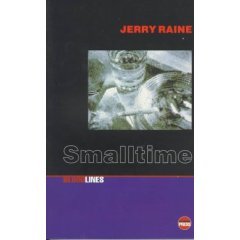
New Swedish noir just keeps coming. There's a newly translated book by Inger Frimansson that I've ordered (it's officially coming out in April in the U.S.) and I just discovered Mari Jungstedt's Unseen, which I've started (but barely). Both come highly recommended. In the meantime, I picked up a copy of Jerry Raine's '90s Smalltime and read (or re-read) it--when I picked it up I couldn't remember whether I'd read it or not, when it was new or newer, and I still can't say for sure. I have a sneaking suspicion that I started it and couldn't finish it. I'd like to hear other people's opinions about Raine, because his next couple of books (Frankie Bosser Comes Home and Slaphead Chameleon) sound like just the kind of noir that I like, but Smalltime is irritating in a lot of ways. The setting is fine--a corner of London suburbia--and the characters are effective, as layabout working class types. But the language is very flat and the plotting is slow without offering any compensation in texture or detail. It's not that the characters or plot are unbelievable, it's just that none of the aspects of the novel seem to add up to much, and the language is so plain-spoken that it has hardly any life. It's not hard-boiled "tough-guy terse" language, it's just so straightforward that you barely sense any author behind it. It is, to be fair, a first novel--and as such it accomplishes its goals in getting the characters through their paces all the way to the end. But it's hard to care about anything in the book, and the occasional comic touches seem added on, not growing integrally out of the situation, just something Raine thought of and added in. Please--any thoughts? Should I go ahead with the next two? And to be honest, I have a smiliar problem with another Do-Not Press author, John B. Spencer. Any thoughts on him?

Saturday, February 24, 2007

Leif Davidsen's Euro-Noir thriller


Or Noir Euro-thriller. Lime's Photograph is a few years old now, but it's a pan-European political novel that avoids a lot of the flaws that, in my opinion, mar the thriller genre as a whole. First, it's a first person novel, with Peter Lime (Danish emigre living in Spain, paparazzo and former leftist) occupying the center of the tale. And although geo-political concerns are aired (those of the post-Wall, EU world we still live in today), Lime isn't walking up to Prime Ministers or one-handedly preventing an international assasination. He takes a damaging photo of a Spanish official in a sexual tryst on a private beach, gets harassed by the police, approached by the Danish security service, and his personal life is wrecked. I won't give away any more of the plot, but it's about Lime in the context of the new Europe, not about kings and presidents and prime ministers. Davidsen is a silled and careful storyteller. The events unfold in a leisurely way (the paperback is 375 pages, plenty of room for the tale and its convolutions to unfold). The focus is on Lime's personality as it suffers and responds to events, as much on the plot (though plot is not stinted, there's plenty of story). I don't know of any other single novel that so carefully and effectively portrays at least 4 nations in the new world order (Spain, Denmark, Germany, and Russia). The passages of action (more necessary for a thriller than other genres within the noir landscape) are effective without overwhelming the rest of the story. The ultimate resolution explains the many threads that have gone before. And the reader's passage through the whole journey is most enjoyable.

Friday, February 23, 2007

A Corpse in the Koryo


Storytelling (and novel-writing) isn't really about revealing "what happened," it's really much more about delaying the telling. What keeps the reader turning pages is the pursuit of the plot, not the revelation of it. James Church, in his new noir crime novel of North Korea, A Corpse in the Koryo, knows that truth all too well. The book reads less like a crime novel than a spy novel, with the concealments, double-crossing, internal disputes among agencies, and final twists. The blurbs compare the novel with Philip Kerr's Berlin Trilogy (now a tetrology, actually) and the like (novels that use the police procedural to open up a closed society to the reader), but "Corpse" is more like Le Carre in many ways. Yes, it does open up a closed North Korea, validated by the pseudonymous author's professional experience there. But it's less about daily life in that country than about inter-agency strife. The protagonist, Inspector O, has plenty of noir attitude, but he's pulled this way and that by seemingly unrelated (even irrelevant) incidents and stories all the way through--like Marlowe, perhaps, is often pulled away from the main track, but in a way there is no main track visible in "Corpse," until close to the end. As I said above, Church has delayed that revelation of what's happening--not a problem, but more a spy maze than a noir one. And O is curiously open in his disdain for the power structure--though the portrait we occasionally glimpse of that country seems to be one that wouldn't tolerate that in a policeman--but that is explained in the story , in O's "protectors" within the system). And the citizens that populate the novel seem less desperately deprived than we are led by the news to believe about the citizens of that country (a member of that select group, the "axis of evil")--but again, the citizens frequently turn out to be hardly "simple citizens," again a factor making the book seem more like a spy novel. I guess it's not hard to tell that this is a book I admired more than enjoyed. I don't want to put other readers off--it's a fine story, and I'd read a sequel--but I hoped for something different, a book that Church evidently did not set out to write, rather than the one he did. A word about cover art--I've seen a number of books lately that don't utilize that aspect of a book terribly well (as evidenced by some of the ones I've reproduced here)--but A Corpse in the Koryo has a particularly good cover, for which the publishers should be commended. It has a great graphic quality and at the same time expresses a lot about the country it depicts.