Tuesday, September 26, 2006

Jo Nesbo, The Redbreast (a new Scandinavian noir crime novel)


Jo Nesbo's The Redbreast has been translated out of sequence in this compelling Norwegian crime series--last year's Devil's Star is actually a later episode than The Redbreast. Reading this one is a bit of an odd experience, since the reader will already know things that the characters will not discover for a long time (and these are long complex novels at over 500 pages each). But each novel is independent, and has its own character. The Redbreast actually shares a number of things with Henning Mankell's early Wallander novel, The White Lioness. Both feature morose leading men who are cops (though there is more humor in Nesbo's book); both have a South African connection and both involve racism, assassination, and weapons that are the tools of professional assasins. Both also deal with international intrigue, conspiracies, and evil people--all of which are more normally the territory of thrillers rather than noir fiction or police procedurals. In both cases, it is the close attention of the author to the melancholy detective that saves the books from becoming simply throwaway thriller knockoffs. And Nesbo's character, Harry Hole, is more noir, perhaps, than Mankell's Wallander. Hole is an alcoholic, lonely man (like Wallander) but Hole falls further into the pit on a regular basis--without ever becoming the cliche "lonely, drunk detective." He continues to engage our attention even when he's wallowing in self-pity, because he's a fully realized character rather than a cardboard one (not that Wallander is cardboard, just that he doesn't fall so low, and for that reason sometimes his self-pity can be a bit irritating). And the global conspiracy plot that underlies The White Lioness and most other Wallander novels is not a prominent element of The Redbreast, in spite of its neo-Nazi, evil bureaucrat, and corrupt police elements. It remains local, of the streets, rather than global in its essence, and therefore more noir (I'm overusing that word but haven't come up with a good substitute: pulp? hard-boiled?). The story goes back to the Norwegian soldiers who enlisted in the SS and fought with the Nazis on the Western front (as well as the "latter-day saints" among those who played both sides or no sides until it was clear the Nazis would lose). Norway's wartime leader, Quisling, bas become the very name of treachery, so it's very interesting to get an inside look into the gray areas of the Nazi period there. And it's not only fanaticism but also love that drives both the murderous plot and the sympathetic surface tension of the novel. I won't go into any more detail, since the twists and turns of the story in this long complex novel are a big part of the pleasure of diving into it. Give Nesbo the time and attention that his work deserves, and you'll be richly rewarded.

Thursday, September 21, 2006

volume 2 of Marseilles trilogy


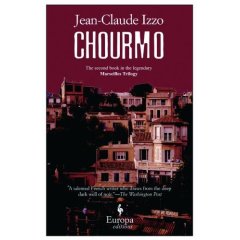
Chourmo, by Jean-Claude Izzo, is the sequel to Total Chaos (also published as One Helluva Mess), and extends Izzo's paen to Marseilles into new territory. This time, former cop Fabio Montale only has memories of his two pals, the gangsters who were the subject of the first volume. His beautiful cousin (one of the infatuations of his youth) shows up and wants him to find her missing son, who has gone to ground in the Arab quarter of Marseilles. In his efforts to find the boy, Fabio discovers a second murder and the two plots intertwine right up to the conclusion. But the chief charm of this series is the loving evocation of Marseilles in all its aspects, gangsters, terrorists, and all. It's best to start this series at the beginning, but the charms and thrills of Chourmo are open to any reader, whether they know Total Chaos or not. We should all thank the Eurocrime publishing series for bringing this (and several other valuable European crime novels and series) to English readers, especially in these attractively printed and bound volumes. The titles of Izzo's novels, by the way, are from Marseillais slang--I won't give them away, though--it's best to discover for yourself how the originate and how they relate to these stories, these characters, and this city.

Sunday, September 17, 2006

Yet another Bruen


Ok, I'm addicted. I keep saying that I'm not reading any more of Ken Bruen's books, but I just finished Calibre, the latest in the Brant series about the Ed McBain-obsessed cop in Southeast London, as well as his cohorts. This series has none of the sentimentalism of Bruen's other series set in Galway. But Calibre has the same roughness and the same references to other noir authors (and the same misspellings of writers' names, as if the books are written and edited so fast that fact-checking is simply not looked after). Calibre is certainly a quick read, carelessly but effectively plotted--things don't happen according to any cliches of the genre, and plot lines are not always followed up (also a characteristic of Elmore Leonard's books, and one of the reasons that his stories are so realistic). In spite of Brant's dedication to the 87th precinct novels, it's really more Leonard and Jim Thompson (the favorite author of the primary villain and alternative point of view in Calibre) that are the models for Bruen. Unlike Bruen's other series, the Brant books also feature several other cops (the only factor that mirrors Ed McBain's series), with new ones added from time to time. The black policewoman, Falls, has had a hard time but seems to be rising up from her low point in the previous novel. Tensions between Falls and other cops are unpredictable and often comic, and Brant's pugnacious character is also often funny--making this note only a more life-like but also more fun than others of Bruen's books. It sounds like I'm giving the author grudging respect, but as sketchy and incomplete as the Brant books are, the are true to noir, fun to read, and each different from the other. The Jim Thompson obsessed villain here is an accountant who kills people who are impolite, and the distinctiveness of his social role and his personality are compounded by the quirky resolution (or non-resolution) of his story. So this one is recommended, even if I can't recommend Bruen's Irish novels.

Monday, September 11, 2006

first of a few more scandinavians


A few more titles in the area of Scandinavian noir are about to be available in English. The first is Voices by Arnaldur Indridason (soon to come are new books by Liza Marklund and Jo Nesbo--the new Marklund sounds as if it may not be a great one, but the Nesbo is one I'm looking forward to, it's a "prequel" to the book already released in English by him--actually an earlier book released out of order). Voices is better than Indridason's 2nd book, Silence of the Grave, and almost as good as his first, released in English under 2 titles, Jar City and Tainted Blood (the book is identical, just 2 different titles). Not to say that all of them are not very good, because they are--just that the first one has stayed with me, and I admire that one particularly. Voices concerns the murder of a doorman/handyman at a hotel in Reykjavik, murdered in his basement room while dressed in a Santa Claus suit with his pants down around his ankles and a condom on his penis. And who says the Scandinavian crime novels are humorless. Actually, there's quite a bit of humor in Scandinavian noir, but like the dead Santa, it's very dry, almost earnest even it its comedy. The dead man turns out to have been a child star, and the cast of characters includes his surviving estranged family, a nasty bunch of hotel employees, the usual crowd of homicide detectives familiar from the first 2 novels, plus a female crime tech who is a possible love interest for Erlandur (Indridason's chief detective) and a couple of prostitutes. A bigger cast than Silence of the Grave, but like that novel occurrences in the distant past hang heavily over the living and the recently dead. The past and the current murder share time with Erlandur's ongoing struggle to find a relationship with his formerly estranged daughter and with the other detectives' attempt to find time for Christmas preparations that their families depend on them for. What I like about Indridason's novels is what I look for in noir--the ordinariness of life, the frequent banality of motives for murder, and the struggle of the characters to find an emotional refuge in the hostile contemporary environment (plus a view of Iceland you won't find in the guidebooks). Voices provides all of the above, and quirky humor--what more could a noir reader ask for?

Tuesday, September 05, 2006

a really bad book


OK, on the way to the train station, desperate for something to read on the journey from Washington to New York and back the same day, I picked up what looked like a pretty good French thriller. The book is Empire of the Wolves, by Jean-Christophe Grange. It's been made into a movie in France, so how bad could it be, right? Actually it can be (and is) very very bad. The author is lazy (and can't blame it on the translator). Long passages of the story are told as if in a scenario, rather than dramatized as in a story. There are fuzzy leaps in the story and much melodrama. Plus some unbelievable plot points that are essential to the ultimately pointless tale that the author wants to pass off as a novel. I had hoped for something at least sort of noir (the French invented the word, after all, and have been producing both the film and fiction versions of noir in abundance). But this thing is laughabloe

Thursday, August 10, 2006

A Cuban cop and socialist noir


Havana Black is the 4th of Leonardo Padura's novels about Detective Lieutenant Mario Conde of Havana (it's a tetralogy, but there is a 5th novel, Adios Hemingway, published in translation as by Leonardo Padura Fuentes, the author's full name--the 5th novel is different in structure and atmosphere from the other 4). The 3rd novel in the tetralogy has been published as Havana Red--no word on whether the 1st two in this "seasonal" series will make it into English. Havana Black started me wondering about the social setting of noir fiction in general. Surely, noir is a Capitalist form of art. The classic statements of noir relied on greedy capitalists and bureaucrats and on a free-market of crime and morality at street level. But there could hardly be a more "noir" atmosphere than the Communist Cuba of Padura's novels. Here the deprivation of the common people is enforced by socialist structural mandates rather than not-so-benign neglect (as would be true in democratic noir. But the darkness is even more enveloping, along with the pessimisn and despair--there's a hurricane coming and Conde keeps wishing for it to wipe things clean, an ongoing metaphor that overlaps the end of the novel, with the hurricane just arriving. Conde, this time, is investigating the murder of a former Cuban (now emigre) bureaucrat who had been in charge of distributing the property expropriated from the fleeing Cuban middle class after the revolution. The decadence of morals that was the theme of Havana Red here shifts into a decadence of politics, with the expropriators expropriating the state's newly stolen property. The consequeneces of that decadence are still reverberating in the Cuba of recent decades, in Padura's novel (originaly published in Spain in 1998). Padura's language, though, relies on a rich and allusive indirection rather than the terse, stripped-down language of classic pulp-era noir. Padura is often nostalgic and poetic in his evocation of Cuban despair. He is no less pessimistic about Miami's Little Havana, as well. His detective, his Cuba, and his noir fiction are all stuck in a politiical trap: on the one hand the decaying Cuba of the embargo and on the other hand the soul-less emigre community of fat, rich Miami. In perhaps a symbol of the situation, more than in a clue to the crime, the former Cuban, former bureaucrat's body is found not only murdered but castrated: perhaps Cuba continues to grab hold of the emigres in just that way, preventing them from moving forward creatively into a new world by their nostalgia for a Cuba that no longer exists (and will not exist even if Fidel is pushed aside, since the past is past). The complex metaphor is echoed in a complex and layered writing style. The novel does not flow easily, in the style of pulp noir, but slowly, in a layered prose that includes history (not only of Cuba's 50-year Communist experiment, but also of the Spanish colonial era, South America in the post-colonial era, and even Chinese history), current social reality (the shortages and difficulties of today's Havana), and the life story of Mario Conde in its Cuban revolutionary context of deprivation and total state control. There are echoes and insinuations of The Maltese Falcon and even adventure novels like King Solomon's Mines, as well as a reflexive joke concerning the main character's inability to conceive of himself as a literary character (and the novel itself rounds off with a reflexive flourish, the Conde tetralogy eating its own tail, so to speak). Ultimately, this novel is about Conde himself, as the representative of a "lost generation" of Cubans who stayed on, neither willing to leave nor endorsing the revolution. The reflexevity, the melancholy, and the rich style of the writing are all in the service of that portrait of a generation.

Monday, August 07, 2006

Jakob Arjouni


There have been a number of German crime novels translated recently (from Bitter Lemon Press and others), and I thought I'd go back to one of the first German noir novels to be translated, Jakob Arjouni's Happy Birthday, Turk! Arjouni's novel predates the marvelous Violetta, by Pieke Bierman (set in Berlin in the first days after the Wall came down). Philip Kerr's noir series set in Nazi Germany have been around a while, but Arjouni's Detective Kayankaya is definitely the senior noir detective of German crime fiction, at least as translated into English. And Kayankaya is definitely a noir anti-hero, of the classic variety. He's pretty good in a fight but is ultimately on the losing end of the violence around him. The clients for his private detective business are the outsiders, not the insiders, of the German miracle (in the case of this first novel they are Turkish immigrants, like Kayankaya himself (the detective is, like the author, a German citizen who speaks no Turkish). The plot wanders through the underground drug and sex trade of Frankfurt and winds its way back to the immigrant community: one of the strengths of this short novel is its unsentimental view of all segments of the German society in the '80s. It's a short book, but pared down to essentials rather than leaving anything out. The terseness suits the noir genre as well as the straight-ahead character of the first-person narrator-hero. At the end, Kayankaya is battered, has a clear moral view that is tangential to the legalities of the murder he's supposed to be investigating, and single-minded in maneuvering his enemies toward some kind of justice. Rereading Happy Birthday, Turk! was if anything more rewarding than reading it the first time, and I'm motivated to continue with the next 2 Kayankaya novels, the only ones translated, as far as I know. Arjouni has a couple of other books in translation, but one is short stories that are apparently fables of a sort and a novel of Berlin that includes crime and criminals but is really a "rootless youth" novel rather than noir.

Saturday, August 05, 2006

Breaking my own rules: new Pelecanos novel


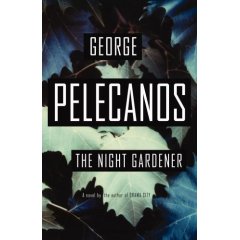
My rule is that I only review non-U.S. crime fiction here, but I'm going to break my own rule for a novel that is not only based in the U.S., it's based in my own neighborhood. George Pelecanos lives in and writes about the same neighborhood, from suburban Maryland to the city of Washington, that I live in and work in. So if I'm breaking the rule, I'm breaking it all the way, shifting from distant lands to my own back yard. The Night Gardener is Pelecanos's best novel so far. I started reading his books after he'd published 4 novels, a trilogy about a private detective and a stand alone noir thriller that recalled the great days of pulp noir (Shoe Dog). One of the pleasures of reading them was seeing familiar streets and places through the lens of noir fiction, but his books had considerable power from the beginning, as noir and as portraits of the Capitol area. Powerful though they were, Pelecanos's earlier novels (not only those first four but throughout the first half, roughly, of his output) shared a common structure: a troubled good guy becomes disillusioned with the ability of the forces of law to deal with a criminal, and he assembles a group of friends to take justice into his own hands, vigilante style. The books typically ended with a bloodbath, and along the way there was much incidental material about popular music, bars, and drunks, as well as an atmosphere of despair. The Night Gardener has a shoot-out toward the end, much like the earlier novels, but the incident only resolves one of the plot lines, and is related to revenge in the drug trade, not the act of an avenging (flawed) hero. And this is the first book in which Pelecanos seriously investigates the world of homicide police (as well as the first book, apparently, that is based on research with a police force, DC's Metropolitan Police). The book is complex and compelling, dealing with a murder that for several reasons conjures up memories of an earlier murder spree that was never solved and thus pulling together two retired cops and a working detective who were at one of the crime scenes related to that earlier murder. None of the details fo the story adhere to a stock plot, and the resolution is satisfying without being cliche (the solving of the contemporary murder is particularly nuanced). There are flaws, to my mind, in Pelecanos's writing that are also evident here: some of his family men are a bit smug about family life, as is the narrator. And there's a strain of homophobia that is ineffectively countered here by a couple of politically correct speeches by leading characters--not enough to overcome Pelecanos's portrait of a couple of gay or gay-ish characters. The only positive gay character is dead. And Pelecanos is very self-righteous about redevelopment of the city and its suburbs, editorializing about the kinds of bars he likes and dislikes, the kinds of development he disapproves of, and so forth. But you can't say he hides his opinions, and if you step into his world, his stories are compulsively readable. If you haven't read his work, this most recent one is a good place to start--it recapitulates a number of his themes but in a more effective way than he's done before. Perhaps he's taken some lessons from the excellent HBO noir-detective series The Wire, for which he's been a producer and writer.

Friday, August 04, 2006

New Sicilian crime novel


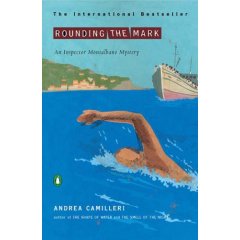
With Rounding the Mark, Andrea Camilleri steps more closely into the territory of Leonardo Sciascia. Like Sciascia, Camilleri in this novel uses actual events to bracket his story and takes an explicit stand on national politics. But Camilleri's tone is very different overall. For Sciascia, much is unspoken; he uses little dialogue, mostly describing and implying events in the narrator's voice. At the time Sciascia was writing, that stance was an explicit metaphor of Sicilian realities, in particular the famous "omerta," the vow of silence with which the mafia imposed its own principles and its own place in Sicilian reality on everyone else. Camilleri's Sicily has changed, at least somewhat. A great deal of any Camilleri novel is dialogue, and there is much discussion of current realities, even those of the mafia. The newest of the Commissario Montalbano series, Sicilian police procedurals, is out in English. The Italian title is more literally "rounding the buoy," actually. As has previously been the case, this book revolves around the sea, seafood, trafficking (of goods and people), and Montalbano's friends and cohorts. Though the crime is very dark, and the mood, health, and personal life of Montalbano are all dark, the tone is typical of the series: light, often comic, and always concerned with food. One of the contributors to Montalbano's black mood is in fact the closing of his favorite trattoria. It's in the interplay of the ensemble (here it's Augero and Fazio plus the irrepressible Catarello from the police, plus a Swedish woman who's been in a few of the previous novels) and their conversation that provide the comedy. The plot, also as usual, moves in fits and starts, less a logical investigation than an accumulation of events and facts that eventually leads to a satisfying conclusion. In this case, as in some but not all of the others, there is a police raid that has almost James Bond overtones, though with more human than superspy in terms of the characters' capabilities and motives. Camilleri's novels are short, enjoyable, and offer a window on coastal Sicily, all very good things. I'm beginning to get a little tired of the English translator, Stephen Sartarelli's use of dialect to mimic the Sicilian dialect of the Italian original: there's no real equivalent in English, and the result makes Catarella in particular sound like a hillbilly from Brooklyn. But the Italian and Sicilann phrases and the dishes in the trattoria (helpfully explained in the notes) are a delight, and the series moves ahead at full speed with Rounding the Mark.

Thursday, August 03, 2006

Italian noir, late fascist era


Carte Blanche is the first novel of a trilogy set in Northern Italy at the end of the Fascist era. Commisario De Luca, the hero of the trilogy, has recently transferred from the political police to the regular police, but politics continues to intrude on his investigation of the murder of a well-connected but shadowy Fascist, and De Luca becomes involved with a fortune-teller, the underworld, the falling government, and the pursuing partisans. There are echoes of The Conformist, but Lucarelli's sleep-deprived cop is more self aware than Moravia's Fascist agent, and the novel refers more to classic noir fiction than to Moravia. Plus De Luca is at the Northern periphery, not the Roman center, of Fascism, keeping things at street level rather than the marble halls and ballrooms (or mission to Paris) familiar from readers of Moravia's novel or viewers of the Bertolluci movie based on it--though the linkages among sex, drugs, and violence are prominent features of Lucarelli's novel as well as Moravia's. Carte Blanche is, in spite of its complicated plot, very short and moves very fast. Not having seen them, I'm guessing that the 2 sequels will round out the story, and that the trilogy is in effect a novel in three sections--but the vagaries of the publication of novels in translation don't allow us to see the whole story yet. What we do have in English now, thanks to Europa Editions, is a fascinating glimpse into one of Italy's most troubled eras, and into a character whose origins is suggested in Lucarelli's fascinating introduction. This novel is quite different from the Inspector Grazia Negro series by Lucarelli (two of which have been translated), which are serial killer thrillers set in Bologna (I've talked about them previously in this blog). A brief preview of an upcoming post: Rounding the Mark, the new Montalbano story by Andrea Camilleri, is out in English now, and a copy is waiting for me--so you'll see something about Sicilian noir soon.

Monday, July 31, 2006

Deadfolk and rural noir


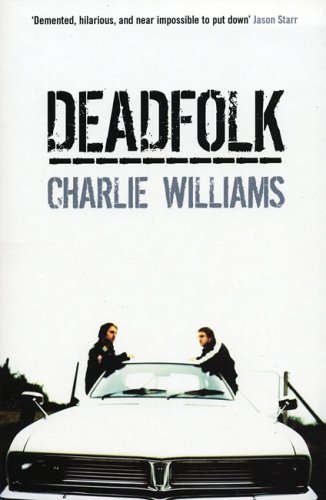
Even more than Daniel Woodrell's backwoods noir, Charlie Williams's novels set in the town of Mangel are the true descendants of Jim Thompson's rural version of noir. Deadfolk is not a new book, but is so distinctive that it warrents (like the odd Harpur and Iles series) further consideration. Williams's hero (though using that word in this case stretches it beyond all recognition) is Royston Blake, a small-time gangster and club doorman, who has lost his nerve and is letting a local gang ride all over him. The book is one of the most violent of all the current (very violent) crop of British noir, and also very funny. The distinct voice in the novel is the heavy local dialect of Blake himself, the first-person narrator. This use of dialect is itself funny, and it is used here very effectively, but it does get old after a while. A reviewer compared Deadfolk (unflatteringly) to the very different novel by Magnus Mills, All Quiet on the Orient Express, which does not use dialect and (despite a murder) is less a crime novel than a fable. But Mills's novel and Williams's are both about towns that seem to trap their occupants totally and inexorably, and both are closed fictional worlds, without any real reference to a recognizable outer world. That kind of thing can be very effective but also very brittle. Mills's book is less funny, but also less brittle. Williams's world is fascinating in the same way a car wreck is fascinating: it's difficult to turn your head away, but the rewards of looking are a bit ambiguous. Deadfolk is a distinct accomplishment but perhaps not one that will invite everyone (myself included) for another visit.

Friday, July 28, 2006

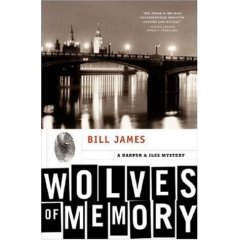
Wolves of Memory, Bill James


There's a new Harpur and Iles book, just out in the U.S. Bill James (his nom-de-plume for this series) is at least as prolific as ken Bruen, but a bit more polished--or perhaps the difference is that the Harpur and Iles books are a strict formula. The novels are static, set in a pattern established in the first 6 or 8 novels (Iles only appears in a small role in the first one, though the peculiar sexual and vicious quality of the series is evident even there--what hasn't developed yet in that first act is the oblique patter between Harpur and Iles, and the constant interrupton of the dominant speaker, whether cop or villain, in dialogue with his underlings). The structure of each novel is very interesting, though--not straightforward at all. James focuses on dialogue, rather than action, and he often joins a dialogue in the middle, and after an event that only becomes clear gradually, in flashback or in the context of the conversation in the "present" tense of the book. The "jerky" quality that this process gives the narrative is a perfect complement to the very odd quality of many of the conversations, in which set-pieces that reveal the character of the characters, particularly the barely restrained viciousness of Assistant Chief Constable Iles, are repeated within a book and from book to book. The plot of a particular novel progresses in the background of these conversations and set pieces. In this latest, James departs from his more common formula, involving local gangsters and their attempts to keep up a balance among themselves and with the police in order to keep their trade going at full steam. In Wolves of Memory, the plot involves an informant from London, a sort of accidental supergrass, whose relocation is under Iles's jurisdiction. Iles predictably takes up a predatory pose toward the supergrass's wife, and there is much philosophical parody regarding (of all people) Thomas Hobbes, among others. As is also typical of the Harpur and Iles books, Harpur is closer to what's actually happening, in spite of his almost passive approach to gathering evidence, and the story takes several surprising, even shocking turns. At the heart of the story is the question of identity, and how it relates to real or constructed identity, particularly with respect to the grass's young children, who must unlearn their identities in order to adopt new ones. The struggle of the children achieves a kind of painful, hysterical comedy that is one of the rewards of this series--though the repetitive quality of each novel and of the series can be a little mind-numbing once you've been through James's mill a few times. But Wolves of Memory reaches a satisfying, unexpected, even startling conclusion, so stay the course--the darkness and the comedy reach an apotheosis by the end.

Sunday, July 23, 2006

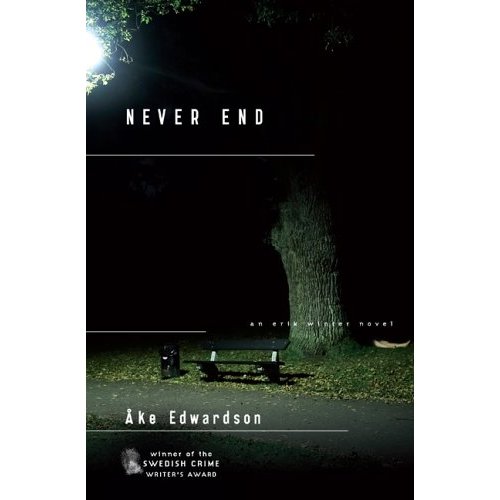
More Scandinavians


Two new Scandinavian crime novels have arrived, Never End, by Ã…ke Edwardson, and What is Mine, by Anne Holt. This post will deal with the former, and I'll get to the second one next week. I didn't much like Edwardson's first novel in English (Sun and Shadow, see the post on Scandinavian noir in my August 2005 archive). But Never End is much better--less of the "soap opera" of the detective's home life, more about the social situation (the "New Swedes," as they are politely termed in the novel--immigrants that are a new feature of contemporary life for Sweden). The novel is a straight-ahead police procedural focused on an investigation that seems to be going nowhere for most of the novel (something like what I think is the best of the Walander books, the first one). And there is an interesting reversal of the usual pattern in noir and crime fiction. Normally, the story begins with a measure of complexity, which is resolved into a clear picture of events as the detectives find out more and more. In Never End, the case keeps getting more and more complicated as the facts are (almost grudgingly) revealed. Even the somewhat abrupt conclusion leaves more murders, more crimes, more diverse involvement in events than any reader would have expected at the beginning. One other improvement over Sun and Shadow--Edwardson's telegraphic style is used to better advantage in Never End, giving a breathless quality to the story as it advances, and providing a linear drive that is lacking in the stories diverging links. One irritating tic in the book--the detectives return again and again (and again) to a grotto in the park, where current and former victims were raped and murdered, to meditate on the crime. Enough would have been enough. I almost didn't bother with Never End, due to my dislike of Sun and Shadow--but my change of mind is amply rewarded in the pleasure of this second book in English from Edwardson's "Erik Winter" series. One further comment--U.S. reviewers frequently complain of the dour, serious quality of Scandinavian crime fiction, and I believe it was the New York Times crime reviewer, Marilyn Stasio, who made that complaint about Never End in particular. But while the novel is no laugh fest, there is relief in terms of the personalities of the characters, and the somber quality of the story is an interesting aspect of the newly developing Scandinavian noir--in the case of Never End, the darkness is maintained even in the long days of the Swedish summer.

Sunday, July 16, 2006

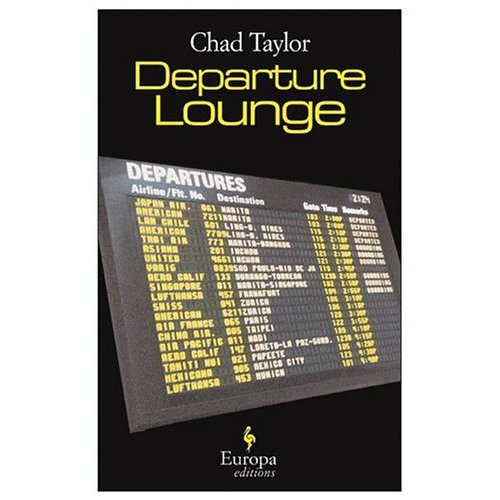
Literary noir from New Zealand


Departure Lounge, by Chad Taylor, is in the noir mode, and it's very well written--but ultimately its aims are more literary than noir. It can even stand up to a literary analysis, as an allegory of (as is often the case with literary fiction) the writing of literary fiction. A writer is a kind of thief, stalking people, invading their homes, and rummaging around in their stuff. That's exactly what Mark Chamberlain, Taylor's first-person narrator, does. But on one of his forays into other people's lives, he runs across a memory from his own, by stepping into the apartment of the recently deceased father of one of his schoolmates, Caroline, a girl who simply disappeared one day. The rest of the novel could be read (again if you are into literary analysis) as a series of tropes that show the ways of telling a story: the noir surface narrative, the family narrative, the urban legend, the rumors (such as, in this case, brought false news of the girl's whereabouts to the police and to her schoolmates), as well as photography and film as modes of narrative (standing in for the visual arts as a whole, represented by a gallery exhibition in which the photos and film are shown). The novel is not a pastiche of these ways of telling a story, though--Taylor's narrator stays in character as a noir hero, shifting ground only in flashbacks to the disappearance of Caroline and to related events in his youth. All the other forms of narrative are referred to, as alternate tales or alternate endings to the one being presented. And, in literary fashion, the multiple threads of the tale are never wound together, and the reader is left to his/her own thoughts about the story and what might have been "true," how either Caroline's or Mark's story might end. I've complained about literary noir before, in particular about the usual failure of the writer to get to the meat of noir fiction by condescending to the form. Taylor doesn't quite do that, although he violates some of the expectations of the genre (for a resolution, for example--though of course The Maltese Falcon doesn't exactly resolve itself). And the writing is beautiful but simple, appropriate to the kind of noir and the kind of the literature that the author is striving for. It would even make a good movie, but it would be more like Blowup than The Big Sleep, more like Blowup than Blowout, even. And to refer back to a comparison I've made recently, the novel is more like Faulkner's Sanctuary than Chase's No Orchids for Miss Blandish, though Taylor is both clearer in his style and more respectful to the form of noir than Faulkner. It is typical of Taylor's intentions that his title refers not to anything concrete in the novel but to a metaphor that is used by the narrator to describe an "in between" state of being neither here nor there, a philosophical description of the characters' state and of human life, when looked at through a philosophical lens. Taylor has at least 3 other novels published, though only one, Shirker, is available widely in the U.S. (or elsewhere, as far as I can tell, outside New Zealand). Shirker sounds like a more extravagant departure from noir, including travel to other dimensions of reality--I've sent for it so I'll let you know, though I'm usually not too enthusiastic about that sort of genre-mixing.

Saturday, July 15, 2006

A Greek crime novel


Nightmare in Athens, by Petros Markaris, is the first crime novel I've run across that's set in modern Greece. Markaris's main character is Costas Haritas, a detective in the Athens police, and the novel sticks to his first-person narration. At first, the novel has something in common with Donna Leon's books--Haritas has a nincompoop boss, whose attractive secretary helps out Haritas, and the detective's home life is a big part of the book. But unlike Leon's detective, Haritas and his wife tolerate one another at best, and their only child is away in medical school. And though the story starts out toward a Leon-like dissection of the injustices of a judicial system that is tilted toward the wealthy and influential, Markaris's tale veers into his own territory with a plot that becomes increasingly complicated as each likely suspect is set aside in favor of another, and as the original crime is set aside in favor of subsequent murders. the tale expands in this fashion until it ultimately comes back around to the story's beginning, and if the complicated passages (and some of the names that are a bit too much alike to an American ear) bog the reader down, there is a payoff in staying with it for the resolution of all the threads (if not a judicial resolution). Like some other books I've reviewed recently, this one is not a "least likely suspect" story (and yet it is). There's no thread of clues, opposed by red herrings, that will lead a reader to discover the truth before the detective does, and yet many of you may figure out who the final "reveal" will reveal as the murderer. But it's the slow investigation, the complexities of Greek history and social life, and the personalities of detectives, victims, and suspects that carry the novel forward, and what begins as a more straightforward mystery ends in the territory of noir, with dark overtones coming from all directions (albeit a few melodramatic overtones as well).

Wednesday, July 12, 2006

Framed, by Tonino Benacquista


Framed, the third novel in translation from French crime-writer and film writer Tonino Benacquista, fulfills the promise of his first novel, Holy Smoke, much more than the second novel, Someone Else. But Framed is very different from Holy Smoke (and from the Highsmith-y Someone Else). If you want the further adventures of the comic hero of Holy Smoke, in translation, you'll have to read the subtitles of a film from a couple of years ago, Love Bites. Framed is not a series novel, but it is indeed noir fiction, in the tradition of, perhaps, David Goodis. Antoine (the trick of naming his hero "almost" after himself is not intrusive here or in Holy Smoke) keeps his day job, as an art handler in a contemporary art gallery, and his night passion, for billiards, completely separate--his friends in one world know nothing of the other world. Unlike the choice that classic noir would surely have made, most of the novel focuses on the day world (dark though it indeed is) rather than the billiard hall. The choice is telling: Benacquista lets us know that he knows where his tale would traditionally be told, and indeed comes back to that world for his denoument; but he shifts the focus into a new realm for noir, fully and realistically rendered (if quite cynically portrayed). Framed is a short and fast novel, a fun read, and highly recommended.

Sunday, July 09, 2006

Alicia Gimenez-Bartlett


There is a genre of crime novels that includes (as one of its characteristics) a close focus on police rather than on the traditions fo the mystery, police procedurals that take seriously the cop's point of view, in form as well as in the profession of the protagonist. Dog Day, by Alicia Giménez-Bartlett, is one of those crime novels. There is a mystery, just as for any police investigation, but there is no series of clues, no unveiling of the "least likely suspect." There is no reason for a reader to pick out the murder or murderes in this story from the rest of the characters. The crime is clarified through successive discoveries of evidence and witnesses, gradually, as if a lens were gradually being focused on the crime. The discoveries are not prefigured or hinted at before the police themselves reach the point of disclosure. There is an element of dramatic irony (a trope characterized by the audience knowing more than the characters), in that surely a reader (an American reader anyway) who will guess a crucial fact of the investigation long before the police do (I won't tell you what that fact is, but it has to do with dogs, like much of the plot of Dog Day). But for the most part, Gimenez-Bartlett stays narrowly focused on her detective, Inspector Petra Delicado, the first-person narrator. We follow everything through her eyes: the facts of the attack that begins the case and the subsequently discovered dog-thefts; the people met (and relationships begun) in the course of the story; the irritations of her relationship with her sergeant/partner; and the meanings that the case takes on for Petra and the other characters (insofar as she understands them). The writing is much more direct than in the most famous Spanish detective series, the novels of Manuel Vazquez Montalban, whose books are to me less satisfying as "noir fiction" or crime novels than those of Giménez-Bartlett (Vazquez Montalban is too digressive, too indirect for me--his concern frequently seems to be mostly with a pair of problems--what's for dinner and what are the political implications of a crime). Although the Montalbano novels of Sicilian writer Andrea Camilleri are (like the name of his policeman) based upon Camilleri's fondness for Vazquez Montalban's novels, Camilleri's books are (like those of Giménez-Bartlett, based on the only example to be translated thus far) more direct and more enjoyable, though both he and she share the older novelist's penchant for specifying what's for dinner (and lunch) and both, like Vazquez Montalban, are careful to include the social environment as both setting and ultimate cause of events. Giménez-Bartlett in particular evokes Spanish fatalism in the face of the horrors as well as the pleasures of life--and her detective's cheerful fatalism maintains the true noir spirit even in the most light-hearted or comic episodes of her novel. I will put Giménez-Bartlett on the lenghtening list of novelists in other languages for whose translations I will await impatiently (and thanks to Europa editions for bringing her books and those of other crime novelists into English).

Thursday, July 06, 2006

Pessimism in Noir--a question

I think of noir fiction as being characterized by pessimism as much as anything else: there's no assumption of the "goodness" of man or of the possibility of achieving any kind of purity in life. Noir is about the impure streets, and one of the differences between noir and conventional mystery fiction is that the middle-class characters of the conventional mystery drive through the streets without stopping. The "cozy," characterized by drawing rooms, libraries, and the other trappings of Agatha Christie and the Clue board game, is the model for that sub-genre of crime that I'm lumping together as "mystery fiction." Some books, of course, cross back and forth across that line. Simenon, for example, peoples his novels with middle and lower middle class characters, yet there is a pervasive atmosphere of the streets (and of pessimism) in his Maigret novels (though these often hinge on that staple of the cozy mystery, the assembly of all the characters in a climactic unveiling of the Truth), and the non-Maigret novels are often claustrophobic family dramas of the lower-middle class (the home is in these novels a merciless trap rather than a refuge). I'm reminded of my taste for pessimism in noir by one more factor that irritates me in The Priest of Evil, which I've just commented on in the previous post. The villain in Joensuu's novel controls his victims by means of telepathy and hypnotism, unexplained by any other "daylight" version of what he's doing. He is even able to murder one victim through hypnotism, though I've heard that you can't actually make a hypnotized person do something that he or she would not be able to make him/herself do awake. The "spiritualist" aspect of The Priest of Evil harks back to the dawn of the mystery novel, in Poe, Wilkie Collins, etc., and that is not in itself a bad thing. Bringing that sense of menace to contemporary stories is an accomplishment to be envied. However, to speak more specifically about noir fiction, I don't think spiritualism has an appropriate place in this genre; fatalism, yes, even karma. But telepathy? Let me know what you think.

Monday, July 03, 2006

Matti-Yrjana Joensuu


Matti-Yrjänä Joensuu is that rare commodity, a working policeman writing police procedurals. The police portions of his novels are as correct and convincing as you would imagine they would be. But there are some problems with his recently translated The Priest of Evil. First a small thing that I find annoying whenever this sort of thing happens in a novel. The author (or translator, but in the circumstances I lay the error at the feet of the writer and his editor) portrays two detectives staring at sections of CCTV surveillance videotape with a magnifying glass, investigating the images of a murder suspect frame by frame. It's a technical thing, perhaps, but if you think about it for even a second, you should realize that there are no images on videotape that can be seen with a magnifying glass, not frame by frame or any other way. He's thinking film, but of course no one uses film in closed circuit cameras in public places (in this case the Helsinki Underground). That mistake doesn't make me throw the book across the room--not quite. The other problem with this novel is bigger. Joensuu spreads the story and the narrator's point of view across several characters in addition to his detective, Harjunpää (his detective in nine novels, only one of which has previously been translated, some years ago, as The Stone Murders--see my earlier post). The splintered narrative is hard to follow at first, and then hard to stay interested in. The effort is ultimately rewarded as the narrative begins to pick up speed, but there are lots of repetitions in both the killer's religious iconography and the detectives' rehash of the clues. Repetition is one of the tricks of the fiction trade (you have to remind the reader of what's gone before because the novel is too long to expect the reader to remember everything), but too much repetition of details can clog up the narrative--as it does for a long time here. The murderer/priest is one of the narrators, and his delusions are intricate but not particularly credible as a paranoid fantasy. The other characters, two children and the father of one of them, are caught up in Joensuu's extended portrait of unhappy families and awful parents (Joensuu, judging from this novel and The Stone Murders, is very interested in families and children, and the socioeconomic framework that supports them). There is also an evident attempt at reflexivity: one of the children is named Matti, and his father is a novelist with a triple name--both factors that point to Joensuu having placed himself metaphorically in the narrative on the side of the civilian-victims rather than his detective or villain. That reflexivity, and his interest in families, suggest that unhappy families, divorce, and family violence and retribution are important to Joensuu. But he doesn't make them all that interesting, and his story is a bit earnest for my taste (none of the wild, dry Finnish humor of the Raid TV series--see my earlier post--or the movies of the Kaurasmaki brothers. And one more complaint: the print in this English version fo the novel is too small, a factor that isn't always irritating, but when I'm already irritated with a book, it makes reading the text all that more a trial instead of a treat. But all my complaints and reservations apply for the most part to the considerable effort of getting involved in The Priest of Evil. If you stick with it, somewhere around halfway through the book the narrative picks up speed, begins to make more sense, and sucks you into the inevitable progress of the characters toward one another and toward a climax. The improvement in the book is proportional to the amount of space given to the detectives rather than the killer, who never really comes alive in spite of his malevolent potential. The conclusion contains several surprises and develops from the author's concern for families rather than a straightforward plot--though because of that shift away from the conventional detective novel, the ending is not what you expect. Altogether, I'm glad I persisted through the novel, but it could have been as good as its best passages, but it unfortunately isn't. And of the Euro-Crime series published by Arcadia Books that I've already read (including the quite excellent Dominique Manotti novels from France) this one is the least satisfying as a whole.

Sunday, July 02, 2006

Self's Punishment


I promised a Finnish novel next (The Priest of Evil), but first...Bernhard Schlink, best known in the U.S. because Oprah Winfrey chose his book The Reader for her book club, wrote Self's Punishment, a detective novel, with Walter Popp in the late '80s, roughly the era in which the novel is set. Though Oprah's endorsement usually signals the middle-brow, The Reader was not so well received by some of her fans--who found it intellectual rather than oriented toward a story. Evidently Schlink has written other crime novels, but none have yet been translated into English. Based on Self, I'd like to see the others. Self's Punishment is as close to classic noir, in the strain from Marlowe to Chinatown, as it is possible to be in a contemporary (more or less--the novel is from before the fall of the Wall and seems a little quaint because so much has happened since then) German context. Self's name is Selb in German, and the name really needn't have been translated--the existential or psychological import of the translated name is not necessary, or even helpful, to the novel. And as is too common, the title is changed from something like "Selb's Justice" to Self's Punishment--which is also not really helpful. Self is a retired Nazi prosecutor who became a private investigator after the war. The novel is not, however, about the progress of a detective in the difficult years after the war or the years of the German miracle. It's about the past returning to bite him in the course of a routine investigation late in his career. The one false note (and I'll have to be careful not to reveal too much in this comment) is that he would have been chosen by his former school friend, Korten, to investigate a security breach in the Chemical firm Korten now heads. It might also be considered a flaw that Self is very good in hand-to-hand combat, considering his age--except that he's succesful more in anticipating his opponent than any fancy technique or physical power--and the fistfights keep the noir character of the novel at the forefront rather than the author's literary ambitions (noir being a physical medium more than a primarily intellectual one). Self, like Germany (a point made explicitly in the novel) has elided his guilt as a participant in the Nazi horror by immersing himself in the daily life of the post-War. The connection with the ambience of Marlowe and Chinatown develops slowly, in the very "daily," even quotidian investigation and life of the elderly detective. What develops is not so much sympathy for Self as immersion in the dailiness of his life on the part of the reader. So that when his investigation results in a death (perhaps more than one) and finally leads to its conclusion, it involves the reader in the network of guilt, politics, and history that Self is mired in. Self's Punishment is a quiet book rather than a sensational one, and the power of its central premise is more powerfully told than in the more typical melodrama of thrillers that try to evoke politics and history. Forget the Oprah connection--this is a book that is effective as noir, as narrative, and as a novel.