

International Noir Fiction includes reviews and ideas on crime novels (mostly from outside the U.S.)
Thursday, July 16, 2015
3 by


Monday, June 29, 2015
Innocence

Friday, June 19, 2015
An Irish book and a Swedish movie

But all of the above is finally subsumed in the same pattern as has appeared in all the Taylor books. The evocative writing serves to set up Taylor's rise from the gutter and his ultimate descent thereto. A regular reader will know immediately upon the entry of a new companion (canine) what the animal's fate is likely to be. I've read most, but not all, of the Taylor books, but I find myself reading them rather rapidly (they're short books, but also easy to cruise through at high reading speed), and growing impatient with the persistent pattern. If this is indeed not the last of the Taylor series, it may still be the last for me.

Johan Theorin's Echoes from the Dead is an impressive crime story set on the Swedish island of Öland that gives a reader a lot in the way of interesting and rounded characters, plus echoes of a larger frame of reference that is mythic or nonrational (without ever abandoning realism). The movie recently made from it maintains the emphasis on character but doesn't manage to convey the fairy tale or mythic quality of the book (maybe that sort of thing is difficult in a film format, unless you go all the way into horror of fairy tale territory). The story develops slowly in both formats, following a double story of a post-World-War II crime and its consequences in subsequent decades. There's a final twist that would seem to upend the life of the cenral character, a woman who lost her child decades earlier and must now return to Öland to help her father (whom she has always blamed for her child wandering away) close up his house after he has moved into a retirement home. But a code gives some consolation, so that the story doesn't end without a note of grace.
All in all, Echoes from the Dead makes a good movie, though a little less distinctive and involving than the book on which it's based.
Monday, May 25, 2015
Donna Leon and Commissario Brunetti

Tuesday, April 21, 2015
New review, new magazine on-line
 My review of Helene Tursten's The Beige Man is now live a the new crime
fiction magazine and website, The Life Sentence: have a look at the new site! The url is www.thelifesentence.net (and beyond reviews, the magazine features interrogations and feature articles across the spectrum of noir, mystery, cozy, spies, thrillers, etc. The editor is Lisa Levy, until recently the noir editor at the Los Angeles Review of Books.
My review of Helene Tursten's The Beige Man is now live a the new crime
fiction magazine and website, The Life Sentence: have a look at the new site! The url is www.thelifesentence.net (and beyond reviews, the magazine features interrogations and feature articles across the spectrum of noir, mystery, cozy, spies, thrillers, etc. The editor is Lisa Levy, until recently the noir editor at the Los Angeles Review of Books.
Wednesday, April 01, 2015
Jake Needham, The Dead American
 The third book in Jake Needham's Samuel Tay series finds the detective on administrative leave, following the suspicious (from the police force's point of view) shooting at the end of the previous book, The Umbrella Man. The always independent and skeptical Tay is approached by Emma Lazar, a writer for the Wall Street Journal, who wants him to help her investigate the apparent suicide of a young American software engineer who had been hired by a Singapore company developing a driverless car.
Tay is reluctant to help but becomes involved (he after all has nothing else to do right now) and becomes, as usual, involved in the complicated politics and bureaucracy of the hyper-nanny city-state. The danger to Tay and Lazar, and everyone else involved, plus the interest shown by Singapore's security establishment, make it clear that there's something going on besides cars without drivers, but the detective and the small team that he enlists to help him cannot penetrate the company's security to find out what's going on.
Needham keeps up the tension by keeping the focus on Tay, not a particularly charming man but a curious one who isn't easily intimidated (except for the ghost of his mother, in whom he doesn't believe but who nevertheless haunts him with advice about his life and the case occasionally). The ghost's presence is not as pervading as the ghosts in the Doctor Siri series by Colin Cotterill, Needham's style is realistic. And the grounding in the real provides a very powerful conclusion to the reasons for the company's secrecy and the murder(s), leading to the dark heart of a conspiracy that is linked to recent headlines and is all-too-believable.
Monday, March 23, 2015
Timothy Williams, new and reissued

Soho Crime, which published The Honest Folk last year, has recently been reissuing Williams previous series, featuring Italian Commissario Piero Trotti. Trotti, a spiky character with fewer social skills than Judge Anne Marie Laveaud of The Honest Folk and the previous Antother Sun, suits Williams's style perfectly: He talks over people, goes his own way, and has difficulty with everyone in his professional and personal life. In his case, Trotti's investigations lead through some of the most difficult years of Italian history, from the "years of lead" onward into the 1990s, each of the five reissued novels tying local crimes to larger social patterns of violence, corruption, and chaos.

The Laveaud books (originally written in French rather than English) show the range of Williams's writing: it's not the same kind of corruption or crime in Guadeloup, and the stakes are different. Laveaud, despite her family troubles, is a more open and social person, caught in the grinding gears of racial and political conficts, corruption of a more distinctively Caribbean sort, and a position in the legal system somewhat more viable professional position than Trotti, whose career is at a seeming dead end. The Guadeloupe books, because of Laveaud's personality and the tropical setting, are quite different fromt he Trotti books, while maintaining the author's quite distinctive approach to crime writing. Both series are highly recommended!
Wednesday, February 18, 2015
Noir in new places: Nesbø and Temple

Some of the purest noir being written today doesn't come from the U.S., or France, or the U.K. Two recent novels by Jo Nesbø (of Norway) and Peter Temple (of Australia) show what can be done with the genre today.
Nesbø's Blood on Snow, a stand along novel, is perhaps the purest noir of the two, and much more pure noir than the author's series featuring Harry Hole. The hero, Olav, is a hit man mostly by default--it's the only thing he's good at, having tried all sorts of other criminal enterprises without much success. He's also something of a stalker, staking out the wife of one of his victims and holding off on killing another who is his current assignment, while he watches her. He has a sentimental streak that keeps him human, along with his love of reading (despite his dyslexia). Once he goes off the rails, defying his boss (a drug dealer) and trying to enlist the help of a rival gang, we descend along with him into a noir spiral as he attempts to escape his situation and save someone else along the way. The end is a contrast between a hopeful vision and a cruel truth.
Temple's Jack Irish books have always had strong elements of noir, in the lapsed lawyer at the center of the stories, who lost his wife to an angry client before the series started. And some of the broader elements of noir are also here: Jack works odd jobs (sometimes very odd) for a racetrack manipulator and former jockey (and his elegant but violent helper) and other shady characters. But Jack also has an avocation rather different from the average noir hero: he's learning high-end furniture craft from an artist of the medium, an emigre from Europe who is his gruff mentor and teacher in the trade. And Jack has an occasional love interest, a reporter, who is an on-again, off-again solace. Jack, unlike Nesbø's hero, is a smart-ass, like so many central characters in classic noir, and like them he is the frequent victim of more powerful and more violent enemies that he collects in his pursuit of clarity or justice.
 In White Dog, he's hired to collect evidence yhsy might clear an artist who is accused of killing her former lover. In the process, Jack walks into a nest of powerbrokers involved in another of the classic noir tropes, property development. The ruthlessness of these developers leads to deaths, beatings, and an encounter with the nasty dog of the book's title. But the other elements of the story, including the revival of a lapsed racehorse and some elegant sounding furniture, give some respite to Jack and the reader (more so than Olav, who only has the solace of fanstasies of love and escape).
Blood on Snow is evidently set for film adaptation, involving Leonardo di Caprio. Somehow that doesn't seem too promising (let me know if you're more hopeful about the film). The Jack Irish series is the basis for a set of Australian films starring Guy Pearce that are in fact a pretty good version of the stories, with convincing performances by Pearce and the rest of the cast. As far as I know, White Dog hasn't yet been filmed.
Friday, January 30, 2015
The Mad and the Bad, Jean-Patrick Manchette

The book is as fast and entertaining as Manchette's other stories, while also being frequently funny, in a very dark way. If I'd read it without the author's name being disclosed, I'd have guessed it to be by another French writer, the very darkly funny crime novelist Pascal Garnier. Manchette and Garnier, both deceased, are a matched set of very skillful and entertaining writers along a spectrum from comic to bleak, and share the same approach to writing crime fiction, stripped down style, direct storytelling, and not taking up more space than necessary. The influence of Simenon, perhaps?
In any case, The Mad and the Bad, after the young girl/mental patient is installed as the orphan/nephew's governess, Manchette lets the daily routine of her new life play out for a short time before suddently shifting into a kidnapping plot (which isn't what it seems), an escape, several deaths, and a race across France with the hit-man in hot pursuit. There's no one writing them like this, any more (or if you know of another writer in this vein, please let me know!).
Thursday, January 29, 2015
Ewart and Evert

I coincidentally read two Swedish crime novels by very different authors (Leif GW Persson and the writing team of Roslund and Hellström), yet there is some interesting overlap. Both feature an overweight senior cop who is not taking care of himself (and they have similar names, Ewart and Evert). Both include a lot of repetitive language, and both develop slowly over a fairly large number of pages. But the experience of the two novels is very different.
Anders Roslund and Borge Hellström often write about prisons, and their newest in translation (Two Soldiers) is no exception. The theme of the book is the birth and rapid development of a new gang, when the young men in a previous gang are spending time in prison. The first, long section of the novel is a claustrophobic vision of the inside of a prison: the encroaching walls are only part of the sensation of being closed in--the closed mind-set of the gang leader (Leon Jensen, who was actually born in prison) is more claustrobic in its violence and misogyny than the cells. In fact, I nearly gave up on the book as this section dragged on. But the normal "hero" of the Roslund and Hellström books, Ewart Grens, finally shows up, with his own narrow mindset and personal difficulties, and the contrast (and contest) between the gang and the cops at least opens up the story in a bearable way. Grens is a wreck, destroyed by the death of his wife and the loss (see the previous novels) of the music that he has been obsessively listening to (to the misery of his partners and collaborators).
Grens shifts his obsession to the danger of the developing gang (when they organize a joint prison break) and recognizes his own role in the life of Jensen (Grens had arressted his father and harassed his mother). The dual obsessions of the book are Grens's drive to stop the gang before it achieves the national reputation Jensen is seeking, and Jensen's drive to destroy whoever gets in his way. The other characters (police and criminals, as well as bystanders) offer a more rounded human portrait to balance these two monomaniacs. Along the way, there is a developing plot that involves Jensen's mother and a fireman and will once again implicate Grens in something beyond his knowledge and power.

Persson is a police expert who often appears on Swedish TV (and he gives a sly reference to that part of his career in the newly translated He Who Kills the Dragon). The "hero" is Evert Backström (and the new Backstrom TV series in the U.S. is partly based on this character and this novel). Backström has been told by a doctor that he has to clean up his life, in terms of healthy habits, and the detective takes it seriously for a bit before reverting to his gluttonous, drunken, corrupt, xenophobic, and misogynist usual self. The repetitiveness in this book is in the language that Backström uses to refer to almost anyone other than himself, uncomplimentary in all cases and in a very narrow range of vocabulary. There is a more rounded humanity here, too, in the other characters (though there is one female cop whose apparent sexual interest in Backström is totally incomprehensible).
Backström doesn't really have any talent as a cop. His self-interest and his luck frequently, though, propel him to achievements that he doesn't deserve. In this case, he is leading the investigation into the death of an old drunk who turns out to be not exactly what he seems, and the case becomes linked to some gang activity in various ways. Persson's writing is always lively and frequently comic, not only in Backström's personality but also in references to crime novels (Gunvald Larsson, of the great Sjöwall and Wahlöö series of the '70s, appears here as a historical reference). But a reader's appreciation of Persson's books that narrow in on Backström in particular will depend on how much tolerance he or she has to the nastiness of the character himself. At one point, in another fictional reference, he compares himself to Andy Sipowicz of NYPD Blue TV fame (though he actually more closely resembles Norman Buntz, an earlier character played by the same actor, Dennis Franz), but the TV character(s) are never quote as mind-numbingly negative as Backström can be to spend time with. Part of the fun, I guess, is knowing that you don't really have to spend time with Backström in real life (if you do have to live with someone like him, the novel may hit too close to home, or on the other hand might be hysterically funny, I'm not sure which).
Persson does plot the story in a tricky and intricate way, so the development of events is interesting in itself, as well as Backström's ability to turn things to his advantage and escape the consequences of his real behavior. I have to say that I enjoyed He Who Kills the Dragon (and perhaps that title is also a sly reference to another book series) more than Two Soldiers, though the latter achieves a tragic stature by the end, leaving a reader with a more emotional and sociological aftertaste, both at the same time. About the Backstrom TV series, I don't have much to offer: the first episode didn't impress me much, it seemed like ordinary TV fare, with the character neither as repulsive nor as interesting as his literary model.
Saturday, January 03, 2015
Two by Parker Bilal

I was struck in reading this pair of novels by how much Bilal (who also writes as Jamal Mahjoub) has created a modern, Egyptian equivalent of classic noir. Dogstar begins with kidnapping and murder of young boys, and suspicion cast on the Christian community; Burning Gates deals with theft of artworks and archaeological antiquities in which an Iraqi military man is implicated. Makana continues to be close to the archetype of the noir hero as described by Raymond Chandler in his famous essay on The Simple Art of Murder: the honorable loner in the mean streets of, in this case, Cairo. Makana lost his wife and daughter in their flight from Suday, and he continues to be haunted by that loss (a major factor in the plots of both the recent novels). He also remains, despite adversity, true to humanistic principles. The mystical overtones of the plot in Dogstar and the focus on corruption in the second add depth to both stories.

Makana's room in a floating house, his landlord's family (especially the young daughter), and various running characters enrich the stories, but the voice is Makana's (though the stories are told in the third person). The vividness of the writing, the pessimistic portrayal of social and political conditions, and the dour Makana are the key attractions, in addition to some humor and a glimpse (from an outsider's point of view) at the distinctive quality of life in Cairo. These are not short books, but the story flows aloong in a compelling way: I highly recommend the whole series.
Monday, December 01, 2014
The Final Silence, by Stuart Neville
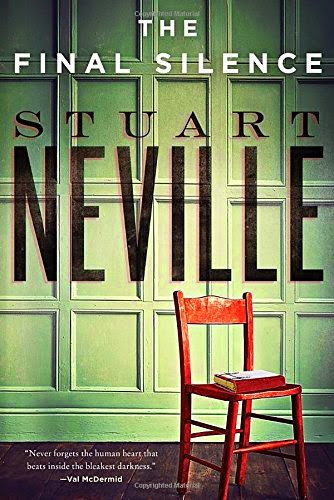
Though before that, Drew's niece discovers and opens her uncle's journal, a true Pandora's box of evil deeds done in the past and evil consequences to come in the present. The whole Belfast series is haunted (almost literally) by the Troubles (each book in a different way). Here, the calm and prosperous surface of things fails to contain the eruption of violence that has its source in the politics of the past as well as the kind of violence that will always be with us.
The violence engulfs everyone touched by the diary, including the niece, her parents, and the still-surviving main characters of the series, the policeman Jack Lennon, his daughter Ellen, Ellen's mother's family (still striving to take her away from her father), Lennon's long-suffering girlfriend Susn, as well as a senior cop new to the series, DCI Serena Flanagan (whose strength as a detective is being sorely tried both by her contact with this case and by events in her private life).
Lennon has always had a problem as a policeman, since he's a Catholic on an overwhelmingly Protestant force (and being a cop makes him anathema to the civilian Catholics as well). His actions in a previous book have made him even more hated, especially by one specific cop who is now in a position to hurt him, and his involvement in the violence after the discovery of the diary cast him even more into the wilderness. What keeps the whole proceedings from being depressing is Neville's skill in both moving the plot forward relentlessly and making the reader care about what happens (partly due to Lennon's redeeming virtues: his love for his daughter and his willingness to put himself on the line against a threat to his own little family or someone else being harmed or threatened by dark forces old and new). The supernatural element of the series has gradually lessened, and is present here only in a suggestion of Ellen's second sight (not a major factor in the plot).
Neville's Belfast novels are some of the most powerful stories coming out of Ireland and Northern Ireland today, and that's quite an accomplishment given the high quality of so much crime fiction originating on the island now.
Sunday, November 02, 2014
A Spanish Saga--LARB
Looks like another review of mine is now live on Los Angeles Review of Books, on The Siege, by Arturo Pérez-Reverte:
http://lareviewofbooks.org/review/spanish-saga
http://lareviewofbooks.org/review/spanish-saga
Saturday, November 01, 2014
South African noir review
My review of two new books from Cape Town's Deon Meyer and Margie Orford is now live at Los Angeles Review of Books:
http://lareviewofbooks.org/review/devils-merry-go-round-cape-town-noir
http://lareviewofbooks.org/review/devils-merry-go-round-cape-town-noir
Tuesday, October 14, 2014
Peter Anderson, The Unspeakable

In The Unspeakable,
set in the dusty northern provinces of South Africa in the last decades of
Apartheid, Peter Anderson invokes a number of literary precedents, but one in
particular, James Hadley Chase, whose novels are glimpsed in a roadside diner’s
book rack, kept coming back to mind as I read the main narrative thread of the novel.
There is a pulp-noir sexuality driving the story, as well as a cast of
characters (the professor, his pretty young girlfriend, a cameraman who is her former
lover, and a black sound technician and driver) whose interactions lead toward
a violent blowup.
The story is told in the voice of Rian, the cameraman, hired
to record the professor’s documentary film on the origins of the human race,
but the novel’s roadtrip through the South African wilderness also provokes
Rian’s memories of childhood on an Afrikaner farm, and these reminiscences are
vivid and evocative. Particularly in the longest of these flashbacks, dealing
with events leading up to the father’s suicide in front of his young son,
Anderson not only suggests some South African classics such as J.M. Coetzee but
also America’s Southern Gothic fiction, with its folkore and racism.
In the
best segments of Rian’s adult story, the casual racism of the white people
(Rian included) in contrast to the hardscrabble lives of tribal peoples
encountered along the way suggests another South African precedent, the
detective stories of James McClure, particularly in the direct portrait of lives
violently twisted in mental and behavioral ways by Apartheid.
But most of the
narrator’s main story depends on a series of adolescent fantasies and absurd actions
on the part of all the white principals, involving jealousies and overt sexual
proposals that are necessary for the plot to move to its tumultuous conclusion,
but are in themselves a bit hard to accept. Here again, a South African
precedent comes to mind, in Tom Sharpe’s lampoons of an Apartheid-era police
force, but Peterson’s characters are not drawn as broadly or with as much
comedy, and the contrast to the other parts of the story is jarring. At one
point, the professor (mostly portrayed as a buffoon) suggests the group abandon
the archaeological documentary to film instead an interracial porn film
featuring the girlfriend and the driver, which would be a dangerous act for the
driver in that era. And several acts of violence seem arbitrary and
unmotivated.
At one point the author, through his narrator, suggests that the
novel’s title refers to the possibility of addressing the unsayable by means of
stories, but there is also an unspeakable act at the end, a chilling indictment
of institutional racism (again reminding me of McClure’s evocation of
Apartheid), flowing directly from both the naturalistic and absurd elements of
the story, and its impact requires a reader to accept both at face value.
Tuesday, October 07, 2014
Fuminori Nakamura, Last Winter We Parted

A writer approaches the condemned man for an interview, intending to publish a book on the murderer and his crimes, but the killer deflects the writers advances in odd ways, as does the murderer's sister. And the writer discovers a subculture of lifelike dolls, created by a master artist who at first refuses and then agrees to model these dolls on living women (rather than lost wives or lovers).
The doubling (of the two victims, of the dolls and their living counterparts, and some other doubles that I can't mention without spoiling the plot) is essential to the story's exploration of identity and desire, and also essential to the sudden reversals of the story itself. The book is an old-fashioned house of mirrors, told in terse, mostly short chapters from various limited points of view that only reveal prismatic views of what's going on. Nakamura's book requires (but also rewards) close attention: it is in a way a Postmodern revival of some of the tropes of classic noir and hard-boiled fiction, with a specifically Japanese sensibility.
Thursday, October 02, 2014
Tana French, The Secret Place

The story revolves around a private girls' school in Dublin. There are two "tracks," a current investigation that takes place all in one day and a back story, looking at the girls through the lens of two cliques, rivalries of a sort. What we don't get much of is the "school" part of their experience: most of what the girls are shown doing is worrying about their friends, contemplating the opposite sex, and dodging responsibility for their minor crimes, as well as the big one: the murder that occurs at the end of the backstory, a year before the current investigation.
What sparks the investigation is the reunion of two characters from a previous French novel (she tends to daisy chain her novels, shifting the focus in a new book to minor characters from a previous book). Holly Mackey is one of the girls in the school. She has discovered a note posted on a "secrets" board at the school (a physical board rather than a website), with text stating that the person posting the note knows who killed a boy a year ago on the school grounds. She brings it to a cold-case detective she had encountered in that earlier book, Stephen Moran (who is the narrator of the current-day portion of the book). Moran would love to shift over to the murder squad, and he takes the note to Antoinette Conway, the officer in charge of the original investigation, hoping to get in on a reopened murder case.

Moran gets his wish (Conway's a pariah in the department, currently without a partner), and though the rest of his part of the story is a long day of chasing down leads within the walls of the school, in both sections of the story we get a very great deal of teen angst, conversation, and attitude. The teen interactions (with each other and with the detectives) mostly ring true, and are sometimes painfully funny (painful comedy having been an element in the previous book in which Holly and Stephen featured, Faithful Place, whose main character was Holly's father Frank). But the sheer amount of teen-dom is a bit daunting (possibly only to an outsider like myself). And, as I mentioned before, the adults can begin to sound childish themselves, wrapped in their own envies and jealousies.
Finally, the payoff at the end (not so much the discovery of the killer and the motive as the resolution of the metaphorical elements of the story) is good enough to make the book rewarding, even if you, like me, don't relish spending quite so much time in YA-land. French has staked out a particular territory, and continues to mine it succesfully--and this time the metaphorical level of the story is particularly effective in a melancholy manner.
Friday, September 19, 2014
Police, by Jo Nesbø

His absence gives the other detectives (both his friends and his enemies) a chance to come forward into the spotlight (hence the more conventional structure) and the result is a quite enjoyable novel, with a lot of twists and turns (Nesbø likes to take the reader down a path, only to reveal that things are not what he has seemingly prepared you for).
The story follows the progress of a serial killer of policemen, seemingly punishing the individuals and the force for their failure to complete a series of earlier investigations. While some readers may guess who is performing this crime wave (there are some hints, but many, many false leads connected to very violent people who don't happen to be involved in this particular series of murders). And there are some ongoing characters who will meet their ends along the way.
There's a lot here that will depend on a familiarity with the books that have gone before, so this isn't the place to start with Harry. Harry himself, though, when he appears, is quite a bit more human and likable than he has seemed in the low points of his drunken self-destructiveness or the high points of his amazing abilities. He reaches a point from which he might fade into the sunset or become a detective of a more normal sort (perhaps the former would be more appropriate for such a larger than life character). There is, however, a bit of unfinished business at the end that seems to lead to another chapter...
Opinions about Harry or the current state of his career?
Sunday, August 31, 2014
crime victim's reading room

Friday, August 29, 2014
Review of Carlo Lucarelli's new novel
I had one request for an English version of my review in Italian (below) which is pretty good for a blog response. So here goes:
 Between 1994 and 2000, Carlo Lucarelli, the master of italian crime fiction, published 4 novels featuring Inspector Grazia Negro, a detective in Bologna. Only two of them have been translated, Almost Blue and Day After Day. All the stories deal with a brutal serial killer. Lucarelli has just published a new novel with Inspector Negro, in 2013. After these thirteen years between the last and the newest novels, Grazia and her lover Simone (who has been in all but one of the books)are trying to have a baby, and she is hot pahhy at all to be investigating a serial killer: but Bologna has one, nonetheless.
The tracks of the killer carry the inspector and her colleague in the Carabinieri to a popular song by Andrea Buffa, The Dream of Flying (also the title of the novel). The song is comic, at the beginning. A loose translation of the first verse is:
Since I was young I've dreamt of flying like a bird,
but now when I press against the air my weight isn't a good thing,
I fly like a brick, like a stone, like a wrench
It seems obvious that flying without wings is a problem.
But Buffa is really talking about two important social issues: the story of the song deals with the death, on a construction site, of a foreign worker. And Lucarelli's serial killer wants to kill all the people who are involved in the death of a construction worker, also a foreigner. It seems as if there's not just one killer, as the murderer sends messages to the police, until a psychologist consulting on the case suggests that in fact it is one person with a multiple personality.
I've heard that most psychologists today don't believe in the diagnosis of multiple personalities, but Lucarelli has created from the idea an interesting novel from his diverse materials: the policewoman, the song, and the social environment of the city. Can we hope for a translation, perhaps of this book and the first one in the series, some day?
The tracks of the killer carry the inspector and her colleague in the Carabinieri to a popular song by Andrea Buffa, The Dream of Flying (also the title of the novel). The song is comic, at the beginning. A loose translation of the first verse is:
Since I was young I've dreamt of flying like a bird,
but now when I press against the air my weight isn't a good thing,
I fly like a brick, like a stone, like a wrench
It seems obvious that flying without wings is a problem.
But Buffa is really talking about two important social issues: the story of the song deals with the death, on a construction site, of a foreign worker. And Lucarelli's serial killer wants to kill all the people who are involved in the death of a construction worker, also a foreigner. It seems as if there's not just one killer, as the murderer sends messages to the police, until a psychologist consulting on the case suggests that in fact it is one person with a multiple personality.
I've heard that most psychologists today don't believe in the diagnosis of multiple personalities, but Lucarelli has created from the idea an interesting novel from his diverse materials: the policewoman, the song, and the social environment of the city. Can we hope for a translation, perhaps of this book and the first one in the series, some day?
Subscribe to:
Posts (Atom)