Friday, June 19, 2015

An Irish book and a Swedish movie

Ken Bruen's Green Hell seems at first to be a series finale, but by the end it leaves open the possibility of future entries focused on his melancholy former Garda Jack Taylor. There's a lot of metafiction in it: an American student becomes fascinated with Jack and abandons his research on Becket to write a biography of the Galway private detective, and a good part of the first half of Green Hell is his research on the project. Bruen himself makes an appearance as a customer/drinker in a bar, and Iain Glen, who plays Taylor in the TV series based on these books, also makes a cameo appearance. There is a crime plot, but it mostly takes place offstage. There are some interesting characters, including Ridge, the female cop who's a running character who has survived (many haven't) and a new Goth who seems a bit modeled on the dragon-tattoo-girl (that seems to be the source of the U.S. cover art fro the book). And as usual there are a lot of references to and quotes from crime fiction and crime TV series.

But all of the above is finally subsumed in the same pattern as has appeared in all the Taylor books. The evocative writing serves to set up Taylor's rise from the gutter and his ultimate descent thereto. A regular reader will know immediately upon the entry of a new companion (canine) what the animal's fate is likely to be. I've read most, but not all, of the Taylor books, but I find myself reading them rather rapidly (they're short books, but also easy to cruise through at high reading speed), and growing impatient with the persistent pattern. If this is indeed not the last of the Taylor series, it may still be the last for me.

Johan Theorin's Echoes from the Dead is an impressive crime story set on the Swedish island of Öland that gives a reader a lot in the way of interesting and rounded characters, plus echoes of a larger frame of reference that is mythic or nonrational (without ever abandoning realism). The movie recently made from it maintains the emphasis on character but doesn't manage to convey the fairy tale or mythic quality of the book (maybe that sort of thing is difficult in a film format, unless you go all the way into horror of fairy tale territory). The story develops slowly in both formats, following a double story of a post-World-War II crime and its consequences in subsequent decades. There's a final twist that would seem to upend the life of the cenral character, a woman who lost her child decades earlier and must now return to Öland to help her father (whom she has always blamed for her child wandering away) close up his house after he has moved into a retirement home. But a code gives some consolation, so that the story doesn't end without a note of grace.

All in all, Echoes from the Dead makes a good movie, though a little less distinctive and involving than the book on which it's based.

Monday, May 25, 2015

Donna Leon and Commissario Brunetti

My survey of the Brunetti series by Donna Leon (on the occasion of her new one, Falling in Love) is now live at The Life Sentence.

Tuesday, April 21, 2015

New review, new magazine on-line

My review of Helene Tursten's The Beige Man is now live a the new crime fiction magazine and website, The Life Sentence: have a look at the new site! The url is www.thelifesentence.net (and beyond reviews, the magazine features interrogations and feature articles across the spectrum of noir, mystery, cozy, spies, thrillers, etc. The editor is Lisa Levy, until recently the noir editor at the Los Angeles Review of Books.

Wednesday, April 01, 2015

Jake Needham, The Dead American

The third book in Jake Needham's Samuel Tay series finds the detective on administrative leave, following the suspicious (from the police force's point of view) shooting at the end of the previous book, The Umbrella Man. The always independent and skeptical Tay is approached by Emma Lazar, a writer for the Wall Street Journal, who wants him to help her investigate the apparent suicide of a young American software engineer who had been hired by a Singapore company developing a driverless car.

Tay is reluctant to help but becomes involved (he after all has nothing else to do right now) and becomes, as usual, involved in the complicated politics and bureaucracy of the hyper-nanny city-state. The danger to Tay and Lazar, and everyone else involved, plus the interest shown by Singapore's security establishment, make it clear that there's something going on besides cars without drivers, but the detective and the small team that he enlists to help him cannot penetrate the company's security to find out what's going on.

Needham keeps up the tension by keeping the focus on Tay, not a particularly charming man but a curious one who isn't easily intimidated (except for the ghost of his mother, in whom he doesn't believe but who nevertheless haunts him with advice about his life and the case occasionally). The ghost's presence is not as pervading as the ghosts in the Doctor Siri series by Colin Cotterill, Needham's style is realistic. And the grounding in the real provides a very powerful conclusion to the reasons for the company's secrecy and the murder(s), leading to the dark heart of a conspiracy that is linked to recent headlines and is all-too-believable.

Monday, March 23, 2015

Timothy Williams, new and reissued


Most dialogue in crime fiction moves forward smoothly, the speakers responding to one another and perhaps gradually revealing the truth of the events in the story. In the novels of Timothy Williams, though, the dialogue follows the patterns of life: the speakers are not really listening to each other and definitely not responding coherently to one another. The reader discovers, in the disconnected conversations, the truths that the speakers are hiding from each other, and even from themselves. His recent novel, The Honest Folk of Guadeloupe, follows this indirect method to its logical conclusion: has a crime taken place, and if so what crime? This is not a whodunit, it's a glimpse into the complex life of the citizens of a post-colonial, conflicted culture.

Soho Crime, which published The Honest Folk last year, has recently been reissuing Williams previous series, featuring Italian Commissario Piero Trotti. Trotti, a spiky character with fewer social skills than Judge Anne Marie Laveaud of The Honest Folk and the previous Antother Sun, suits Williams's style perfectly: He talks over people, goes his own way, and has difficulty with everyone in his professional and personal life. In his case, Trotti's investigations lead through some of the most difficult years of Italian history, from the "years of lead" onward into the 1990s, each of the five reissued novels tying local crimes to larger social patterns of violence, corruption, and chaos.

The five Trotti novels appeared originally along with some of the major crime novels set in Italy by English-speaking writers, including Magdalen Nabb, Donna Leon, and Michael Dibdin. Williams is less well known that some of the others, but his work is of the same rank and more specifically links the crime stories to specific facts and events (all of the writers deal with corruption, for example, but only Williams points to specific and specifically Italian corruption. His indirect style is particularly suited to the frequently indirect patterns of life and crime in Italy, without falling back on the more picturesque or charming qualities of life there for solace: his novels are darker, more grimly funny, and in some senses truer. Big Italy involves Trotti in a web of child abuse, conspiracy, and murder, just at the point when he's trying to retire.

The Laveaud books (originally written in French rather than English) show the range of Williams's writing: it's not the same kind of corruption or crime in Guadeloup, and the stakes are different. Laveaud, despite her family troubles, is a more open and social person, caught in the grinding gears of racial and political conficts, corruption of a more distinctively Caribbean sort, and a position in the legal system somewhat more viable professional position than Trotti, whose career is at a seeming dead end. The Guadeloupe books, because of Laveaud's personality and the tropical setting, are quite different fromt he Trotti books, while maintaining the author's quite distinctive approach to crime writing. Both series are highly recommended!

Wednesday, February 18, 2015

Noir in new places: Nesbø and Temple


Some of the purest noir being written today doesn't come from the U.S., or France, or the U.K. Two recent novels by Jo Nesbø (of Norway) and Peter Temple (of Australia) show what can be done with the genre today.

Nesbø's Blood on Snow, a stand along novel, is perhaps the purest noir of the two, and much more pure noir than the author's series featuring Harry Hole. The hero, Olav, is a hit man mostly by default--it's the only thing he's good at, having tried all sorts of other criminal enterprises without much success. He's also something of a stalker, staking out the wife of one of his victims and holding off on killing another who is his current assignment, while he watches her. He has a sentimental streak that keeps him human, along with his love of reading (despite his dyslexia). Once he goes off the rails, defying his boss (a drug dealer) and trying to enlist the help of a rival gang, we descend along with him into a noir spiral as he attempts to escape his situation and save someone else along the way. The end is a contrast between a hopeful vision and a cruel truth.

Temple's Jack Irish books have always had strong elements of noir, in the lapsed lawyer at the center of the stories, who lost his wife to an angry client before the series started. And some of the broader elements of noir are also here: Jack works odd jobs (sometimes very odd) for a racetrack manipulator and former jockey (and his elegant but violent helper) and other shady characters. But Jack also has an avocation rather different from the average noir hero: he's learning high-end furniture craft from an artist of the medium, an emigre from Europe who is his gruff mentor and teacher in the trade. And Jack has an occasional love interest, a reporter, who is an on-again, off-again solace. Jack, unlike Nesbø's hero, is a smart-ass, like so many central characters in classic noir, and like them he is the frequent victim of more powerful and more violent enemies that he collects in his pursuit of clarity or justice.

In White Dog, he's hired to collect evidence yhsy might clear an artist who is accused of killing her former lover. In the process, Jack walks into a nest of powerbrokers involved in another of the classic noir tropes, property development. The ruthlessness of these developers leads to deaths, beatings, and an encounter with the nasty dog of the book's title. But the other elements of the story, including the revival of a lapsed racehorse and some elegant sounding furniture, give some respite to Jack and the reader (more so than Olav, who only has the solace of fanstasies of love and escape).

Blood on Snow is evidently set for film adaptation, involving Leonardo di Caprio. Somehow that doesn't seem too promising (let me know if you're more hopeful about the film). The Jack Irish series is the basis for a set of Australian films starring Guy Pearce that are in fact a pretty good version of the stories, with convincing performances by Pearce and the rest of the cast. As far as I know, White Dog hasn't yet been filmed.

Friday, January 30, 2015

The Mad and the Bad, Jean-Patrick Manchette

The Mad and the Bad is a noir fable, quite different from the previously translated Jean-Patrick Manchette books (which are mostly tight, terse tales of professional killers and the like). The Mad and the Bad has a young woman/orphan rescued from an asylum to become a governess, a monster living in a castle in the mountains, an evil stepfather (he has adopted the son of his wealthy brother after the brother and his wife are killed in an accident)--but also a hit man (who is himself dying) and his vicious (but not totally dependable) cohorts.

The book is as fast and entertaining as Manchette's other stories, while also being frequently funny, in a very dark way. If I'd read it without the author's name being disclosed, I'd have guessed it to be by another French writer, the very darkly funny crime novelist Pascal Garnier. Manchette and Garnier, both deceased, are a matched set of very skillful and entertaining writers along a spectrum from comic to bleak, and share the same approach to writing crime fiction, stripped down style, direct storytelling, and not taking up more space than necessary. The influence of Simenon, perhaps?

In any case, The Mad and the Bad, after the young girl/mental patient is installed as the orphan/nephew's governess, Manchette lets the daily routine of her new life play out for a short time before suddently shifting into a kidnapping plot (which isn't what it seems), an escape, several deaths, and a race across France with the hit-man in hot pursuit. There's no one writing them like this, any more (or if you know of another writer in this vein, please let me know!).

Thursday, January 29, 2015

Ewart and Evert


I coincidentally read two Swedish crime novels by very different authors (Leif GW Persson and the writing team of Roslund and Hellström), yet there is some interesting overlap. Both feature an overweight senior cop who is not taking care of himself (and they have similar names, Ewart and Evert). Both include a lot of repetitive language, and both develop slowly over a fairly large number of pages. But the experience of the two novels is very different.

Anders Roslund and Borge Hellström often write about prisons, and their newest in translation (Two Soldiers) is no exception. The theme of the book is the birth and rapid development of a new gang, when the young men in a previous gang are spending time in prison. The first, long section of the novel is a claustrophobic vision of the inside of a prison: the encroaching walls are only part of the sensation of being closed in--the closed mind-set of the gang leader (Leon Jensen, who was actually born in prison) is more claustrobic in its violence and misogyny than the cells. In fact, I nearly gave up on the book as this section dragged on. But the normal "hero" of the Roslund and Hellström books, Ewart Grens, finally shows up, with his own narrow mindset and personal difficulties, and the contrast (and contest) between the gang and the cops at least opens up the story in a bearable way. Grens is a wreck, destroyed by the death of his wife and the loss (see the previous novels) of the music that he has been obsessively listening to (to the misery of his partners and collaborators).

Grens shifts his obsession to the danger of the developing gang (when they organize a joint prison break) and recognizes his own role in the life of Jensen (Grens had arressted his father and harassed his mother). The dual obsessions of the book are Grens's drive to stop the gang before it achieves the national reputation Jensen is seeking, and Jensen's drive to destroy whoever gets in his way. The other characters (police and criminals, as well as bystanders) offer a more rounded human portrait to balance these two monomaniacs. Along the way, there is a developing plot that involves Jensen's mother and a fireman and will once again implicate Grens in something beyond his knowledge and power.

Persson is a police expert who often appears on Swedish TV (and he gives a sly reference to that part of his career in the newly translated He Who Kills the Dragon). The "hero" is Evert Backström (and the new Backstrom TV series in the U.S. is partly based on this character and this novel). Backström has been told by a doctor that he has to clean up his life, in terms of healthy habits, and the detective takes it seriously for a bit before reverting to his gluttonous, drunken, corrupt, xenophobic, and misogynist usual self. The repetitiveness in this book is in the language that Backström uses to refer to almost anyone other than himself, uncomplimentary in all cases and in a very narrow range of vocabulary. There is a more rounded humanity here, too, in the other characters (though there is one female cop whose apparent sexual interest in Backström is totally incomprehensible).

Backström doesn't really have any talent as a cop. His self-interest and his luck frequently, though, propel him to achievements that he doesn't deserve. In this case, he is leading the investigation into the death of an old drunk who turns out to be not exactly what he seems, and the case becomes linked to some gang activity in various ways. Persson's writing is always lively and frequently comic, not only in Backström's personality but also in references to crime novels (Gunvald Larsson, of the great Sjöwall and Wahlöö series of the '70s, appears here as a historical reference). But a reader's appreciation of Persson's books that narrow in on Backström in particular will depend on how much tolerance he or she has to the nastiness of the character himself. At one point, in another fictional reference, he compares himself to Andy Sipowicz of NYPD Blue TV fame (though he actually more closely resembles Norman Buntz, an earlier character played by the same actor, Dennis Franz), but the TV character(s) are never quote as mind-numbingly negative as Backström can be to spend time with.  Part of the fun, I guess, is knowing that you don't really have to spend time with Backström in real life (if you do have to live with someone like him, the novel may hit too close to home, or on the other hand might be hysterically funny, I'm not sure which).

Persson does plot the story in a tricky and intricate way, so the development of events is interesting in itself, as well as Backström's ability to turn things to his advantage and escape the consequences of his real behavior. I have to say that I enjoyed He Who Kills the Dragon (and perhaps that title is also a sly reference to another book series) more than Two Soldiers, though the latter achieves a tragic stature by the end, leaving a reader with a more emotional and sociological aftertaste, both at the same time. About the Backstrom TV series, I don't have much to offer: the first episode didn't impress me much, it seemed like ordinary TV fare, with the character neither as repulsive nor as interesting as his literary model.

Saturday, January 03, 2015

Two by Parker Bilal

I've gotten a little behind on both reading and writing lately, and have 2 books by Parker Bilal to report on, Dogstar and The Burning Gates, the 3rd and 4th in the series featuring Sudanese refugee Makana, a former policeman who now ekes out a living as a private detective in Cairo. The series begins years before the Tahrir Square rebellion and its collapse into the current regime, and Dogstar ends with Makana hearing news that the World Trade Center in New York has been attacked. Burning Gates begins with a scene from the subsequent American invasion of Iraq.

I was struck in reading this pair of novels by how much Bilal (who also writes as Jamal Mahjoub) has created a modern, Egyptian equivalent of classic noir. Dogstar begins with kidnapping and murder of young boys, and suspicion cast on the Christian community; Burning Gates deals with theft of artworks and archaeological antiquities in which an Iraqi military man is implicated. Makana continues to be close to the archetype of the noir hero as described by Raymond Chandler in his famous essay on The Simple Art of Murder: the honorable loner in the mean streets of, in this case, Cairo. Makana lost his wife and daughter in their flight from Suday, and he continues to be haunted by that loss (a major factor in the plots of both the recent novels). He also remains, despite adversity, true to humanistic principles. The mystical overtones of the plot in Dogstar and the focus on corruption in the second add depth to  both stories.

Makana's room in a floating house, his landlord's family (especially the young daughter), and various running characters enrich the stories, but the voice is Makana's (though the stories are told in the third person). The vividness of the writing, the pessimistic portrayal of social and political conditions, and the dour Makana are the key attractions, in addition to some humor and a glimpse (from an outsider's point of view) at the distinctive quality of life in Cairo. These are not short books, but the story flows aloong in a compelling way: I highly recommend the whole series.

Monday, December 01, 2014

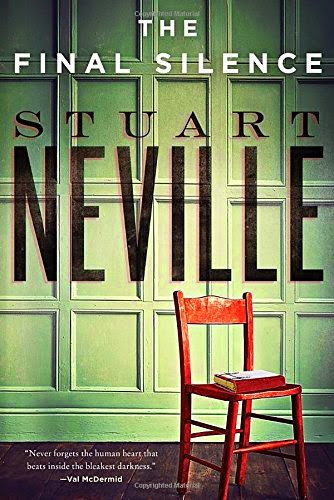
The Final Silence, by Stuart Neville

Given the very dark nature of the stories in Stuart Neville's Belfast novels (of which The Fatal Silence is the 4th), that title suggests a very bleak story indeed. And there's plenty of darkness in the tale that unfolds from the slow death of Raymond Drew (of natural causes) at the beginning. But there is a kind of open-ended, skeptical moment of optimism that provides a breath of hope.

Though before that, Drew's niece discovers and opens her uncle's journal, a true Pandora's box of evil deeds done in the past and evil consequences to come in the present. The whole Belfast series is haunted (almost literally) by the Troubles (each book in a different way). Here, the calm and prosperous surface of things fails to contain the eruption of violence that has its source in the politics of the past as well as the kind of violence that will always be with us.

The violence engulfs everyone touched by the diary, including the niece, her parents, and the still-surviving main characters of the series, the policeman Jack Lennon, his daughter Ellen, Ellen's mother's family (still striving to take her away from her father), Lennon's long-suffering girlfriend Susn, as well as a senior cop new to the series, DCI Serena Flanagan (whose strength as a detective is being sorely tried both by her contact with this case and by events in her private life).

Lennon has always had a problem as a policeman, since he's a Catholic on an overwhelmingly Protestant force (and being a cop makes him anathema to the civilian Catholics as well). His actions in a previous book have made him even more hated, especially by one specific cop who is now in a position to hurt him, and his involvement in the violence after the discovery of the diary cast him even more into the wilderness. What keeps the whole proceedings from being depressing is Neville's skill in both moving the plot forward relentlessly and  making the reader care about what happens (partly due to Lennon's redeeming virtues: his love for his daughter and his willingness to put himself on the line against a threat to his own little family or someone else being harmed  or threatened by dark forces old and new). The supernatural element of the series has gradually lessened, and is present here only in a suggestion of Ellen's second sight (not a major factor in the plot).

Neville's Belfast novels are some of the most powerful stories coming out of Ireland and Northern Ireland today, and that's quite an accomplishment given the high quality of so much crime fiction originating on the island now.

Sunday, November 02, 2014

A Spanish Saga--LARB

Looks like another review of mine is now live on Los Angeles Review of Books, on The Siege, by Arturo Pérez-Reverte:
http://lareviewofbooks.org/review/spanish-saga

Saturday, November 01, 2014

South African noir review

My review of two new books from Cape Town's Deon Meyer and Margie Orford is now live at Los Angeles Review of Books:
http://lareviewofbooks.org/review/devils-merry-go-round-cape-town-noir

Tuesday, October 14, 2014

Peter Anderson, The Unspeakable


In The Unspeakable, set in the dusty northern provinces of South Africa in the last decades of Apartheid, Peter Anderson invokes a number of literary precedents, but one in particular, James Hadley Chase, whose novels are glimpsed in a roadside diner’s book rack, kept coming back to mind as I read the main narrative thread of the novel. There is a pulp-noir sexuality driving the story, as well as a cast of characters (the professor, his pretty young girlfriend, a cameraman who is her former lover, and a black sound technician and driver) whose interactions lead toward a violent blowup. 

The story is told in the voice of Rian, the cameraman, hired to record the professor’s documentary film on the origins of the human race, but the novel’s roadtrip through the South African wilderness also provokes Rian’s memories of childhood on an Afrikaner farm, and these reminiscences are vivid and evocative. Particularly in the longest of these flashbacks, dealing with events leading up to the father’s suicide in front of his young son, Anderson not only suggests some South African classics such as J.M. Coetzee but also America’s Southern Gothic fiction, with its folkore and racism. 

In the best segments of Rian’s adult story, the casual racism of the white people (Rian included) in contrast to the hardscrabble lives of tribal peoples encountered along the way suggests another South African precedent, the detective stories of James McClure, particularly in the direct portrait of lives violently twisted in mental and behavioral ways by Apartheid. 

But most of the narrator’s main story depends on a series of adolescent fantasies and absurd actions on the part of all the white principals, involving jealousies and overt sexual proposals that are necessary for the plot to move to its tumultuous conclusion, but are in themselves a bit hard to accept. Here again, a South African precedent comes to mind, in Tom Sharpe’s lampoons of an Apartheid-era police force, but Peterson’s characters are not drawn as broadly or with as much comedy, and the contrast to the other parts of the story is jarring. At one point, the professor (mostly portrayed as a buffoon) suggests the group abandon the archaeological documentary to film instead an interracial porn film featuring the girlfriend and the driver, which would be a dangerous act for the driver in that era. And several acts of violence seem arbitrary and unmotivated. 

At one point the author, through his narrator, suggests that the novel’s title refers to the possibility of addressing the unsayable by means of stories, but there is also an unspeakable act at the end, a chilling indictment of institutional racism (again reminding me of McClure’s evocation of Apartheid), flowing directly from both the naturalistic and absurd elements of the story, and its impact requires a reader to accept both at face value.

Tuesday, October 07, 2014

Fuminori Nakamura, Last Winter We Parted

Each of Fuminori Nakamura's novels published in English so far is quite different from the others. The newest, Last Winter We Parted (from Soho Press, translated by Allison Markin Powell), is a twisty noir thriller, with murder, false identity, sexual perversion, and revenge. The story alternates among several narrators, focusing on a photographer who is awaiting execution for the murder (by fire) of two young women. The first fire was thought to be an accident and he was burned in a possible attempt to save the first of the victims, the second, almost identical fire was most damning evidence against him (and there is some evidence that, instead of rushing to aid the women, he photographed their deaths).

A writer approaches the condemned man for an interview, intending to publish a book on the murderer and his crimes, but the killer deflects the writers advances in odd ways, as does the murderer's sister. And the writer discovers a subculture of lifelike dolls, created by a master artist who at first refuses and then agrees to model these dolls on living women (rather than lost wives or lovers).

The doubling (of the two victims, of the dolls and their living counterparts, and some other doubles that I can't mention without spoiling the plot) is essential to the story's exploration of identity and desire, and also essential to the sudden reversals of the story itself. The book is an old-fashioned house of mirrors, told in terse, mostly short chapters from various limited points of view that only reveal prismatic views of what's going on. Nakamura's book requires (but also rewards) close attention: it is in a way a Postmodern revival of some of the tropes of classic noir and hard-boiled fiction, with a specifically Japanese sensibility.

Thursday, October 02, 2014

Tana French, The Secret Place

It's been obvious since her first book that Tana French's true milieu, as a writer, is adolescence: all her books include a substantial element of childhood or youth, and sometimes even the adults talk and act like teenagers. But in The Secret Place, adolescence per se is her subject, specifically the tiny worlds of tight adolescent friendships. There is an odd supernatural/telekinetic element to the story (though it's not a Irish ghost story), which is resolved near the end in a way that illuminates French's view of these relationships in particular.

The story revolves around a private girls' school in Dublin. There are two "tracks," a current investigation that takes place all in one day and a back story, looking at the girls through the lens of two cliques, rivalries of a sort. What we don't get much of is the "school" part of their experience: most of what the girls are shown doing is worrying about their friends, contemplating the opposite sex, and dodging responsibility for their minor crimes, as well as the big one: the murder that occurs at the end of the backstory, a year before the current investigation.

What sparks the investigation is the reunion of two characters from a previous French novel (she tends to daisy chain her novels, shifting the focus in a new book to minor characters from a previous book). Holly Mackey is one of the girls in the school. She has discovered a note posted on a "secrets" board at the school (a physical board rather than a website), with text stating that the person posting the note knows who killed a boy a year ago on the school grounds. She brings it to a cold-case detective she had encountered in that earlier book, Stephen Moran (who is the narrator of the current-day portion of the book). Moran would love to shift over to the murder squad, and he takes the note to Antoinette Conway, the officer in charge of the original investigation, hoping to get in on a reopened murder case.

Moran gets his wish (Conway's a pariah in the department, currently without a partner), and though the rest of his part of the story is a long day of chasing down leads within the walls of the school, in both sections of the story we get a very great deal of teen angst, conversation, and attitude. The teen interactions (with each other and with the detectives) mostly ring true, and are sometimes painfully funny (painful comedy having been an element in the previous book in which Holly and Stephen featured, Faithful Place, whose main character was Holly's father Frank). But the sheer amount of teen-dom is a bit daunting (possibly only to an outsider like myself). And, as I mentioned before, the adults can begin to sound childish themselves, wrapped in their own envies and jealousies.

Finally, the payoff at the end (not so much the discovery of the killer and the motive as the resolution of the metaphorical elements of the story) is good enough to make the book rewarding, even if you, like me, don't relish spending quite so much time in YA-land. French has staked out a particular territory, and continues to mine it succesfully--and this time the metaphorical level of the story is particularly effective in a melancholy manner.

Friday, September 19, 2014

Police, by Jo Nesbø

Some of Jo Nesbø's Harry Hole novels stretch credulity a bit when Harry gets into impossible situations and works his way out of them somehow. That doesn't stop the stories from being great entertainment, though. Police, the latest and perhaps last (a great many readers may have assumed the previous novel was the last, given how it ended) is a more straightforward police procedural, with Harry offstage (spoiler alert) for a good portion of the time.

His absence gives the other detectives (both his friends and his enemies) a chance to come forward into the spotlight (hence the more conventional structure) and the result is a quite enjoyable novel, with a lot of twists and turns (Nesbø likes to take the reader down a path, only to reveal that things are not what he has seemingly prepared you for).

The story follows the progress of a serial killer of policemen, seemingly punishing the individuals and the force for their failure to complete a series of earlier investigations. While some readers may guess who is performing this crime wave (there are some hints, but many, many false leads connected to very violent people who don't happen to be involved in this particular series of murders). And there are some ongoing characters who will meet their ends along the way.

There's a lot here that will depend on a familiarity with the books that have gone before, so this isn't the place to start with Harry. Harry himself, though, when he appears, is quite a bit more human and likable than he has seemed in the low points of his drunken self-destructiveness or the high points of his amazing abilities. He reaches a point from which he might fade into the sunset or become a detective of a more normal sort (perhaps the former would be more appropriate for such a larger than life character). There is, however, a bit of unfinished business at the end that seems to lead to another chapter...

Opinions about Harry or the current state of his career?

Sunday, August 31, 2014

crime victim's reading room

Last Monday night someone came up on the deck of my beach house, poured gasoline on the decking by the back door, and set it on fire. The house is pretty much a total loss, between flames, smoke, and water. That house is where I kept most of my books of international crime fiction, about 450 copies, and though none of them burned, all are thoroughly smoked and wet. Though the books are certainly not our biggest problem at the moment, I thought I should post a brief elegy for them here, in a place where people might understand this particular piece of the loss. The  photo is from the "reading room" on the top floor, not originally so open to the view. The library is just behind you, if you are standing where the picture was taken from. The detectives from the state fire marshal's office are looking for the arsonist, but no report so far.

Friday, August 29, 2014

Review of Carlo Lucarelli's new novel

I had one request for an English version of my review in Italian (below) which is pretty good for a blog response. So here goes:

Between 1994 and 2000, Carlo Lucarelli, the master of italian crime fiction, published 4 novels featuring Inspector Grazia Negro, a detective in Bologna. Only two of them have been translated, Almost Blue and Day After Day. All the stories deal with a brutal serial killer. Lucarelli has just published a new novel with Inspector Negro, in 2013. After these thirteen years between the last and the newest novels, Grazia and her lover Simone (who has been in all but one of the books)are trying to have a baby, and she is hot pahhy at all to be investigating a serial killer: but Bologna has one, nonetheless.

The tracks of the killer carry the inspector and her colleague in the Carabinieri to a popular song by Andrea Buffa, The Dream of Flying (also the title of the novel). The song is comic, at the beginning. A loose translation of the first verse is:
Since I was young I've dreamt of flying like a bird,
but now when I press against the air my weight isn't a good thing,
I fly like a brick, like a stone, like a wrench
It seems obvious that flying without wings is a problem.

But Buffa is really talking about two important social issues: the story of the song deals with the death, on a construction site, of a foreign worker. And Lucarelli's serial killer wants to kill all the people who are involved in the death of a construction worker, also a foreigner. It seems as if there's not just one killer, as the murderer sends messages to the police, until a psychologist consulting on the case suggests that in fact it is one person with a multiple personality.

I've heard that most psychologists today don't believe in the diagnosis of multiple personalities, but Lucarelli has created from the idea an interesting novel from his diverse materials: the policewoman, the song, and the social environment of the city. Can we hope for a translation, perhaps of this book and the first one in the series, some day?

Carlo Lucarelli: Il sogno di volare


I'm taking advantage of a homework assignment in my Italian class to post a short review in Italian of Carlo Lucarelli's new Grazia Negro novel (corrected by my teacher--thanks Federica!). If anyone's interested I can add an English version.

Fra il 1994 e il 2000 Carlo Lucarelli, il maestro dei gialli Italiano, pubblicava quattro romanzi con protagonista il personaggio Ispettore Grazia Negro, una poliziotta a Bologna. Solo due di loro sono stati tradotti, Almost Blue (il titolo originale è in Inglese) e Un giorno dopo l’altro. Tutti le sue storie tratta di un serial killer brutale. Lucarelli ha appena pubblicato un nuovo romanzo con Ispettore Negro, nel 2013. Dopo questi tredici anni, Grazia e il suo amante Simone stanno cercando di avere un bambino, e a lei non piace per niente di indagare un altro serial killer, ma Bologna ne ha uno, nonostante tutto.

Le tracce dell’ assasino portano l’ispettore e il suo collega dei Carabinieri à una canzone popolare del cantautore Andrea Buffa, Il sogno di volare (che anche è il titolo del romanzo). La canzone è divertente--il primo versetto è:

Da giovane avevo un sogno, volare come un uccello
Ma adesso che schiaccio l’aria, col mio peso non mi pare bello
Io volo come un mattone, come un sasso, una chiave inglese
Volare senza le ali, è un problema mi sembra palese

Ma Buffa sta veramente parlando di due importanti questioni sociali: la storia della canzone tratta di una morta sul lavoro di un lavoratore extracommunitario. E il serial killer di Lucarelli vuole uccidere tutta la gente che è coinvolte nella morte di un operaio in un cantiere. Ma sembra che non sia solo un assassino fino a quando uno psicologo suggerisce che è infatti una persona con personalità multiple.

Il maggior parte degli psicologi oggi non credono nelle personalità multiple, ma Lucarelli ha creato un romanzo intesressante dai materiali diversi (la sua poliziotta, la canzone, e l’ambiente sociale della sua città).

Friday, August 22, 2014

New review at Los Angeles Review of Books

My first review at Lost Angeles Review of Books is now live, discussing two new books dealing with dark passages of Italy in the 20th century : http://lareviewofbooks.org/review/bleak-world-italian-noir
The books I'm reviewing there are Dominique Manotti's Escape and Maurizio De Giovanni’s By My Hand. (The Los Angeles Review of Books is a nonprofit literary and cultural arts magazine in great American tradition of the serious book reviews.)

Philadelphia noir series

Just a word about a TV series that I'm guessing too few people are aware of: The Divide, on basic cable channel WE tv. It's a smart updated noir set in the Philadelphia of today but hearkening back to the classic noir Philly writer, David Goodis.

The Divide begins with an Innocence-Project-like group that specializes in revisiting the DNA evidence in prior convictions, in this case investigating the conviction of a white man awaiting the death penalty for murdering 3 of the 4 members of a middle-class black family. The cast includes the surviving daughter of that family, the black district attorney and his family, a young man convicted of complicity in the murders, now serving a life sentence, and members of the legal group, with a particular focus on a law student whose own father is imprisoned for a crime he may not have committed.

But what's interesting about the series is the issues it confronts, beyond the issues of crime and punishment. The continuing reverberations of race as an issue in American life are at the forefront, but also the influence of money and position on law and politics. It's a smart blend of ideas, dialogue, issues, and plot that's among the best things on television right now. WE tv isn't a flashy pay cable channel and isn't as well known as some of the basic cable outlets, but this series deserves a wide audience, and would reward a bit of binge watching if you can get it on demand or streaming. Several thumbs up...

Monday, August 04, 2014

Down a dark road in France...

Pascal Garnier's 2010 novel La place du mort (the title literally means "the death seat," I think) has just been translated into English as The Front Seat Passenger (Jane Aitken is the translator and Gallic Books is the publisher). Garnier is an amazingly economical storyteller: he packs an amazing amount of menace, humor, and violence into 139 pages, and he does it in the milieu of an ordinary man whose orderly life is upset (twice).

The novel begins with a traffic accident, and then moves to the point of view for the rest of the book (told in the third person): Fabien, whose marriage to Sylvie has become more a matter of routine than love. But he hardly expects to discover that while he has been on a reluctant visit to his father, Sylvie has been killed in a car driven by her lover, whose existence he had never expected.

A good deal of the rest of the book involves his stalking of the dead lover's widow, without a clear motive. He moves in with his friend Gilles, who is estranged from his wife, and the son of that broken marriage, who spends a lot of time with Gilles. The three males develop a sort of all-male family (with all the maleness that one might expect, with considerable comedy), but Fabien continues to stalk the widow in secret, eventually following her and her constant female companion on their vacation, where he meets them under false pretenses.

Once he meets them, the tone gets edgier, building toward a violence that the reader knows is coming yet is nonetheless unexpected. There are several abrupt twists, with Fabien always the front seat passenger in the journey, since he doesn't drive.

Each of Garnier's novels is quite different, but each portrays a life that is very ordinary in most ways (even his novel about a hitman), but twisted out of the ordinary into the nightmare along the way. In addition to comic scenes, there is a comic aspect even to the violence, in the intricacies of the plot and the close analysis of the characters involved. The cover blurb compares Garnier with Patricia Highsmith (though his writing is tighter than hers) and Georges Simenon (though the comparison is apt for his "serious" novels, not the Maigret series). But Garnier is quite unique, in a very French and philosophical manner.

Monday, July 28, 2014

Karin Fossum: The Murder of Harriet Krohn

To her credit, Karin Fossum doesn't adhere to a formula in her series featuring Inspector Sejer, the calm, relentless Norwegian detective. In the newly translated The Murder of Harriet Krohn, Sejer and his team are almost completely offstage: Sejer himself appears toward the end in the role of interrogator.

At the center of the novel, instead, is the murderer, Charlo Torp, a compulsive gambler who lost his marriage and his daughter due to that compulsion's effects on the family. Now, he has turned to theft, initially to get out of debt but finally as the basis for a redemptive gift to his daughter, but his target, the titular Harriet, doesn't cooperate.

Most of the novel occurs after the murder and in flashbacks, Charlo re-envisioning his life as a reformed addict. He's not a total sociopath, there are moments of guilt. But he is so focused on his goal (to reestablish contact with his daughter) and so self-centered that the guilt and even the fear of being caught are minor impediments to his plan.

Staying in Charlo's point of view is a risky narrative strategy: he is not a pleasant man, and his self-justifications are painful. What Fossum gains is a sense of doom related to the inevitability of classic tragedy: we know that this is not going to end well, and though we see the daughter only through Charlo's eyes, we feel as much compassion for her as for Harriet. Sejer becomes primarily the engine of the fate we know is coming.

Fossum's experiments with the genre are not always to my liking, and I still prefer her more directly police-procedural novels: but The Murder of Harriet Krohn is a remarkable descent into the mind of a troubled, twisted soul who is less a hardened criminal or a psychopath than simply one of us, twisted by ego and addiction into a disastrous parody of normality.

Sunday, July 13, 2014

Italians: Camilleri, Lucarelli, De Cataldo

A few short fictions by some of Italy's leading crime writers are coming into English: Andrea Camilleri's Brewer or Preston and a collection of novellas called Judges, with short works by Camiller, Carlo Lucarelli, and Giancarlo De Cataldo.

The Judges collection includes Camilleri's Judge Surra, which deals with the appearance of a northern Italian judge in Montelusa and Vigata (the fictional Sicilian cities of his Montalbano series) just after the unification of Italy; Lucarelli's The Bambina, about a young female judge in Bologna during the years of violent political action that are called the anni di piombo, or years of lead; and De Cataldo's, The Triple Dream of the Prosecutor, which  concerns the lifelong conflict between two boys who grow up to be a crime boss and a prosecuting magistrate in a northern Italian town.

Each of the stories has an element of comedy as well as threat. In Judge Surra, the magistrate's utter innocence regarding the ways of Sicily leads him not to failure but to paradoxical success in his endeavors. The Bambina, whose title comes from a popular nickname for the young-looking woman magistrate, deals with an attempt on the judge's life in which the police force is implicated and, not able to trust anyone, she adopts a somewhat extra-legal strategy. De Cataldo's story deals with the extension of a schoolyard bully's domination of his classmates into a career of intimidation and untouchability, along with the judge's strategies to thwart his activities.

All the stories are short, but long enough to engage the reader effectively in the judges' (and Italy's) struggles. Camilleri exploits a similar strategy in The Brewer of Preston, a short novel that whose brief chaptes each take a different poiint of view and narrative strategy, almost as if the book were an anthology rather than a single novel (each chapter begins with a phrase drawn from a literary classic (there's a key at the end), and one of the books is Calvino's If On a Winter's Night a Traveler, and anthology-novel each of whose chapters parodies a literary style.

The Brewer, also set in Montelusa and Vigata just after Italy's unification,  is the funniest of Camilleri's novels to appear in English so far. It takes off from a real incident, in which a bureaucrat sent from the north attempts to put on an obscure opera to inaugurate a new opera house. The locals, however, regard the opera (as well as the bureaucrat) as a cultural intrusion being forced upon them. What ensues is an operatically tragic tale of arson, murder, the Mafia, misunderstandings, and the invention of a steam-powered fire engine. Along the way, the story frequently takes on something of the character of a sex farce, albeit a sometimes deadly one. This is the only one of Camilleri's novels (among those translated) to fracture both the narrative timeline and the style and tone of the narrative approach, to considerable comic effect.

While fans of the Montalbano series may be a bit puzzled at first, The Brewer definitely rewards the reader's persistence. The cultural contradictions of contemporary Sicily have their roots in the social discrepancies that Camilleri skewers in his historical novel.

Friday, July 11, 2014

New French noir: Antonin Varenne's Bed of Nails

Antonin Varenne's Bed of Nails, newly translated by Siân Reynolds for Maclehose Press, is a dark, strange book. At first, it seems like a cross between Fred Vargas's Commissaire Adamsberg series and the Department Q novels by Jussi Adler-Olsen, but the story keeps going in a downward spiral darker than either of those.

The setting is the Paris police's suicide squad, an assignment given to a detective that the powers-that-be want to get rid of, Guérin. The novel opens with his assistant, Lambert, showing a surveillance video of a man committing suicide by running naked along the peripheral highway outside the city--the group of cops gathered around the screen as if watching a porn video.

Guérin's downfall, as well as his strength, is that he sees connections everywhere, leading him to conspiracy theories that bring all the evidence together. As Guérin and Lambert investigate the naked runner and other cases, including a fakir, a performer who dies while suspending himself from hooks onstage in a seedy cabaret, another thread of the story proceeds to draw "the American," a hermit- or hippy-like character and an archer living in the woods in rural France, Nichols. (the quirkiness of the cast of characters should suggest why I thought of Fred Vargas when I started reading the story). The dead fakir turns out to be an old friend of Nichols, who is asked to come to Paris to identify the body.

From there, almost anything I could say about the plot would be a spoiler. There are intertwining conspiracy theories that tie Guérin into knots, sending him to the brink of insanity and also threatening to engulf Lambert and Nichols in the maestrom of what might be actual conspiracies. The denouement is a twisted parody of the Simenon or Christie pattern of bringing all the suspects together to extract a confession, but in this case the result is something much darker and more violent. The results derive directly from character traits that have been evident all along, on the part of Guérin as well as Lambert, and the conclusion is rather more bleak than neat.

There have been several newly translated French crime writers published recently, including classics like Jean-Patrick Manchette and newer writers like Pierre Lemaitre, revealing to American readers new aspects of French noir: Varenne's novel is among the best, but also among the strangest.

Thursday, June 26, 2014

An Event in Autumn: not the final Wallander but the last to reach us

Henning Mankell's Wallander saga has ended, with the final novel (A Troubled Man) and the final 6 episodes of the Swedish TV series, which extends the melancholy ending of A Troubled Man in an even more melancholy way, with new cases and new insights into the Ystad detective's last days. But a "new" Wallander story has finally arrived in English: actually a novella originally written for a Dutch book promotion, which offered free short books to crime fiction buyers in a specific month. In the chronology of the series, the story falls after Before the Frost: Linda Wallander is a police officer in Ystad, living with her father for the time being in his Ystad apartment. The novella was filmed as part of the British Wallander series with Kenneth Branagh in the leading role.

What will come later in the series is foreshadowed (Wallander is looking for a house in the country, thinking of getting a dog, worrying about getting older), but this moment in his personal autumn has its own interests as well. The relationship with Linda is clearer here than anywhere else in the book series (somewhat different, though recognizable, from the relationship between the detective and his daughter in the three filmed versions of the stories), and the fact that they are constantly irritating one another has begun to take on a slightly comic character. Previously, one might have wondered why they bothered to stay in touch, family ties notwithstanding, but here the affection between them clearly underlies their spiky interactions.

The case relates to an unfortunate discovery in the garden of a house that Martinsson (Wallander's long-standing right-hand man) has suggested Wallander think about purchasing as his house in the country. In an almost subliminal moment, the detective uncovers a skeletal hand sticking out of the earth. What follows is a pure police procedural, as the investigative team works through the old mystery without much hope of finding a solution. There are false leads, and leads that seem dead ends but turn out to be productive. And there is a brief confrontation with death (not quite an "exciting conclusion") as the solution is achieved.

The usual cast of characters is present, each exhibiting his/her personal characteristics as well as a specific role in the series and the investigation, and while it's a short book, the laconic style and very personal and rounded characters (detectives, witnesses, and suspects alike) that we know from the longer books are very much in evidence. In fact, the very "dailiness" and ordinary nature of the crime are more interesting to me than some of the more global and conspiratorial plots of some of the full novels. Thanks are due to translator Laurie Thompson and publisher Vintage Crime/Black Lizard for making the story accessible to we Anglophones.

Thursday, June 05, 2014

Åsa Larsson, The Second Deadly Sin

Dogs have been an important element in Åsa Larsson's Rebecka Martinsson novels before, but in the newly translated (by Laurie Thompson) The Second Deadly Sin (due out in the U.S. this summer) the dogs are more fully characterized than some of the important human characters (and one of the dogs will ultimately be the subject of a crucial and very affecting plot point late in the book). Among the characters who get shorter shrift are the husband of Anna-Maria Mella (the police detective in this series, set in Kiruna, Sweden's most northern city) and a shadowy figure who becomes one of the primary suspects.

The book begins with a bear attack but quickly shifts to the murder of a woman who lives alone with her grandson (who has disappeared). Rebecka is assigned as the lead prosecutor on the case but is quickly relieved of her post by a jealous colleague (and that colleague and his jealousy are a key element in the story). Another thread of the tale goes back to the beginning of the 20th century, to the founding of Kiruna by mining interests: a young woman arrives to be the teacher in the mine-supported school, and is met and courted by the mine's director, who is actually a historical character, the man who is credited as the founder of the city.

The jealous prosecutor is so totally defined by his mania to destroy Rebecka that he ceases to become a fully realized character, and the villain in the historical tale (the mine's manager) is so totally "Simon Legree" evil that he, too, is a cartoon rather than a character. It's a shame to waste two such potentially interesting figures, and their thin-ness takes away from a pair of interesting stories. The historical thread not only fills in the family history that will ultimately lead to the present-day murder but also gives an interesting portrait of not only the northern frontier town but the class and culture struggles of Sweden as a whole around the time of World War I (when the country was neutral rather more for commercial advantage than ideological purity).

In the present-day story, Rebecka takes advantage of the fact that the murdered woman's family has endured a number of sudden deaths in recent years to conduct her own unauthorized investigation, uncovering the deadly avarice that is the mortal sin of the title ultimately. Rebecka's nearly animistic connection to her natural surroundings is only an occasional factor in the narrative, a marker of the isolation caused by the traumas delineated in earlier books in the series as well as her uneasy relationship with her former boss and her former urban life, in the job she left to come to Kiruna (which might be the only route back into a life with her lover). A possible love interest who is resident in the north is a police dog handler who has shown up in previous books, a gentle but terribly disfigured man more comfortable with his canine colleagues than the human ones.

Though the book does carry the series forward in interesting ways, to me it's not the strongest of the Martinsson series, and is definitely not the place for a reader to start (the first two of Larsson's novels deal with a subject not often focused upon in other Swedish crime novels, religion, in interesting ways, and the introduction to Martinsson and other characters in these and the other two subequent books is really necessary to follow what's going on between the lines in the new book.

Tuesday, May 13, 2014

All the Things You Are: A departure for Declan Hughes

I must confess to being a bit befuddled by Declan Hughes's new book set in the university town of Madison Wisconsin. Not because of the change of setting from Hughes's earlier books, but because of the change of form. The previous novels form a private detective series self-consciously referring to Ross MacDonald (among others), and carrying that form successfully to contemporary Dublin (a setting meticulously realized).

All the Things You Are is instead a psychological thriller, with a very promising beginning. Claire, a middle-aged housewife who some years earlier left behind a not-so-promising career in the Chicago theater world to marry and raise a family in Madison with a college sweetheart, arrives back home from a midlife-crisis trip to Chicago to find her family missing, all the furniture (seemingly) in the house removed, and the family pet murdered. There is a hint of a private message (in the form of a statuette remaining on the mantle) that keeps Clair from simply declaring the husband a kidnapper.

But while the mystery remains, in various of its aspects, the energy quickly dissipated, for me. The reader discovers some of what's going on rather early on, in sections from points of view other than Claire's, and another mystery, from her husband's youth, begins to take over. By the time the police investigation kicks into high gear, on the one hand, and an Irish hitman, a refugee from the IRA, comes on the scene, Hughes had pretty much lost me. It's partly, I'm sure, that I'm more a fan of the Ross MacDonald influenced genre than the genre of, say, Sophie Hannah, whose work this book in some ways resembles. Hannah, though, seems to me to keep the tension of the central mystery torqued up for much longer.

My problem is also with the setting. I'm sure that (especially for an American) the U.S. college town is less evocative than Dublin, but the setting never really takes on a character of its own here--except as the setting for the family taproom, and even that rather important site is not really evoked in any detail. Others fonder of this sort of thriller will certainly find more to like than I'm suggesting in this review, but I'd be more interested in another Dublin detective story than another Madison thriller from Hughes.

Thursday, May 08, 2014

New series from John McFetridge

A lot of crime writers will do two or even more different series at the same time or in sequence (a trilogy followed by another trilogy, or whatever), but I have seldom read a second series that is so different from the first as is the case with John McFetridge's previous Toronto novels and his new series based in Montreal (Black Rock, from ECW publishers). To make a comparison (always dangerous) he has shifted from Elmore Leonard's territory to Joseph Wambaugh's. What the series do have in common is one factor that both those classic crime writers share: the ordinariness or "dailiness" of the stories.

McFetridge's Toronto novels (there are four, I think) are present-day, and the arc of the story tells the tale of Montreal biker gangs that have shifted to Toronto to take over organized crime there from (in part) the Italian mob from south of the border. The stories frequently shift focus among a number of characters and the plots take unexpected turns in the way that life does. There is a dark, wry comedy to the novels, in the twistiness of the plots, the concrete and thoroughly believable dialogue and "real life" of the characters, and the sympathy that the author derives from the reader for some pretty unlikeable people.

Black Rock (the title comes from a popular name for a monument to immigrants of a previous century) is set in 1970 in Montreal, a time of upheaval and unrest partly shared with the rest of Canada and with the U.S. and partly unique to the violent separatism in Québec at that time. There are so many bombings in the story (and in the memory of the characters) that the violence (or threat, since the bombers frequently warn the police) that they have become part of the daily routine.

The central character, who, unlike in the author's previous novels, is the sole pair of eyes through which we see the story, is a beat cop rather than a detective. He is also an Anglophone, though raised in a Francophone neighborhood, and he is as isolated on the police force as he was in that neighborhood. His name is Eddie Dougherty, and one running bit of comedy is the butchery that the French speakers do with that Irish last name. But the conflict and mistrust among the divided communities is a very serious aspect of the story, as in real life.

McFetridge's style is more straightforward in this series: though he sets out to tell the story of a cop's daily life in the way Wambaugh does, he avoids the intermittently hilarious style of some of the American writer's books. McFetridge seems to be involving the reader in Dougherty's life more directly, and perhaps for the long haul: the arc of this story is the young cop's journey from an outsider officer who goes where he's told to one whose determination and attention to detail will break cases. But McFetridge avoids a simplistic "rise to stardom" or Sherlockian insight and pat resolution of the story. Dougherty gets through to a truth, not the total solution to everything that's been going on.

Amid the search for increasingly dangerous bombers, sucking in more and more of the police force's resources, Dougherty happens to be the first on the scene at the discovery of a murdered girl, a French speaking girl from his neighborhood. Officially and unofficially, Dougherty begins to work with an alcoholic but proficient detective on the notion that her murder isn't a one-off: there are aspects that suggest the work of a serial killer known to the police as "Bill."

Along the way, Dougherty meets a graduate student researcher who's interested in the "Bill" case, but the young cop's involvement with her is as tentative and resistant to final resolution as aspects of the bomber and the murder investigations. The new and more serious and historical of McFetridge's series is ultimately as realistically unpredictable as his previous, more comic and current series: and as engaging as that earlier set of stories for the reader.

Tuesday, May 06, 2014

Two by Pascal Garnier

Gallic Books has lately been bringing out a series of novels by French noir writer Pascal Garnier, whose voice is very distinctive. It's not too much of a spoiler to say that two of them (The Panda Theory and How's the Pain, end and begin (respectively) with suicide of a sort, and that what follows or precedes the death is a frequently funny (in a deadpan manner) journey through the author's dark imagination but at the same time a closeup view of ordinary life.

How's the Pain is about a hitman at the end of his life, suffering through the mishaps of a final job. He sort of adopts a feckless small town young man as a driver, but other characters accumulate along the way until there is a sort of ad hoc family gathered around the professional killer (family as a need that can be met with the help of strangers is an aspect of both these books). There are a number of deaths. some of them quite dramatic (such as the one alluded to in the cover art) and some quite straightforward. The prose is very direct and the book is short, probably just as well since the story is a dark ride through the human miseries of daily life). Though there's plenty of darkness, there's also a glimmer of hope in the outcome.

The Panda Theory holds out perhaps a little less hope, or perhaps hope of a different kind. For most of the novel, we follow Gabriel in two time frames, flashbacks of the difficulties of his life  and a current narrative of his very ordinary daily experiences in a Breton village that he is visiting seemingly for no particular reason. Gabriel is very helpful to a number of residents of the town, without expecting much in return: often exhibiting a particular talent for cooking meals with minimal supplies or equipment.

But the final favors that Gabriel bestows veer into a philosophy of life that is very dark indeed, based on where happiness and rest are to be found or not found. The end is a bit of a twist but affirms or extends Gabriel's view of life in an unexpected way.

Garnier, who is no longer with us, writes in a manner that is particularly French: his countrymen have often used noir fiction and film in a philosophical and psychological manner more than the sociological style of noir in some other countries. But Garnier's narrator is always somewhat distanced from the story, supplying details but not offering commentary. The philosophy, the humor, and the impact of the stories is instead in the dailiness of his characters' migrations among life's meager pleasures and deep miseries--always in a compelling, even fascinating manner.

The covers and overall design of the series are as understated and effective as the novels they contain, with an elegance one can feel as well as see--reaffirming that there can be physical as well as mental pleasures in reading an actual book that are not possible with digital formats.

Friday, May 02, 2014

New installments of Swedish crime

Two of the most succesful purveyors of Swedish crime are Mari Jungstedt and Helene Tursten, both of whom have had TV series based on their books.  In the case of Jungstedt, the series is an odd German-Swedish amalgam (though many of the actors are Swedish, the soundtrack is in German, and the backstory and even the name of the lead character, Anders Knutas, has been Germanized, though the setting remains the island of Gotland, off the Swedish coast). Though the TV shows vary considerably from the novels in Tursten's case, the characters and the basic plots remain recognizably the territory of Detective Irene Huss's Göteborg/Gothenburg.

The latest novels to be translated from the original Swedish of the two authors continue in typical fashion, though neither seems to me to be the most succesful of either series. Jungstedt's Dark Angel is concerned with the death of a prominent party planner, who is in the process of leaving his wife for another woman whose identity has been shared with neither the reader nor the other characters in the book. There are other undisclosed identities, including that of a parallel, first person narrative, a sort of journal by a man who seems to be blaming all his problems on his mother. As I mentioned in my previous post about Henry Chang's Death Money, most noir goes back to unhappy families, but in this case I find the diarist very annoying, and his moaning is to me a distraction from the rest of the story regardless of the importance of his voice to the plot. And the plot moves ahead rather slowly in any case--by the final twist (made possible by some of the information withheld from the reader all along) I had grown a bit tired of the whole thing.

There is also, as with Mankell's Wallander stories and some other Scandinavian crime fiction, the emergence of a moral dilemma that other European and certainly American readers may find oddly moralistic or inflexible (dare I say Protestant?): in this case concerning the actions of Knutas's close associate Karin at the end of a previous novel, in which (spoiler alert!) she let a murder escape. Anders discovers that her recent behavior is the result of her suffering from pangs of conscience for this incident, of which he had been unaware, and considers ruining her career and his professional life by reporting her--not something a hard-boiled detective elsewhere would worry much about, in my opinion.

Tursten is less concerned with plot twists: her Irene Huss stories are straightforward police procedurals, for the most part, with liberal helpings of Irene's home life (which, despite normal family problems, is happy and ordinary, in contrast with the families involved in the crimes she deals with in her professional life). In The Fire Dance, there's a substantial flashback to Irene's early career (which is an interesting aspect of the book) when a young dancer disappears and she realizes she has talked to the girl's family before, on the occasion of a suspicious house fire. The unhappy families involved are complicated by divorces and a death in that earlier fire, and when the young dancer is found dead in another suspicious fire, there are lots of paths for the investigation to follow.

One of the threads that Irene follows involves martial arts: she herself is a jujitsu specialist, one of the common threads of the series, but the dancers (and ultimately one of her own daughters) become fascinated with a Brazilian fighting style, capoeira, which is being integrated into a dance performance important to the story (and the captivating Brazilian practitioners of the art are also an important part of the story).

But there are a few aspects of The Fire Dance that held the story back, for me. One is the dance performance itself, which seemed pretty dreadful to me as described in some detail--but then I'm not a dance aficianado. And the story winds through a lot of distractions as Irene's boss pushes her to help with other, unrelated cases as little progress is made on the main storyline which plods ahead without much progress until it winds up rather suddenly and (for me) with a bit if anticlimax. I like Tursten's series, and the procedural format that it follows, but (again, for me) this was not the strongest of the books. My memory of the TV show derived from this book is that it was a bit tighter and more dramatic, but considerably different from the book.


Thursday, May 01, 2014

Death Money, Henry Chang

I like Henry Chang's series featuring NYPD Detective Jack Yu more and more as it goes along (Death Money is the fourth). I don't know if I'm just getting used to the Chinatown elements (including some supernatural aspects, in particular Jack's consultations with an elderly clairvoyant), but the milieu is more and more natural and believable, and Jack is certainly totally embedded in it.

I usually deal with non-U.S. noir fiction here, but Jack's Chinatown is pretty much not the U.S., in several ways. The customs and gangs of the district have more to do with towns from which the residents (or their forebears) came than with the other neighborhoods around Canal Street (or even the non-Chinese denizens of Chinatown proper). This is not the Chinese-America of the dragon parade or the fortune cookie.

In Death Money, Jack is called outside his district to investigate a floating corpse (because the body is Asian, and Jack is the department's go-to Chinese officer). As he digs into the immediate uptown neighborhood's Chinese restaurants and their Chinese gang connections, a picture emerges of the continuing realities of immigration from China and Jack's own particular Chinese-American life. When he delves into the ladder of power in the gangs, he reaches the sad heart of this and most noir fiction: unhappy families.

Chang's writing is clear and fluid, without padding or melodramatics, and though there are ongoing plot elements (including the sad state of Jack's love life) across the series, it's easy to pick up the story with any of the books if you can't start with the first one. Jack's saga is compelling and non-formulaic crime fiction, but also a glimpse into the closed world of an Asian diaspora.

Wednesday, April 09, 2014

A Few Drops of Blood, Jan Merete Weiss

The second volume of Jan Merete Weiss's series featuring Carabiniere Captain Natalia Monte (and set in Naples) is embedded in the life in the streets of the city and in the troubled social history of the region. In the first book of the series, Monte goes underground (literally, into the catacombs, as well as figuratively) jbut in the second, she is immersed in the light of day (though it may not illuminate much).

The story begins with a gruesome crime, two naked, murdered men discovered on the back of a sculpted horse in the garden of a wealthy Neapolitan widow. Natalia and her new partner, a young woman from Sicily, pursue the crime in a fairly straightforward way, through the art, gossip, and gay circles of the city, and at a certain point get derailed into a different kind of story altogehter: one in which conventional law and morality are not at the center.

The murders may have something to do with a vendetta that involves not only the Camorra but also the intertwined stories of the mob, the partisans, and the Fascists during the 1940s. Then there's the mob family perched on the verge of change, as the old boss is about to get out of prison and the young son may not be too willing to give way or go back to the old ways.

Weiss's style is polished and straight-ahead, with a third-person narrator who sticks close to Monte. The result is occasionally elliptical, as murders happen outside the Captain's view and she's left to pick up the pieces. Her personal story, involving not only her former partner in life and work, the Zen-oriented Pino, but also her childhood girlfriends, some of whom are involved in the Camorra in ways that may compromise Monte herself. The plot takes some twists and turns, but Weiss keeps the reader involved and up to speed throughout. By the end, the strong woman a the book's center is matched by strong women other, related fields in ways that have implications for future editions in the series.

A Few Drops of Blood shows Weiss honing her craft and keeping us looking for more and even better things int he future. There are other crime series set in Naples (some in earlier eras) but though Weiss is not a native of the city her portrait of it is concrete, sympathetic, and totally credible (without descending into travelogue).