Monday, February 04, 2013

Ratlines, by Stuart Neville


Stuart Neville's new novel is something of a departure: his previous novels deal with the violent aftermath of the "Troubles" in Northern Ireland, after the peace accord. Beginning with The Ghosts of Belfast, these were some of the most accomplished crime novels of the current Irish wave of crime writing. Ratlines goes back in time, to the aftermath of another war, World War II.

Albert Ryan is a Protestant Irishman who fought for the British during the war. Now an odd man out (both as an ex-soldier in civilian society and as both a Protestant and someone who didn't follow the orthodoxy of Irish neutrality. One aspect of that neutrality has come back to haunt him, along with those he killed (an overlap with The Ghosts of Belfast, though not emphasized here in the same way as that earlier novel).

Like most readers, I was not aware of the Irish government's policy of giving sanctuary to Nazis and Nazi collaborators after the end of the war. On the eve of John Kennedy's presidential visit to Ireland, someone is raising the profile of these unsavory characters by systematically murdering them. Charles Haughey, justice minister and future prime minister, enlists Ryan to find the murderers and to report not only to the government but to the most high-profile of the Nazi "guests," a famous strategist in the war. The title refers to lines of communication and transportation set up to rescue war criminals from the victorious allies, in the aftermath of war and even later.

So far, it sounds like a fairly conventional thriller. But the alliances and betrayals, the sharp characterizations, and the uncertain morality of all concerned keep the story leaning over the edge of conventional storytelling into an edgier and more interesting territory. Ryan is particularly interesting: he's not a leading man (in terms of looks and savoir-faire), a genius, or a martial-arts star (though there's a sort of parody of the James Bond sort of martial expertise, in a fencing match). He's a "good soldier" with little to gain or lose in this investigation that's been forced on him. He can only negotiate as best he can the dangerous and violent situation he's been thrust into.

The whole post-war-Nazi thing has been much mined by crime and thriller writers, but Neville uses it in a novel way, to reveal something about Irish history as well as the characters in the story. Though historical fiction (even recent history) is not my usual cup of tea, Ratlines is an excellentn read that held my interest completely.

Thursday, January 31, 2013

Only one of Giorgio Scerbanenco's crime novels featuring Dr. Duca Lamberti had been published in English translation (Duca and the Milan Murders) before Hersilia Press brought out the very first Duca story, A Private Venus, last year. When I read Duca and the Milan Murders years ago, it struck me as a conventional murder mystery--but now, having read A Private Venus, I'm going to have to go back and re-read it (if I can find it), because A Private Venus is anything but conventional.

Duca is a disgraced physician, just released from prison, when a wealthy man offers him an unconventional job, watching over (and if possible, detoxifying) the alcoholic waster who is his son. Duca takes the job, not having any other prospects, but discovers that there is a crime underlying the young man's lethargy and alcoholism. He enlists the help of a policeman from his past as well as a young woman that he meets, but basically Duca draws all the narrative energy upon himself.

Which is a bit of a problem, since that young woman is the most interesting character in the book, and she reaps the whirlwind sown by Duca. I won't go into any more detail, but Duca makes some extraordinarily stupid decisions as he tracks down the criminals, but he's not the one who will pay the price for the mistakes.

The writing style is a bit indirect and always interesting, and a reader is drawn along by the characters, especially the unfortunate young woman, into the seedy, noir milieu of post-War Milan. The criminal enterprise at first seems even a bit quaint, but turns as sinister as any current crime before the end. Scerbanenco presents a moral conundrum for the reader: Can we empathize with Duca when he is drawing misfortune on other characters? If anyone remembers Duca and the Milan Murders or has read any of the other books in the original Italian, please let us know if Duca becomes a character that it's easier to identify with.

Friday, January 11, 2013

Babylon, Camilla Ceder


Camilla Ceder's Babylon, the second in her series featuring detective Christian Tell and his (now) girlfriend Seja Lundberg, has a family resemblance to a specific end of the Scandinavian crime spectrum: specifically that occupied by Mari Jungstedt and Camilla Läckberg. In all these writers' books, a central male character (a policeman or a reporter) meets a woman who is a witness in the first book's crime, and they become a couple in later books. In Läckberg's case, the non-cop/reporter female character is her central character, Erica Falck, is her central character and continues to be involved in crimes and investigations. In the cases of Jungstedt and Ceder, the relationship remains central to the stories, but the non-professional partner is less involved directly in the crimes (though in the case of Jungstedt she's dragged into events at least once more).

Also, the books by all three are about the people in the story more than the crimes. And in all three, the private lives of the central characters remain an important aspect of the books, even when not directly related to the current plot. For example, Seja, in Babylon, is not really involved in the crime plot at all, but still remains a central character, with a good portion of the book told from her point of view. In other Scandinavian crime fiction, the detective's private life is frequently part of the action, but the wife/husband/partner is less central to the story (think of two other writers whose books are, like Ceder's, set in Göteborg, Åke Edwardson and Helene Tursten).

The emphasis on the partnership rather humanizes the investigator in the books of Ceder, Jungstedt, and Läckberg, but also shifts the stories somewhat away from the "noir" end of the crime fiction spectrum, which traditionally focuses on loners or at least detectives with difficult private lives. The observation isn't a value judgment--just an observation about the nature of Ceder's books.

The plot of Babylon has something to do with the title's historic region, but is mostly set in and around Göteborg. There's a rural aspect, too, since Seja continues to live in a remote cabin with no indoor plumbing (something that's hard for me, at least, to grasp in a Swedish setting--imagine the outhouse on cold nights...

But Ceder conveys both urban and rural settings vividly. The story starts with an interesting character who's more than a bit of a mess, a character who might have been more central to the story than she turns out to be here. She's a jealous girlfriend whose live-in boyfriend is murdered, along with his academic mentor (who is also his lover). The evidence points toward the jealous girlfriend, but there's a break-in at her house that raises other possibilities. The ex-husband of the mentor is implicated, and the reader gets a glimpse of the men involved in the break-in--leading to complications and shifts between Denmark, Turkey, and Sweden that Ceder handles very well.

I have to confess a preference for crime fiction with a somewhat less domestic focus (hence the title of this blog), but Ceder manages to keep a reader's interest in her characters, even the ones who don't figure directly in the crime. The uneasy relationship between Seja and Christian is solidly based in their personalities, but I confess I becaue a little impatient with the amount of time devoted to their personal pleasures and difficulties rather than with the crime at hand. My prejudice as a reader, I'm sure. I'll probably continue with Ceder's series, but my main interest in Swedish crime fiction is at the other end of the spectrum I mentioned above.

Wednesday, January 09, 2013

Crime in Singapore


Apparently Jake Needham's newly published second volume of his Inspector Tay series, The Umbrella Man, is available only in a Kindle version because the government of Singapore is not happy with his portrayal of their island republic. Having been to Singapore, and having just read The Umbrella Man, I can well believe that. The novel is about the blending of personal, professional, and cultural disasters, but the story is grounded in an unusually direct portrayal of the consequences of Singapore's quest for stability and prosperity at the expense of other democratic goals.

The novel begins with a series of bombings that will inevitably suggest terrorist attacks across the world (particularly, to an American reader at least, 9/11). The attack destroys the architectural and commercial heart of the city-state, as well as the confidence of its citizens. But Tay, due to the events of the previous novel, The Ambassador's Wife, is persona non grata with his own superiors and with the U.S. authorities who are elbowing their way into the bombing investigation. Tay is shunted aside into the investigation of a single, seemingly insignificant, murder in an apartment at the distant edge of Singapore.

But Tay is, of course, determined to leverage his assignment into an investigation of the larger crime, and with the help of his long-suffering assistant, as well as a coroner, and a few others (including the mysterious American spook who played a large role in The Ambassador's Wife, plus a ghost from Tay's past) Tay stumbles up against both the truth and the solid resistance of almost everyone else involved in the bombing investigation.

The story is not a straight-ahead police procedural or thriller. Tay is led back and forth from his own family history to various possible truths about the smaller and the larger case, through official theories about the bombing and the murder and through versions of the truth that relate directly to Singapore's politics and culture. The ending evolves directly from Tay's life and his dogged pursuit, without stretching credulity or falling into the cliches of grand international conspiracy (a sort of novel for which I have little use). Needham, in fact, leads the reader forward with Tay's convictions and uncertainties, into the avenues and the back streets of a Singapore that he has surgically opened up with the fictional device of the bombings. The result is an unusually potent combination of the potent drivers of noir, criminal acts and social insight.

Tuesday, December 18, 2012

Missing Maxine

I have to add my voice to the chorus mourning the loss of Maxine Clarke, who was not only a great reader and a great blogger (as Petrona) but also a great reader of blogs. It has been her voice more than any other who has tied together the crime fiction bloging community, and she is irreplaceable.

International crime, corruption, fraud

The Eyes of Lira Kazan is a new thriller from France, written by a journalist (Judith Perrignon) and a prosecutor (Eva Joly) and translated by Margaret Crosland and Elfreda Powell (published by Bitter Lemon). As you might expect, there's plenty of realistic detail in this story of corruption and murder across international borders, in the age of our current financial crisis. But the story is also compelling and well-written, in a straightforward, ensemble style reminiscent of some of Dominique Manotti's novels (the documentary and ensemble ones more than the series based on a Inspector Daquin). In my opinion, that's a high standard.

The story brings together several threads, from a Nigerian fraud investigator forced to flee the country to a Russian Journalist (the title character), to a court clerk in Nice, a russian oligarch, and a banker-fisherman from the Faroe islands. The oligarch figures mostly in the background, as a ruthless gangster who needs a lot of money laundered, and he thought he had found the perfect laundry in the banking system of the tiny Scandinavian outpost in the middle of the Atlantic Ocean. But the Faroes bank is caught up in the same house of cards that brought down the banks of Iceland, and suddenly the whole system of illegal currency is threatened with collapse, and with violent retribution. The banker's wife drowns in Nice, dressed in an evening gown, and the clerk and his judge follow the trail of murder and money in dangerous directions.

Lira is at the center of the story: It's her journalistic pursuit of the oligarch that draws the others in (the Russian mobster is implicated not only in the Faroes bank but also in Nigerian fraud and corruption and government machinations in France). Lira travels to London to meet the Nigerian emigre but is attacked on the street, and her injury draws the characters and the story together.

The three crusaders from Russia, Nigeria, and France are threatened not only by the mobster but also by at least 2 governments, and can trust no one. They go on the run and rely ultimately upon the weapons of the 21st century to find at least some measure of justice (in [Spoiler Alert] what seems to me to be a bit of revenge fantasy that leaps just a bit beyond the novels dominant realism and pessimism--not a flaw in the story so much as a bit of skeptical hope built into its conclusion).

This is a slow-paced story that doesn't rely on dramatic representation of violence for its effect (most of the violence is "offstage" or understated). It's the threat felt not only personally but also politically and culturally by these characters that tightens the story and involves the reader. The "good guys" aren't flawless heroes, they're full characters with plenty of flaws, who in many ways draw themselves into the danger that threatens them. If you need a thriller with lots of blood and violence, this is perhaps not the book for you. But if you are looking for something more rooted in the realism of our international milieu, more coomplex and less obvious--I'd recommend The Eyes of Lira Kazan, and I hope Joly and Perrignon keep writing books like this.

Friday, December 14, 2012

Border Noir

Journalist Sebastian Rotella has published a first novel that is a convincing, well-written, and evocative portrait of the border regions of San Diego/Tijuana and the Triple Border in South America (where Argentina, Brazil and Paraguay meet).

It's an ensemble story, without a single lead character (though it begins and ends with Valentine Pescatore, a young U.S. border patrol agent). Besides Pescatore, there's a Mexican human rights activist turned cop (leader of an elite anti-corruption squad), the Mexican woman who took his place when he quit the human rights agency, an American woman who's an agent for the border patrol's inspector general (a "rat squad" sort of thing), and numerous policemen and narco-criminals.

The plot takes sudden twists and turns--when it seems like the story is going in a conventional cops-and-drug-lords or border-agents-and-illegal-immigrants direction, it will suddenly veer into the corruption story or an undercover cop story or a story of betrayal (of several sorts). Rotella keeps all of the above convincing, through his skill in writing as well as his refusal of a coherent single plotline. All the characters, even minor ones (even ones who speak hardly at all) are vivid, and there is considerable skepticism about characters who would be the good guys in a more conventional novel, as well as sympathy (of a sort, at least) with the gangster crews. There are also various references to adventure novels of the past (in particular The Three Musketeers).

The various U.S., Mexican, and tri-border settings are also convincing and complex, as well as the varied and powerful threats that the characters live under in each of those settings. One of the more startling settings is a Mexican prison that is surreal, but clearly based in reality.

I received this book as a review copy (thanks, Mulholland Books), with a different cover (there are a couple of different covers out there, shifts in the marketing campaign I guess. The cover of the copy I have is a bit more subtle than the one above (just the border fence and an over-flying helicopter), and the one above is a bit less busy than another one that's out there, which has the same image but white stripes across the cover (kind of busy, if you ask me).

I actually put off reading this book for a while after I received it, thinking it was just a border-thriller (and too American, perhaps, for a blog that is supposed to be international). But it's not a conventional border story, and there's plenty of international perspective.

Wednesday, November 28, 2012

Comic noir collaboration: Camilleri and Lucarelli


Acqua in Bocca is a short novel published in 2010 (by minimum fax, a publisher in Rome) in an almost epistolary style: an exchange between characters created by Andrea Camilleri and Carlo Lucarelli (Salvo Montalbano and Grazia Negro, respectively) in the process of an investigation of a murder in Bologna. The book actually resulted from a correspondence between the two authors, instigated by the publisher almost on a whim and then executed over time (the process is explained ina postscript). The book is unfortunately only available in Italian.

The story is fairly simple: a body is discovered on the floor of an apartment, a plastic bag over the victim's head and the corpses of a couple of "beta splendens" (Siamese Fighting Fish) nearby. Later, another fish is discovered in the corpse's windpipe, a contributing cause to the death. Ispettore Grazia Negro is assigned the case, but certain aspects of the case cause her to be circumspect with her superiors about what she is doing.

The witness who discovered the body then disappears, traced to a train station in Sicily, near Vigata, where Montalbano is the Commissario. Grazia, persistent in spite of being warned, contacts Salvo, asking him to be discreet. The exchange that follows is frequenty very funny, with Salvo taking different positions in his open and secret communications and messages passing back and forth concealed in cannoli (dispatched from Sicily) and tortellini (dispatched from Bologna).

Gradually, many of the characters in other books by the two authors appear in supporting roles (sometimes not directly "seen" but in the background of the story), including Mimi and Catarella from Sicily and Cogliandro from Bologna. Camilleri's contributions are frequently funny, particularly for anyone familiar with the Montalbano series, but Lucarelli's are also full of puns (including some characters' names), as well as other comic complications.

The book is short and (by the nature of the project) episodic, with documents and photographs interspersed in the text (Montalbano and Negro represented, obviously enough, from the TV series based on him and the movie based on her).

When the action shifts from Bologna to Milano Marittima, where Grazia has fled from those threatened by her investigation, the story takes a dark, but still comic, turn that it only partly explained by the final missive from Montalbano: we must choose to believe whether a violent act is intentional or coincidental.

Acqua in Bocca is light entertainment in a noir/comic mode. I read it a couple of times, as I've been studying Italian, with increasing comprehension--the language is fairly straightforward, if occasionally frustratingly idiomatic (Google Translate was sometimes more help than a dictionary). It was a lot of fun to practice Italian with, leading me onward to at least somewhat more literary texts (including several by Lucarelli and some I've just begun to tackle by Loriano Machiavelli (also quite comic in a particular way). My Italian teacher says she learned English by listening to pop music from England and America, because she was motivated to understand the lyrics, so I suppose my version of that is reading Italian noir, a rich vein of international crime fiction.

Tuesday, November 27, 2012

2 questions and 2 books


If anyone's listening, I have a couple of questions for you. First, I've been learning Italian, and have gotten enough of the language to start reading noir (which the Italians call "gialli" or yellows) if the language the author is using isn't too difficult. So is anyone interested in reviews of books in Italian that are not available in English, and perhaps unlikely to be? I don't pretend to get every nuance of the stories, but armed with a dictionary (and sometimes Google Translate) I can at least follow the stories.

Second question, related to the books reviewed below, should bloggers review books that are disappointing, but not terrible? I don't want to warn readers off of books that I liked well enough to finish, but wasn't enthusiastic about (perhaps other readers might be more engaged by them)? Dead Man Upright, the fifth book in Derek Raymond's groundbreaking Factory series, but previously unpublished in the U.S, is in line with the others, in terms of style and pace until the last quarter o the book, when the unnamed Sergeant (the main character in the series) and a psychologist begin to interview the serial killer that they've been chasing. The conversations are interesting, and certainly relevant to any fictional (or real-world, for that matter) consideration of the phenomenon of the serial killer, but for me the pace and drive of the story are over.

Operation Napoleon, by Arnaldur Indridason, is a stand-alone thriller by the author of the excellent Icelandic series featuring Erlendur and the other detectives of his squad. Napoleon is, instead, about a plane that crashed in Iceland at the end of World War II, bearing some sort of secret, and the intrigue that occurs when the glacier that has been hiding the plane gives it back up to the light of day.

There's one interesting aspect of the book fro an American reader: the author evidently expects readers to accept that American military men and intelligence agents will be willing to do absolutely anything, no matter how heinous, in the pursuit of their ends. I don't necessarily disagree, but the degree of demonization is beyond that of, say, the Bourne sort of thing, and other U.S. thrillers with U.S. military and intelligence villains. But with that positive side of the story set aside, the book seemed to be repetitive and, except for the passages near the beginning when the story of a woman caught up in the drama begins to be established. The woman, Kristin, is a lawyer whose brother is unfortunate enough to witness the uncovering of the plane. He calls her just at the point when he's captured by the U.S. soldiers. What ensues, along with a threat from another angle, moves along at a good clip as a "chase" story for a while, but then gets bogged down in the details of the plane and its secret.

So conspiracy fans may get more out of the book than I did. Erlendur fans will probably sorely miss the gloomy detective and his team, as well as the procedural format of which Indridason is a master.

Is the above too negative, or am I revealing too much about the plot of the two books?

Friday, October 26, 2012

A Murder in Tuscany, Christobel Kent

A Murder in Tuscany is the second of Christobel Kent's Florence mysteries featuring private detective (and former cop) Sandro Cellini (there's already a third one, but I haven't gotten to it yet). Most of the action in this book takes place in the Tuscan hills rather than in Florence itself.

Sandro is having trouble building a clientele for his business. He is at the beginning of the story simply tailing a teenage girl, whose father thinks she's getting in with the wrong crowd. He's also beginning to fear that his wife, recently recovered from breast cancer, is drifting away from him.

But Sandro gets a call from an artist's colony in the Maremma hills, whose director has been killed when her car slides off an icy road late at night. But her husband, a prominent attorney, doesn't believe the police's conclusion that her death is simply an accident

The book proceeds very slowly, partly through the eyes of a young woman employed at the artist's colony, and we see a lot of the artists and staff there without really getting to know any of them very well. Several theories of the crime slowly develop, by means of a narrative that frequently twists back on itself. Kent's writing is always clear, but in the back and forth of the characters' recent memories and present moment, it would be possible to get really confused if you put the book down for a while and then try to come back to it.

A Murder in Tuscany is a well written "country house" mystery, more or less in the English tradition, with a closed group of possible suspects and a narrow frame of reference (plus an annoying aristocrat and a "below stairs" contingent. But there's really not much plot. Toward the end the characters begin to move around a bit more, but there's only a brief moment of uncertainty or threat that Cellini and the young employee have to face. Cellini is likably uncertain about his life and his profession, and it will be interesting to hear further about him. But A Murder in Tuscany was a bit too slow for me, a bit of a sophomore slump after her first book, which was a bit livelier.

Thursday, October 25, 2012

The last of Harry Hole?


I don't know whether Phantom is meant to be the last of Jo Nesbø's Harry Hole series, but (without giving away any of the plot) it certainly has a elegaic air. A number of incidents and people (living and dead) from previous novels (at least the ones that have been translated) are referred to in passing, and Harry seems to be toching a lot of bases, as if for the last time.

The plot is complicated, with lots of clues and red herrings concerning what's actually going on. And there are lots of cliffhangers along the way (in typical Nesbø fashion), some of which are resolved in ways that strain credulity. But Nesbø has always stretched reality when it suits him, perhaps to the breaking point in The Leopard in particular. here, the parts that are a bit difficult to swallow are just credible enough that you want to look them up somehow, to see if they might just be possible.

Harry returns from Hong Kong but not as a cop. He uses his police connections to help him prove someone's innocence (I won't say who, because some of the sort-of-surprises eve at the very beginning are part of the pleasure of the story). He meets old and new enemies, old and new friends, sometimes without clear lines as to which category in which the characters should ultimately be classified.

There are some passages of bravado writing, such as we've come to expect from the best of Nesbø's books (and I still think the trilogy of The Redbreast, Nemesis, and The Devil's Star are the peak of the Harry Hole books--and please read them in the order they were written rather than the order they were translated). The Bat, the first of the Hole books, is now available in English, and we're apparently going to the the second before too long. After that, perhaps more Harry Hole (somehow) or perhaps more stand-alone books like Headhunters?

Wednesday, October 17, 2012

Arnaldur's new Iclandic noir


I had some doubts about Arnaldur Indridason's Black Skies when I ordered it, because it is centered on Sigurdur Óli, the least likable or interesting of the cops in the circle around Erlendur, his usual central character. Erlendur has left on a mysterious trip to the area in which he grew up (and where he lost his brother as a child), and the previous book in the series, Outrage (which focuses on Elinborg, the other running character) and Black Skies occur at the same time, with occasional overlaps as the two detectives consult with one another (and worry about Erlendur's extended absence.

I had (as it turned out, well placed) confidence in Arnaldur as a writer, though, and indeed Black Skies is very interesting. As the book explores Sigurdur Óli's life and character he first grows even less likable (without making the story less interesting). He can be a bit impulsive, and in his private life, self-destructive, traits that are given some context. He's also an unrepentant political conservative, going back to his school years (when he edited a conservative literary journal). He's also a bit of a fop, and his taste in clothes in addition to his character overlap just a bit with one of the great characters if Scandinavian crime fiction, Gunvald Larsson (of the Sjöwall/Wahlöö books). Sigurdur Óli is, though, less vocal and violent.

Perhaps the most interesting aspect of Black Skies is the use of overlapping plots. It's a common strategy to start off with a crime, then shift to another crime that eventually gives way to or becomes connected to that initial scene. Arnaldur plays with that theme here, setting up a gruesome scene that only very gradually comes into focus, while Sigurdur Óli concentrates on other things: primarily a mess he gets into when doing a favor for a friend. When he goes to a couple's apartment (after the friend begs him to scare them into giving up a blackmail attempt) he finds the woman in the couple almost dead, and runs into the assailant. To say more would be spoiling things. The blackmail plot, though, leads in very interesting directions before coming to a surprising conclusion.

One of the interesting directions is an investigation of the Icelandic banking practices that will (not long after the timeframe of the novel) lead to the crash of the country's economy (the book is set just before, but was written just after, the crisis). The ominous shadows of the crash loom over the book.

But the story is not an economic tract: it's aim is both broader, in terms of the society, and narrower, in terms of its vivid portrait of the detective and the numerous characters involved in the story's various threads. Though I'm particularly attracted to Erlendur throughout the series, and though the book focusing on Elinborg was very good, I think perhaps Black Skies is one of Arnaldur's best books (high praise indeed).

Tuesday, October 16, 2012

Martin Limon, The Joy Brigade


The 9th of Martin Limon's novels set in and around a U.S. Army base in South Korea is quite different from the others, so firmly linked into the series. The 8th novel ended with a cliff-hanger that leads directly into The Joy Brigade, which itself ends with a scene that clearly leads to a sequel.

Army cop George Sueño is on his way to North Korea as the story opens, without his regular partner (who only appears late in the book). George is on a secret mission related to his discovery of possible tunnels under the DMZ and of the location of his former lover, now in the North. What follows is much more an adventure novel than a mystery or a police-procedural, and it's a good example of that style of story. There are some spots that strain credulity (but then that's a basic element of the adventure genre, right?).

George's plan for infiltrating the North falls apart right away, and he's constantly on the run, just ahead of one sort of threat or another, aided from time to time by more or less sympathetic citizens of the North. Limon gives a convincing portrait of the contrast between the grim lives of the ordinary citizens and the privileged situation of the party members and the army. The book's title refers to a brigade of women recruited into prostitution for those privileged classes, in a militarized fashion typical of everything else in the country.

There are a few spots where George's escape from danger seem pretty unlikely (I won't go into detail for fear of spoiling the fun), but the most unlikely part of the story to me is the relative ease with which a foreigner obviously of Western rather than Eastern ethnicity (even in disguise and with false documents) navigates the society in his mission and his escape. Limon has an explanation, which seems logical, if not quite convincing.

So I'd recommend The Joy Brigade to fans of the series, to fans of adventure novels, and to anyone interested in this fictional glimpse of life in the North (quite different from the other crime series set in North Korea, by a former Western intelligence officer who uses the pseudonym James Church).

Friday, October 12, 2012

Brian McGilloway, The Nameless Dead


The lead characters in crime fiction series tend to have certain fixed and dominant traits that are a shorthand and a constant, providing capsule descriptions of his/her character and continuity through the series. The character may be more complex than the shorthand description, as with Wallander, for example: yet Wallander remains the melancholy detective, useless in his relationships with women. In lesser series, the shorthand is pretty much the whole characterization of the "hero."

Brian McGilloway's series featuring Garda Inspector Ben Devlin, on the other hand, takes no shortcuts. Davlin is a fully realized person, in his professional and personal lives, and is no more summarizable than someone you might meet on the street. The "fullness" of the character is echoed in the "roundness" of all the secondary characters, as well as the distinctly local/regional quality of the voices of all the characters, and the natural quality of the plotting. The result is a novel fully satisfying as a crime novel, or simply as a novel.

In this, the fifth Devlin novel, a Commission is digging for the graves of the "disappeared," people who are almost certainly dead but whose bodies had been hidden during the Troubles, along the border between Ireland and Northern Ireland. The Commission, part of a "truth and reconciliation" process, requires that no investigation or prosecution can be made on evidence uncovered in the dig, in order to encourage people to identify the sites where corpses might be found. The layers of Irish history are uncovered along with the layers of earth on a small island in a river between the Republic and the North, with Devlin present as an observer.

When the body of s deformed child is discovered, rather than that of the young man for whom the diggers are looking, several new layers are added to the story. The first is the burial of unbaptised babies, consigned to limbo by the Catholic Church and buried secretly in unconsecrated ground by the parents, in unofficial graveyards such as the one located on the island--but the baby's body is not found in that section of the island, and was buried more recently, as well as likely being murdered rather than being stillborn or dying of natural causes.

The story is complex, but McGilloway is skillful in keeping things moving and keeping things straight for the reader. There's the family of the man whose body is being sought, including the son born after the man's disappearance, bitter that his father will receive no justice even if he is found. There are the nearby ghost estates, condemned to remain mostly empty when developers abandoned them after the Celtic Tiger collapsed. There is the duality of the two mostly cooperating police forces, along with Jim Hendry, Devlin's colleague on the other force. There is Devlin's own family, undergoing both the normal strains of having two children at the cusp and the full flower of adolescence in the house, as well as more particular strains having to do with prior events and ongoing unfortunate (from Devlin's point of view) relationships, straining the Inspector's relationship with his children and also his wife (though the marriage is pretty solid by this time in the series).

So the complexity of the characters is mirrored by the complexity of the plot, but the story and the region's history are always at the forefront, never lost in the fog. I've enjoyed this series all along, but The Nameless Dead balances all the elements of the series and its setting particularly well: I think it's the best so far.

Thursday, October 11, 2012

Polish noir: Zygmunt Miloszewski's second

A Grain of Truth, Zygmunt Miloszewski's second crime novel featuring Polish prosecutor Teodore Szacki (published by Bitter Lemon and translated by Antonia Lloyd-Jones), is, like the first book in the series (Entanglement) a satisfying combination of police procedural and mystery novel, with considerable humor and social commentary added in. Szacki has left Warsaw for the small city of Sandomierz, seduced by its beauty but now regretting his separation from Warsaw's urbane pleasures as well as his ex-wife and estranged daughter.

But he finally gets a good murder to sink his teeth into: a well-known woman, wife of a town councillor and herself a promoter of educational theater, is found with her throat slashed just outside a former synagogue (now a state archive). Near the body is found a kind of knife used by kosher butchers, raising the long and continuing history of Polish anti-semitism as well as the country's new liberalism (what if the murderer is in fact Jewish?).

The development of the story and the investigation of the crime develop slowly at first, ultimately shifting into underground tunnels, attack dogs, and multiple murders that veer toward the Gothic and the conspiratorial excesses of Dan Brown (who is mentioned) but ultimately Miloszewski succeeds in accessing the energies of those genres within a contemporary realism that is convincing and satisfying. Plus there's ultimately a twist that will satisfy the fans of the puzzle mystery.

There are profuse references to popular culture, mostly from outside Poland, though there are many references to a Polish TV mystery series filmed in Sandomierz, Father Mateusz, which seems to be a remake of the long-running Italian series, Don Matteo (complete with bicycle and gentle non-threatening plotting. Mateusz provides a contrast for the grittier reality of Szacki's life.

While Miloszewski explores anti-semitism and its history in depth, he leaves unexamined a flaw in his own character that keeps him human but also may irritate some readers. His language, especially in his interior monologues, can be unpleasantly sexist. But he genuinely regrets the actions on his part that destroyed his marriage, and his almost painfully comic blunders with his current love life provide evidence that the author is an intentional character flaw rather than unconscious prejudice (though the flaw may temper a reader's sympathy for Szacki's difficulties with the women in his life).

Both of Miloszewski's novels are complex, involving, and interesting, but A Grain of Truth is more satisfying as a crime story than Entanglement, and the use of history, conspiracy, and the extended range of crime fiction are livelier. Entanglement relies more on the locked-room mystery and the gathering of suspects together in a room, both being longstanding elements of the genre, but tending toward static rather than dynamic plotting. A Grain of Truth shifts toward the dynamic side of crime writing, though still with considerable care in development and careful attention to the voices of all the characters, including the difficult but engaging prosecutor himself.

Thursday, October 04, 2012

Seven Days, Deon Meyer


While all of Deon Meyer's crime novels (mostly set in and around Cape Town, South Africa) are related in a daisy-chain fashion, Seven Days is a direct sequel to another recent Meyer book, Thirteen Hours. The cast of both is pretty much the same, detective Captain Benny Griessel of the elite "Hawks" squad and the professional and personal associations around him. In addition, the novels are linked by the time-frame of the titles and the time and setting of the second novel, which closely follows the first. For some reason the novel's title is 7 Days in the U.K. and Seven Days in the U.S., in the editions brought out by Hodder & Stoughton and Atlantic Monthly Press. In both cases, the translator is K.L. Seegers, who does an excellent job of making the language fluid and clear while at the same time giving a flavor of the local mix of dialects and cultures (there's a glossary at the back, but it's really not necessary once you get into the flow of the text).

This time Benny, a recovering alcoholic, and his colleagues are confronted with a two-track investigation. A sniper is shooting cops and says he will go on shooting one each day (at first only wounding them) until a recently closed cold case is re-opened and solved. So Benny is assigned the cold case, concerning the murder of a young female lawyer in her own house, and Mbali Kaleni, a "star" of Thirteen Hours, is assigned the sniper case. There are many other detectives and police officials involved, and Meyer does an excellent job of portraying each, including his flaws, and relating their characters to the story.


Meyer is here in his police-procedural (rather than thriller) mode, and it's a genre that he is comfortable with. It's not a puzzle, it's a process, and as the team follows leads (a lot of them false) from communists and the Russian mafia to policement and politicians, Griessel agonizes over the slow pace and his own (in his mind) incompetence. Meanwhile, his is struggling with his family and a new responsibility/relationship with another alcoholic, a singer first met in Thirteen Hours. Kaleni is dealing with demons of her own, not only her difficulty being accepted as a colleague by many of her fellow cops (because of her gender and figure) but also because of a rumor regarding a possible scandal that occurred while she was on a training detail in Amsterdam.

The murder case is vivid and the character and life of the victim is gradually revealed in complex detail, while the sniper case provides narrative drive and an occasional glimpse of what's happening from the sniper's point of view. This is an excellent ensemble story, though clearly focused on Griessel above all. I first discovered Meyer's books in a second-hand bookshop in Cape Town in 2001, and was first attracted to his work by a tourist's interest in the city. But I'm grateful for the author's rise to international prominence, because it has made it possible to keep reading his books for Meyer's high quality of writing and the compelling nature of his stories, as well as the continuing glimpses of the developing, complex portrait of life in today's South Africa


Friday, September 14, 2012

Invisible Murder, Lene Kaaberbøl and Agnete Friis


The first book by Lene Kaaberbøl and Agnete Friis, The Boy in the Suitcase, was among the best international crime fiction of recent years, and I was grateful when SoHo Press sent me a review copy of the sequel, Invisible Murder. Kaaberbøl translated the first book herself, but this time the translation into English is by Tara Chace, who also did a great job. The prose is clear and moves along very well.

Invisible Murder is almost as good as the first book--I say "almost" because one of the pleasures of The Boy in the Suitcase was discovering who the main character was going to be, among the plethora of characters vying for attention. Nina Borg, a Red Cross nurse, hardly seemed the most likely and it is to the authors' credit that she takes and holds the center of the story very well (as she continues to do in the second book). I have a bit of a quibble with the ending, something other reviewers have mentioned, but only in that after the vivid story up to that point, the end is a bit flat.

The book begins in Hungary, where two boys seeking salvage find a way into a sealed hospital abandoned by the Soviet Union at the end of their occupation of Hungary. We see little of what they find there, but the whole story flows from their discovery. One of the boys, a Roma, has a half-brother who's studying law in the capital, and we follow him, partly from his point of view, throughout the story (the narration is third-person).

In Copenhagen, Nina, who has promised her husband not to volunteer for the asylum network (which got her into trouble in the first novel) while he is away on an oil platform at sea. But she gets a call asking her to help some sick Roma children living in an abandoned garage. When she arrives and tries to offer medical assistance, she is rebuffed and threatened. But her attempts to help the children bring her story and that of the half-Roma law student toward each other.

No more plot details: the reader will have figured out what's going on long before Nina or a police officer who also occupies a good deal of the narrative--it's one of those books that make you want to shake the characters and yell at them to make them understand what's going on. But the authors keep them in the dark in very convincing ways. A reader might also want to grab Nina and tell her to pay more attention to her family: Nina's family life is an integral part of the story and is the focus of the most effective parts of the ending.

Kaaberbøl and Friis have created not only one of the best new crime series, but also one of the most unusual, in terms of the characters, the plots, and the way the crimes are integrated into the story. Their two books so far available in English elevate the crime fiction genre as a whole and are unique among Scandinavian noir (at least in what's available in translation) for the credibility and intensity of the stories.

Monday, September 10, 2012

Unwanted, by Kristina Ohlsson


Kristina Ohlsson's first novel, translated as Unwanted in English, takes some interesting angles on the standard police procedural. At the beginning, the leader of the investigative team, Alex Recht, seems to be the main character. But gradually the reader's interest and the motion of the plot shift to another person, Fredrika Bergman, who is a civilian academic working on the police team (judging from a couple of recent Swedish crime stories, this must be common in Sweden). Recht and his younger assistant, Peder Rydh (who is in his own mind the ace detective of the unit, at least at the beginning) discount Fredrika's abilities because of her civilian status as well as plain old sexism.

In fact, one of the interesting characteristics of the novel is the abuse, mental as well as physical, exerted by almost all the men in their personal relationships. Partly, this aspect of the book is a generator of red herrings, since the person they are tracking is clearly an abuser of women. But it seems to be a deeper point, made more subtly than in the Dragon Tattoo books, about men's attitudes, even in the supposedly enlightened land of the midnight sun.

The story begins with the disappearance of a young girl from a Stockholm-bound train, while her mother is distracted by a phone call. The husband and father is immediately and obviously the main suspect, with only Fredrika willing to keep her mind cracked open enough to see other leads that need to be followed up (and there is some obvious telegraphing of the plot as the story shifts over to her point of view--plainly she's going to be proved right at some point). There is also a large plot point that will be quite obvious to the reader long before anyone, even Fredrika, figures it out. But the procedural format frequently includes that sort of dramatic irony, so I don't really fault the novel on that point. Karen at Eurocrime makes the point that Alex, supposedly a star on the police force (at least he is in Peder's mind) doesn't really demonstrate anything that would give him that status--he's as dense as Peder most of the time.
The English title refers to a word written on his victims by the perpetrator of the crimes; the Swedish title, Askungar, actually means, literally, "ash children," or "Cinderellas" and both words have resonance in the plot. In English, though, Cinderellas would have been a misleading title, at least here in the land of Disney. The UK. cover, showing a young woman's face, is certainly apt, but the U.S. cover, showing the same red shoes as the original Swedish cover (though in a different design) has an interesting relationship to the story that's missing from the U.K. cover--one might think they refer obliquely to the young kidnap victim's shoes, abandoned on the train, but they don't, and the misdirection makes their actual significance more interesting.

I liked Unwanted, though it's perhaps not as good overall as a book I was reading at about the same time (the newly translated Nina Borg book, Invisible Murder, but Kaberbøl and Friis, which is difficult to compete with) but it's a good sign that a first novel by a Swedish crime writer has been translated very soon after its original appearance in Sweden: more please, not only of Ohlsson but of other new Scandinavian crime writers (and in the order of their original publication, please).

Thursday, September 06, 2012

Donna Leon's Non-Brunetti


I received a digital copy of Donna Leon's new novel, The Jewels of Paradise, from NetGalley and began reading it without having any prior knowledge of the book or its history. For a while, I kept expecting Commissario Brunetti to pop up somehow, but gradually I figured out that it's her first non-Brunetti novel. It's part of a larger project on which she collaborated, dealing with a production of Baroque opera (which is in fact her real interest in art and life).

The story is a novelty in one other sense, her main character and the person through whom we see nearly everything is a woman, an Italian native who has been pursuing an academic career outside Venice for a number of years and is tempted back to her native city by an offer of a temporary job, assessing the papers of a lesser-known Italian composer of the Baroque era.

She quickly becomes embroiled in a web of family and greed that readers will recognize from the Brunetti books: Leon's view of contemporary Italian society is unromantic. But the primary intrigue is what she finds out about the composer's life through his papers. Leon has used an actual composer (I won't give his name because part of the intrigue at the beginning of the book is whose papers are being researched and why). There are crimes in the book, though mostly in the composer's life, as he struggled with personal, religious, and political situations beyond the scope of his musical career. The resolution of the book in the present day grows organically from that nexus of the composer's interests.

I found the book to be fascinating, and the research intriguing. It's not a thriller or even, in the usual sense, a mystery or a crime novel. But there is plenty of tension, and the satirical impulses evident in Leon's other books are deployed even more here. It's also interesting to see what Leon can do when freed from the usual structure and cast of characters. I read the book on an iPod Touch, and it's a testament to the story and to the quality of the writing that I didn't feel any strain at all in reading the novel on such a small screen.

Friday, August 24, 2012

New crime from Iceland

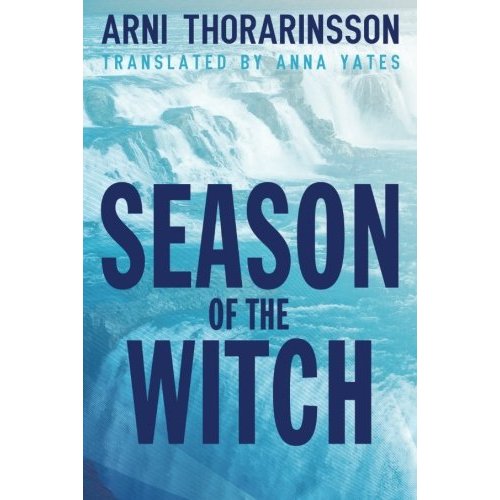
Arni Thorarinsson is a succesful Icelandic crime writer with a big following in France (among other places) and is just now arriving in English (courtesy of translator Anna Yates and AmazonCrossing, Amazon.com's venture into translated fiction) with the fourth, rather than the first, of his series featuring intrepid journalist Einar (many Icelanders (including this books's author), as readers of other Icelandic crime fiction know, mainly use their first name, along with a patronymic rather than a family name).

Einar is a recovering alcoholic who has been sent (for his sins) to cover the privincial city of Akureyri (rather than his usual Reykjavik beat), along with his former news editor, now downgraded to heading the Akureyri office. There's obviously some back story to all this, but a reader will not be handicapped by not having been able to read the previous novels.

There's an interesting parallel and contrast not only between Thorarinsson's book and the books of the most prominent Icelandic crime writer (outside Iceland, at least), Arnaldur Indriðason and a Swedish author, Mari Jungstedt. The contrast with Indriðason is stark: his books are vivid and gripping but emotionally cool and decidedly dour, in terms of the characters and the stories. Thorarinsson's hero is a first-person narrator with a quick wit and a sarcastic attitude: rather than grim and dour, Einar's narrative is lively but still vivid. Though Einar is a smart-ass, with all the friction that comes with that attitude, in terms of his relations with co-workers and others, he also shares a quality with Mari Jungsteadt's journalist character, JOhann Berg: both are working in the provinces, and both have a higher sense of journalistic ethics than their bosses. And both tend to be a bit self-righteous about their ethics (more a Scandinavian attitude, perhaps--I can't think of an American or British journalist in crime fiction with his attitude).

Another similarity with Jungsteadt's stories is Joa, the young woman photographer who has also been banished from Reykjavik to Akureyri. Pia, in the more recent Jungstedt books, works with Johann but is very independent and has a bit of Lisbeth Salander in her (toned down to a more realistic character). Joa, too, is independent and quick-witted and, when push comes to shove in a confrontation with some skinheads, also has a bit of Lisbeth in her.

I had been looking forward to having access to Thorarinsson's books in English for some time, and Season of the Witch (named for the Donovan song, with plays a part in the story at several points) fulfilled its promise. It's a quite different kind of Icelandic crime fiction, and gives a different view of Icelandic culture and landscape from other writers in the genre. I have to say I don't like the cover that AmazonCrossing has given it very much: it doesn't really give much sense of the story or setting, seemingly pointing only to the first syllable in the name of the country. There are a couple of points in the book where I couldn't quite go along with the story (that fight with the dkinheads collapsed a bit, for me--I won't give away anything by explaining) and an otherwise effectively comic character (a small bird) comes in for some over-the-top comic effect toward the end. But those are small quibbles, i recommend the book and am already looking forward to having more of the author available in English (especially if Anna Yates contitues to be the translator--the prose glides smoothly and elegantly along in English).

I bought the book as a second-hand galley (without the cover that I don't like), but full disclosure: I know the author's sister, a sculptor who is well-respected both in and outside Iceland.

Friday, August 10, 2012

One from Finland and one from Sweden


I finally got my hands on a digital copy of mari Jungstedt's The Dead of Summer (courtesy of Netgalley) and also received a new Finnish crime novel (new to English) courtesy of the Ice Cold Crime publishing company: Seppo Jokinen's Wolves and Angels. They're both police procedurals, but are quite different from each other.

Jungstedt's series featuring Anders Knutas, head of the Gotland detective squad, is unusual in several respects (in comparison to other crime series). One is the setting: the vacation island off the coast of Sweden, and in particular the medieval city of Visby. But the most interesting quality of the series is that it reads like one continuous narrative, particularly in terms of a strong set of plotlines concerning secondary characters, the reporter Johann Berg and his on-again-off-again relationship with a witness from the first novel in the series, Emma Winarven. At the point where The Dead of Summer begins, Johan has been expelled from Emma's life except for the occasional hand-off of their child.

Another secondary character in the series is Karin Jacobssen, Knutas's most competent detective and now his assistant in the department. Karin has been a bit of a cipher in the series, but here she gets more time in the foreground and we find out a bit more about her own background (as well as, in the conclusion, her character). Though there is indeed a dragon-tattooish female character in this and other books in the series, a young photographer who works with Johan, Karin provides a more realistic portrait of a woman crime-fighter in Sweden today, as well as being a complex character in her own right.

There are several plotlines in The Dead of Summer, including Karin's first chance to head up an investigation (Knutas is away in his wife's native Denmark on vacation), when a camper on the Gotland coast is shot to death. Knutas, to Karin's dismay, has trouble staying away. There's a backstory concerning a German family decades before whose vacation on Gotland is disrupted by violence. And then there's Johan and Emma.

A reader will figure out how these plotlines come together long before they actually do, but the identity of the perpetrator and the final outcome of the investigation are more interesting and well worth pursuing to the end of the book.


Jokinen's story is also unusual in a couple of respects. The series features Detective Sakari Koskinen, head of the detective squad in Tampere (one of Finland's larger cities). Wolves and Angels isn't the first of the series, but is the first to make it into English. Koskinen's detectives are individually characterized in interesting way, but it's Koskinen himself who is the main focus and the most interesting character. After his divorce, he has dedicated himself (become obsessed, even) with exercize, particularly running and cycling, and he takes a lot of ribbing from his puzzled cohorts about the obsession. But he's also very quick to anger, and having trouble controlling his temper.

The story is also a bit unusual, beginning with the first victim: a paraplegic but runs with a "gang" of wheelchair bound "fallen angels." There's a lot of interesting material about people living in an assisted living facility (and their lives are not whitewashed in terms of their disabilities or their personalities). Koskinen makes slow progress through another murder and a disappearance, fighting resistance from one stubborn and outspoken detective as well as several other colleagues whose attitudes Koskinen is having trouble figuring out or dealing with.

There's an earnestness about the dialogue among the cops, in spite of their various attempts at levity, that seems particularly characteristic of nordic noir: these writers take their social milieux very seriously. But Jokinen is never preachy and his characters and his plot are always believable. And in this case, it's not only the Finnish setting that is "another country" for most readers, there's also the world of those having difficulty with the physical management of their daily lives.

Monday, July 30, 2012

Tana French, Broken Harbor

Broken Harbor is the 4th of Tana French's "Dublin Murder Squad" novels, each of which takes a secondary character from the preceeding book as the central character in the new one. This one features Detective Michael "Scorcher" Kennedy, along with his trainee partner Richie Curran. Kennedy, not quite back on his feet from a previous investigation that turned into a disaster (see Faithful Place) is sent out to one of Ireland's "ghost estates" when the Spain family is found, three murdered and one almost dead.

All of French's novels have some common ground. They all feature adolescents in very important roles (current to the story and also in backstory). They are all psychological thrillers rather than mysteries, per se, or police procedurals (though police procedure plays a very important role in Broken Harbor). And in all of them, something in the central detective's past haunts him or her when the present investigation starts to deteriorate into disaster.

But what limits the impact of Broken Harbor, for me, can be seen in the book's contrast to the first and third of the series. In Faithful Place, the third, there's a lot of painful humor in the family relationship that haunts the main character (and the plot). The family is so true, and so truly horrible, that a reader's eyes are riveted to the story. In In the Woods, the first of the series, There is an abiding mystery in the detective's past that haunts the current investigation, and any solution seems tantalizingly out of reach.


Broken Harbor has psychological trauma in abundance, but none of it so sharply drawn or darkly comic as the situation in Faithful Place. And there's plenty of weirdness and mystery (unexplained holes in the wall, lurking animals, stalkers, and more), but the author doesn't really exploit them for the full effect that she achieved in her debut novel.

What pulls the story along briskly at first is a sense of a "real-time" investigation, as Kennedy and his colleagues move slowly, inch-by-inch through the preliminary investigation and the discovery of the strange details of the Spain's house and their assault. But after about a quarter of the book, the details of the story begin to be rehashed over and over by the detectives as they try to decipher what happened, and to me the dialogue gets a bit tiresome after a while. The pace and interest pick up again as Kennedy (the narrator) starts to point out to the reader the points at which the investigation starts to go wrong, and there are, indeed, some surprises along the way (in a particularly "Tana French" fashion, in a couple of cases, as people bring down disaster on themselves).

The ghost estate is used very effectively in a couple of ways (and much more directly than in the several other recent Irish crime novels that have used the unfinished (never-to-be-finished) housing estates that fell victim to the financial collapse in Ireland. The crumbling estate, isolated on the fringes of society, becomes a psychological symbol as well as a social emblem.

Broken Harbor is a good read, if a bit long, and the traumas of the crime victims and of Detective Kennedy himself are effectively drawn, But for me there's a bit of a spark missing, in comparison to what I still think is her best book, Faithful Place.

Tuesday, July 24, 2012

Adrian McKinty, Falling Glass

Adrian McKinty's newest thriller is (in part) the return of Michael Forsythe, the central character in the trilogy that made him famous. Only in part, though, since Forsythe is mostly off-stage. The central character here is a minor character from the trilogy, known mostly as Killian. What Falling Glass has in common with the trilogy is a relentless pace and overarching metaphorical resonance—but Falling Glass is a better book, the best of anything I've read by McKinty so far. The setting is mostly Northern Ireland, and mostly countryside rather than city, though at the beginning the story moves across a lot of global geography.

The situation is that Killian is hired by an Irish airline magnate (sort of Richard Branson on a smaller scale) whose ex-wife has disappeared with their two daughters. Killian is simply asked to find them. The situation gets a lot more complicated when the magnate finds out that something else is missing, and several other characters get dropped menacingly into the mix, including a Russian hitman, a ruthless fixer, and the ex-wife herself.

One of the main threads in the novel is the culture of the traveler community in Ireland and beyond, a culture little known beyond its closely guarded circle of families. The reader will learn a lot about the travelers (known by many other names, most of them derogatory epithets coined by the larger culture), their stories, their outsider (and sometimes criminal) life and languages, and the discrimination and violence to which they have been subject over many years. But discovering how this culture is embedded in the story is part of the pleasure, so I won't give away any more.

There's a very interesting coda at the end of the story that is told in straight, realistic style but nevertheless verges into the kind of metafiction that Salman Rushdie has exercised, among others. But at the same time, it has a logical (even when it moves in unexpected directions) forward progress that, to me, works better than the stories of the trilogy as a realistic crime novel. McKinty has given us a story that works as a straight thriller as well as a kind of romance, a primer on a little known culture, and a literary tour de force. And, to me, the literary aspect of this book works more integrally with the tale than did those aspects of the trilogy. As I said, it's McKinty's best book so far, which is saying something.

Monday, July 16, 2012

Austrian noir film


There have been three films made from the crime novels of Wolf Haas, featuring his sometime-detective, Brenner. All three star Josef Hader and were directed by Wolfgang Murnberger. The first, set in Vienna, whose title translates as Come Sweet Death, was funny, a bit disconncted, and looked like a low-budget indy film. Brenner is a detective who lost his job on the police force (by sleeping with his boss's wife) and is now working for an ambulance service. The second film, Silentium, is much more visual (with some striking effects and visual metaphors) and the plot is a bit more straightforward (and also funny). One extended scene, in which Brenner becomes one of the "players" in a foosball table, is hysterical.

The third film, from 2009, translates as The Bone Man, is one of the best crime films I've seen in a long time. It kept reminding me of Blood Simple and The Postman Always Rings Twice, both at the same time. But its humor and storytelling are uniquely those of Haas and Murnberger.

Brenner is now a repo man, sent out to a rural(though under a highway overpass) guesthouse to deliver a last notice to an artist whose Volkswagen beetle is past due for payments. Once there, Brenner is caught in a twisty story of fathers and sons, husbands and wives, sexual difficulties, blackmail, and meatgrinders. The owner of the guesthouse is a fascinating character, alternately friendly and hostile, who has gotten in over his head on several fronts.

The humor is understated and the visuals, though well done, aren't as much in the foreground as that foosball table in Silentium: the emphasis is on the characters and the story. One of the things I liked about The Bone Man, in contrast to most crime movies as well as the first two Brenner films, is that it's about ordinary people rather than VIPs. Even the East European gangsters are of the "mensch" variety, low-level operators rather than international criminals.

I found all three Brenner films on Amazon.de, which may not be the easiest source for a lot of people, though the price was low enough for the films to make the shipping charge acceptable—the DVDs, though, are Region 2, though, so in the U.S. you'll need a region-free player or computer. There are English subtitles, though, and since only one of the Brenner novels has been translated (see my recent review), the films are the best source of the Haas books for a non-German-speaker. I almost hesitate to advice starting the series at the beginning, since I would rate Come Sweet Death as "interesting," Silentium as "very good," and The Bone Man as "excellent." But there are running elements in the series that are best understood if a viewer does indeed start at the beginning. If you find the films less-than-thrilling at first, I'd say stick with them: they get better and better.

Tuesday, July 10, 2012

From Sweden: Carin Gerhardsen, The Gingerbread House

One of the newest entries in the Scandinavian crime wave, Carin Gerhardsen's The Gingerbread House is a police procedural set in and around Stockholm. The central detective characters are Conny Sjöberg (whose family life with his wife and children form a large part of the story) and Petra Westman, whose own private life leads to a separate investigation. The main crime in the story is set up when a lonely man happens to see a man he recognizes on the street as the grown-up version of a pre-school bully who had so tormented him that it has affected his entire life. The bully turns up dead the next day.

From there, the police investigation alternates with the diary of the killer, which is increasingly graphic in its brutality, and the bullied man's memories of the childhood violence, which is also grimly brutal. Many, even most, of us have some experience of bullying, but Gerhardsen accentuates and highlights the social problem by linking it to lifelong trauma, even insanity. Late in the book, one of the cops comments that most people who are bullied grow up to be more or less normal people, but the rest of the book emphasizes people who don't.

Petra's separate investigation concerns a sexual assault that takes place in her off-duty life, and, to my mind, the author leaves the reader wanting to know more about this case. There is a bit of a twist at the end (as there also is in the main story), leaving an opening, perhaps, for a sequel that will give us more details about the resolution of this part of the story.

Speaking of the twist in the main story, it's one of those shifts that gets you looking back at the earlier sections of the book to see if you've been misled by the author. But The Gingerbread House is carefully constructed: the reader may be fooled but not cheated. What kept the book from being at the top rank of Swedish crime, for me, was an excess of digression (not only into the personal life of Sjöberg but also into, for example, the history of war in Lebanon. These sections bog down the story rather than creating tantalizing delay and anticipation.

The story overall resembles most, among Scandinavian crime fiction, the Erik Winter novels of Åke Edwardsson (set in Gothenberg): both series have leading men with more or less happy home lives (with normal bumps in the road) rather being tormented loners. Both series have important female characters who are competent detectives with their own complex personal lives. Edwardsson's recent novels are among the best written and constructed of all the newer Scandinavian crime novels; if this first of Gerhardsen's doesn't quite live up to that standard, perhaps the later entries in the series will. The Gingerbread House is published by Stockholm Text, a new and welcome enterprise bringing Swedish writers to English readers, and I obtained my copy as an e-book through NetGalley.

Friday, July 06, 2012

New Irish Noir: Michael Clifford's Ghost Town


The newest Irish entry in contemporary crime fiction works both as a story and as cultural history or criticism (Cliford is a political reporter of substantial reputation, and his style as a novelist has some of the no-nonsense quality of journalism). Joshua Molloy, nicknamed The Dancer for his football skills (a career aborted by his addictions as well as his associations with criminals) has just been released from an English jail and is back in Dublin. He's going to AA meetings and trying to stay straight while seeking to meet his son, born while he was incarcerated.

But Molloy's path is criscrossed with those of many others in an Ireland crippled by the housing and banking debacles of the economic crash. A former associate, a not-too-bright gangster on the make, lures Molloy into a scheme to murder a crime boss, and the story is off and running (as is Molloy). In addition to the thugs and bosses who are chasing him, his lawyer turns out to be the wife of a property developer on the run from his investors (some of whom are ready to use non-legal means to get their money back), the mother of his child is a junkie whose life is controlled by the very gangsters who are after Molloy himself, and there's a reporter trying to rehabilitate his career by getting a big story out of all that's going on.

Most of the novel is straightforwardly told, with vivid characterization and dialogue and a believably erratic plot. There's some comic relief in the magazine pieces written by the reporter (reproduced in the novel), which are wild tabloid versions of the truth, and in the reporter's own overblown sense of self-worth. The only caveat I have about the plot is that there is a point toward the end that has a twist that is a bit too neat, but upon reflection on the whole story is probably necessary to get to where the story needs to end.

As the estimable Declan Burke has pointed out (at Crime Always Pays), Clifford's book bears closest resemblance (among current Irish crime writers) to the work of Gene Kerrigan, and that's a very high standard that Ghost Town definitely lives up to. The story moves rapidly forward, keeping the lives of all the characters (particularly Molloy and his lawyer but also many minor characters) moving forward at every point, even when their stories overlap. I can highly recommend Ghost Town as a great read as well as a vivid portrait of the current Irish situation, in fictional form.

Wednesday, June 20, 2012

Kind of Cruel, by Sophie Hannah


Sophie Hannah's crime stories (set in and around Spilling and featuring detectives Charlie Zailer and Simon Waterhouse) are unusual in several ways. First, though set in small English towns, they're hardly cozy: She mines the darkest corners of suburbia like few other writers have been able to. Second, her running characters are frequently at the fringes of the narrative rather than at the center.

I've missed the past couple of Zailer-Waterhouse novels (there are seven in all, and I quite enjoyed the first 4). They require a certain amount of attention to appreciate all that is going on, and therefore a certain commitment of time. But once started, the books pull the reader in and on (and I will certainly go back and fill in the taps in my Sophie Hannah reading).

The new book, Kind of Cruel, combines mystery, tension, character, and comedy in a way that Hannah's readers have come to expect. And in this one, the humor grows out of not only the running characters (Zailer and Waterhouse are spiky and interesting but the other cops are distinctly characterized and frequently but usually unconsciously funny, not to mention Charlie's sister), but also in the central character of this story, Amber Hewerdine, who is acerbically intelligent and does not suffer fools at all. Other characters who are at the center of the various threads (and sometimes are the narrators of those threads) include a sincere hypnotherapist, Amber herself, and various members of Amber's numerous and distinctly odd extended family.

Amber and her husband Luke took in the daughters of her best friend when the friend was murdered by an arsonist, and in the midst of working out this instant family, Amber is suffering chronic insomnia. When she visits a hypnotherapist for help with the insomnia, she meets an annoying fellow patient and kicks off a series of events and encounters that will eventually illuminate several cases that the police have been unable to solve.

Waterhouse seizes upon Amber as a witness, though her relationship to the crime he's investigating is sketchy at best, and his superior officers are displeased (not an uncommon situation for Simon). Zailer is no longer working directly with the CID, and her involvement complicates (rather than simplifying) Simon's relationship with his fellow officers (not least because she and Simon are now married, their own relationship itself quite odd).

The story is quite complicated, requiring some repetition of facts and relationships as various characters involve themselves in various ways, but the repetition creates a spiral within the narrative rather than bogging it down. The voice of the hypnotherapist is an intrusion of psychotherapeutic ideas that are mostly helpful, even if a reader might find therapy-talk in general a less-than-entertaining mode. The psychotherapy is in the end necessary to the story, because the motive, especially, is quite complex. Without the therapist, the impulse behind the crimes might not seem credible, but from the hypnotherapists point of view, everything finally comes together in a convincing, but very dark way that gives a realistic but perhaps pessimistic coda for the troubled family relationships that have been the subject of the novel all along.

One word about cover art. I think Hodder has done a great job with the covers of Hannah's series, suggesting the domestic interiors that are not simply the setting for the series but the zone of both safety and horror lurking in the characters' lives.

Thursday, June 14, 2012

No Sale, by Patrick Conrad


Patrick Conrad's No Sale, translated from the original Dutch by Jonathan Lynn, is set in Belgium, mostly in Antwerp, but it's real venue is the silver screen. Victor Cox is a professor of film studies, specializing in film noir, on the verge of retirement when his estranged wife is killed by a hit-and-run driver and dumped into the water along the docks. Two policemen, Lannoy and Luyckx (the latter known as the Sponge) suspect the professor and, as murders accumulate, continue to meet and interrogate Cox throughout the novel.

The murders seem random but Cox increasingly suspects that they are planned to coincide with the plots of noir films or the lives of actresses who starred in them or women whose lives were the sources for movie plots. Because the professor sees life mostly through the lens of the cinema (mostly, but not exclusively, American movies), the reader will hear a lot about film history even beyond the plots that coincide with the murders. Film noir is, indeed, not only the setting but the subject of the book.

Lannoy and the Sponge occupy one level of the narrative, and the professor and his diaristic musings form another. Every murdered woman seems to have some connection to Cox, but as several years pass, there's no evidence to link him to the killings. Then, as his involvement with a young student grows, the professor begins to lose the distinction between his waking life, his dreams, and the film noir plots he knows so well, the source of some confusion and much comedy. He even begins to suspect that he may have murdered the women while inhabiting an alter-ego.

The solution to the crime has a bit of a Nabokovian flair, and there is much local color along the way, in the noir-ish underworld of Antwerp as well as the fictional world of the cinema. The novel is clever and entertaining, more of a "meta-fiction" in a way than a straightforward story. But Conrad takes seriously his commitment to fiction and doesn't betray the reader's trust, the way some meta-fiction (and Nabokov, in fact) sometimes do.

No Sale (the English title comes from an incident in the movie Butterfield 8, while the original title was Starr, after one of the characters and her historical double) is another entry in Bitter Lemon's interesting and quite varied list of world crime fiction.