Adrian McKinty's newest thriller is (in part) the return of Michael Forsythe, the central character in the trilogy that made him famous. Only in part, though, since Forsythe is mostly off-stage. The central character here is a minor character from the trilogy, known mostly as Killian. What Falling Glass has in common with the trilogy is a relentless pace and overarching metaphorical resonance—but Falling Glass is a better book, the best of anything I've read by McKinty so far. The setting is mostly Northern Ireland, and mostly countryside rather than city, though at the beginning the story moves across a lot of global geography.
The situation is that Killian is hired by an Irish airline magnate (sort of Richard Branson on a smaller scale) whose ex-wife has disappeared with their two daughters. Killian is simply asked to find them. The situation gets a lot more complicated when the magnate finds out that something else is missing, and several other characters get dropped menacingly into the mix, including a Russian hitman, a ruthless fixer, and the ex-wife herself.
One of the main threads in the novel is the culture of the traveler community in Ireland and beyond, a culture little known beyond its closely guarded circle of families. The reader will learn a lot about the travelers (known by many other names, most of them derogatory epithets coined by the larger culture), their stories, their outsider (and sometimes criminal) life and languages, and the discrimination and violence to which they have been subject over many years. But discovering how this culture is embedded in the story is part of the pleasure, so I won't give away any more.
There's a very interesting coda at the end of the story that is told in straight, realistic style but nevertheless verges into the kind of metafiction that Salman Rushdie has exercised, among others. But at the same time, it has a logical (even when it moves in unexpected directions) forward progress that, to me, works better than the stories of the trilogy as a realistic crime novel. McKinty has given us a story that works as a straight thriller as well as a kind of romance, a primer on a little known culture, and a literary tour de force. And, to me, the literary aspect of this book works more integrally with the tale than did those aspects of the trilogy. As I said, it's McKinty's best book so far, which is saying something.
Tuesday, July 24, 2012
Monday, July 16, 2012
Austrian noir film
There have been three films made from the crime novels of Wolf Haas, featuring his sometime-detective, Brenner. All three star Josef Hader and were directed by Wolfgang Murnberger. The first, set in Vienna, whose title translates as Come Sweet Death, was funny, a bit disconncted, and looked like a low-budget indy film. Brenner is a detective who lost his job on the police force (by sleeping with his boss's wife) and is now working for an ambulance service. The second film, Silentium, is much more visual (with some striking effects and visual metaphors) and the plot is a bit more straightforward (and also funny). One extended scene, in which Brenner becomes one of the "players" in a foosball table, is hysterical.
The third film, from 2009, translates as The Bone Man, is one of the best crime films I've seen in a long time. It kept reminding me of Blood Simple and The Postman Always Rings Twice, both at the same time. But its humor and storytelling are uniquely those of Haas and Murnberger.
Brenner is now a repo man, sent out to a rural(though under a highway overpass) guesthouse to deliver a last notice to an artist whose Volkswagen beetle is past due for payments. Once there, Brenner is caught in a twisty story of fathers and sons, husbands and wives, sexual difficulties, blackmail, and meatgrinders. The owner of the guesthouse is a fascinating character, alternately friendly and hostile, who has gotten in over his head on several fronts.
The humor is understated and the visuals, though well done, aren't as much in the foreground as that foosball table in Silentium: the emphasis is on the characters and the story. One of the things I liked about The Bone Man, in contrast to most crime movies as well as the first two Brenner films, is that it's about ordinary people rather than VIPs. Even the East European gangsters are of the "mensch" variety, low-level operators rather than international criminals.
I found all three Brenner films on Amazon.de, which may not be the easiest source for a lot of people, though the price was low enough for the films to make the shipping charge acceptable—the DVDs, though, are Region 2, though, so in the U.S. you'll need a region-free player or computer. There are English subtitles, though, and since only one of the Brenner novels has been translated (see my recent review), the films are the best source of the Haas books for a non-German-speaker. I almost hesitate to advice starting the series at the beginning, since I would rate Come Sweet Death as "interesting," Silentium as "very good," and The Bone Man as "excellent." But there are running elements in the series that are best understood if a viewer does indeed start at the beginning. If you find the films less-than-thrilling at first, I'd say stick with them: they get better and better.
Tuesday, July 10, 2012
From Sweden: Carin Gerhardsen, The Gingerbread House
One of the newest entries in the Scandinavian crime wave, Carin Gerhardsen's The Gingerbread House is a police procedural set in and around Stockholm. The central detective characters are Conny Sjöberg (whose family life with his wife and children form a large part of the story) and Petra Westman, whose own private life leads to a separate investigation. The main crime in the story is set up when a lonely man happens to see a man he recognizes on the street as the grown-up version of a pre-school bully who had so tormented him that it has affected his entire life. The bully turns up dead the next day.
From there, the police investigation alternates with the diary of the killer, which is increasingly graphic in its brutality, and the bullied man's memories of the childhood violence, which is also grimly brutal. Many, even most, of us have some experience of bullying, but Gerhardsen accentuates and highlights the social problem by linking it to lifelong trauma, even insanity. Late in the book, one of the cops comments that most people who are bullied grow up to be more or less normal people, but the rest of the book emphasizes people who don't.
Petra's separate investigation concerns a sexual assault that takes place in her off-duty life, and, to my mind, the author leaves the reader wanting to know more about this case. There is a bit of a twist at the end (as there also is in the main story), leaving an opening, perhaps, for a sequel that will give us more details about the resolution of this part of the story.
Speaking of the twist in the main story, it's one of those shifts that gets you looking back at the earlier sections of the book to see if you've been misled by the author. But The Gingerbread House is carefully constructed: the reader may be fooled but not cheated. What kept the book from being at the top rank of Swedish crime, for me, was an excess of digression (not only into the personal life of Sjöberg but also into, for example, the history of war in Lebanon. These sections bog down the story rather than creating tantalizing delay and anticipation.
The story overall resembles most, among Scandinavian crime fiction, the Erik Winter novels of Åke Edwardsson (set in Gothenberg): both series have leading men with more or less happy home lives (with normal bumps in the road) rather being tormented loners. Both series have important female characters who are competent detectives with their own complex personal lives. Edwardsson's recent novels are among the best written and constructed of all the newer Scandinavian crime novels; if this first of Gerhardsen's doesn't quite live up to that standard, perhaps the later entries in the series will. The Gingerbread House is published by Stockholm Text, a new and welcome enterprise bringing Swedish writers to English readers, and I obtained my copy as an e-book through NetGalley.
From there, the police investigation alternates with the diary of the killer, which is increasingly graphic in its brutality, and the bullied man's memories of the childhood violence, which is also grimly brutal. Many, even most, of us have some experience of bullying, but Gerhardsen accentuates and highlights the social problem by linking it to lifelong trauma, even insanity. Late in the book, one of the cops comments that most people who are bullied grow up to be more or less normal people, but the rest of the book emphasizes people who don't.
Petra's separate investigation concerns a sexual assault that takes place in her off-duty life, and, to my mind, the author leaves the reader wanting to know more about this case. There is a bit of a twist at the end (as there also is in the main story), leaving an opening, perhaps, for a sequel that will give us more details about the resolution of this part of the story.
Speaking of the twist in the main story, it's one of those shifts that gets you looking back at the earlier sections of the book to see if you've been misled by the author. But The Gingerbread House is carefully constructed: the reader may be fooled but not cheated. What kept the book from being at the top rank of Swedish crime, for me, was an excess of digression (not only into the personal life of Sjöberg but also into, for example, the history of war in Lebanon. These sections bog down the story rather than creating tantalizing delay and anticipation.
The story overall resembles most, among Scandinavian crime fiction, the Erik Winter novels of Åke Edwardsson (set in Gothenberg): both series have leading men with more or less happy home lives (with normal bumps in the road) rather being tormented loners. Both series have important female characters who are competent detectives with their own complex personal lives. Edwardsson's recent novels are among the best written and constructed of all the newer Scandinavian crime novels; if this first of Gerhardsen's doesn't quite live up to that standard, perhaps the later entries in the series will. The Gingerbread House is published by Stockholm Text, a new and welcome enterprise bringing Swedish writers to English readers, and I obtained my copy as an e-book through NetGalley.
Friday, July 06, 2012
New Irish Noir: Michael Clifford's Ghost Town
The newest Irish entry in contemporary crime fiction works both as a story and as cultural history or criticism (Cliford is a political reporter of substantial reputation, and his style as a novelist has some of the no-nonsense quality of journalism). Joshua Molloy, nicknamed The Dancer for his football skills (a career aborted by his addictions as well as his associations with criminals) has just been released from an English jail and is back in Dublin. He's going to AA meetings and trying to stay straight while seeking to meet his son, born while he was incarcerated.
But Molloy's path is criscrossed with those of many others in an Ireland crippled by the housing and banking debacles of the economic crash. A former associate, a not-too-bright gangster on the make, lures Molloy into a scheme to murder a crime boss, and the story is off and running (as is Molloy). In addition to the thugs and bosses who are chasing him, his lawyer turns out to be the wife of a property developer on the run from his investors (some of whom are ready to use non-legal means to get their money back), the mother of his child is a junkie whose life is controlled by the very gangsters who are after Molloy himself, and there's a reporter trying to rehabilitate his career by getting a big story out of all that's going on.
Most of the novel is straightforwardly told, with vivid characterization and dialogue and a believably erratic plot. There's some comic relief in the magazine pieces written by the reporter (reproduced in the novel), which are wild tabloid versions of the truth, and in the reporter's own overblown sense of self-worth. The only caveat I have about the plot is that there is a point toward the end that has a twist that is a bit too neat, but upon reflection on the whole story is probably necessary to get to where the story needs to end.
As the estimable Declan Burke has pointed out (at Crime Always Pays), Clifford's book bears closest resemblance (among current Irish crime writers) to the work of Gene Kerrigan, and that's a very high standard that Ghost Town definitely lives up to. The story moves rapidly forward, keeping the lives of all the characters (particularly Molloy and his lawyer but also many minor characters) moving forward at every point, even when their stories overlap. I can highly recommend Ghost Town as a great read as well as a vivid portrait of the current Irish situation, in fictional form.
Wednesday, June 20, 2012
Kind of Cruel, by Sophie Hannah

Sophie Hannah's crime stories (set in and around Spilling and featuring detectives Charlie Zailer and Simon Waterhouse) are unusual in several ways. First, though set in small English towns, they're hardly cozy: She mines the darkest corners of suburbia like few other writers have been able to. Second, her running characters are frequently at the fringes of the narrative rather than at the center.
I've missed the past couple of Zailer-Waterhouse novels (there are seven in all, and I quite enjoyed the first 4). They require a certain amount of attention to appreciate all that is going on, and therefore a certain commitment of time. But once started, the books pull the reader in and on (and I will certainly go back and fill in the taps in my Sophie Hannah reading).
The new book, Kind of Cruel, combines mystery, tension, character, and comedy in a way that Hannah's readers have come to expect. And in this one, the humor grows out of not only the running characters (Zailer and Waterhouse are spiky and interesting but the other cops are distinctly characterized and frequently but usually unconsciously funny, not to mention Charlie's sister), but also in the central character of this story, Amber Hewerdine, who is acerbically intelligent and does not suffer fools at all. Other characters who are at the center of the various threads (and sometimes are the narrators of those threads) include a sincere hypnotherapist, Amber herself, and various members of Amber's numerous and distinctly odd extended family.
Amber and her husband Luke took in the daughters of her best friend when the friend was murdered by an arsonist, and in the midst of working out this instant family, Amber is suffering chronic insomnia. When she visits a hypnotherapist for help with the insomnia, she meets an annoying fellow patient and kicks off a series of events and encounters that will eventually illuminate several cases that the police have been unable to solve.
Waterhouse seizes upon Amber as a witness, though her relationship to the crime he's investigating is sketchy at best, and his superior officers are displeased (not an uncommon situation for Simon). Zailer is no longer working directly with the CID, and her involvement complicates (rather than simplifying) Simon's relationship with his fellow officers (not least because she and Simon are now married, their own relationship itself quite odd).
The story is quite complicated, requiring some repetition of facts and relationships as various characters involve themselves in various ways, but the repetition creates a spiral within the narrative rather than bogging it down. The voice of the hypnotherapist is an intrusion of psychotherapeutic ideas that are mostly helpful, even if a reader might find therapy-talk in general a less-than-entertaining mode. The psychotherapy is in the end necessary to the story, because the motive, especially, is quite complex. Without the therapist, the impulse behind the crimes might not seem credible, but from the hypnotherapists point of view, everything finally comes together in a convincing, but very dark way that gives a realistic but perhaps pessimistic coda for the troubled family relationships that have been the subject of the novel all along.
One word about cover art. I think Hodder has done a great job with the covers of Hannah's series, suggesting the domestic interiors that are not simply the setting for the series but the zone of both safety and horror lurking in the characters' lives.
Thursday, June 14, 2012
No Sale, by Patrick Conrad

Patrick Conrad's No Sale, translated from the original Dutch by Jonathan Lynn, is set in Belgium, mostly in Antwerp, but it's real venue is the silver screen. Victor Cox is a professor of film studies, specializing in film noir, on the verge of retirement when his estranged wife is killed by a hit-and-run driver and dumped into the water along the docks. Two policemen, Lannoy and Luyckx (the latter known as the Sponge) suspect the professor and, as murders accumulate, continue to meet and interrogate Cox throughout the novel.
The murders seem random but Cox increasingly suspects that they are planned to coincide with the plots of noir films or the lives of actresses who starred in them or women whose lives were the sources for movie plots. Because the professor sees life mostly through the lens of the cinema (mostly, but not exclusively, American movies), the reader will hear a lot about film history even beyond the plots that coincide with the murders. Film noir is, indeed, not only the setting but the subject of the book.
Lannoy and the Sponge occupy one level of the narrative, and the professor and his diaristic musings form another. Every murdered woman seems to have some connection to Cox, but as several years pass, there's no evidence to link him to the killings. Then, as his involvement with a young student grows, the professor begins to lose the distinction between his waking life, his dreams, and the film noir plots he knows so well, the source of some confusion and much comedy. He even begins to suspect that he may have murdered the women while inhabiting an alter-ego.
The solution to the crime has a bit of a Nabokovian flair, and there is much local color along the way, in the noir-ish underworld of Antwerp as well as the fictional world of the cinema. The novel is clever and entertaining, more of a "meta-fiction" in a way than a straightforward story. But Conrad takes seriously his commitment to fiction and doesn't betray the reader's trust, the way some meta-fiction (and Nabokov, in fact) sometimes do.
No Sale (the English title comes from an incident in the movie Butterfield 8, while the original title was Starr, after one of the characters and her historical double) is another entry in Bitter Lemon's interesting and quite varied list of world crime fiction.
Tuesday, June 12, 2012
Jake Needham, A World of Trouble

A World of Trouble is the third of Jake Needham's "Jack Shepherd" novels set mostly in Thailand (though both this book and the previous one, Killing Plato, range pretty far afield). At the end of the previous book, Jack is seemingly at a dead end: his wife has left him and everything else has fallen apart, too. At the beginning of A World of Trouble, he's not much better off. He has moved to Hong Kong, but his only client is a former Prime Minister of Thailand who's now in exile in Dubai, and Jack is in Dubai with his client (also the 98th richest man in the world, as it happens).
Jack is a financial expert, but his management of he ex-Prime Minister's vast wealth gets a little complicated when Jack is asked to get a very large sum out of Thailand and is required to travel to Bangkok to manage the deal. Several characters from previous books (including a cop and a couple of contrasting characters from the Thai intelligence agency) come into the plot as Jack deals with the Prime Minister's business as well as his own demons.
Needham is good at making the Shepherd stories focus around Jack's financial expertise even as the story veers into politics and violence. This time, the story involves enough (and realistic enough) Thai politics that the author feels it necessary to assert on his own blog that no one should seek any parallels between his book and the real Thailand. It's to the author's credit that the disclaimer is necessary: A World of Trouble draws a completely believable portrait of a society on the verge of collapse, and of the meddling of certain American agencies in the process.
But the story doesn't go for the thriller-cliché. Just as it seems that Jack will be thrust against his will into the role of hero, the story takes a different turn (which I won't reveal) and heads into more realistic (though not cheerful) direction.
That less-than-cheerful ending, though, doesn't alter one of the chief charms of the series: though the stories are told in the third person, most of the action is told in dialogue or from Jack's point of view. Both the narrator and Jack himself are charming company, as well as moving the story forward briskly. There's a lot of back and forth from country to country (along with interesting glimpses of exotic locations) and a lot of financial and political dealings, but the story never bogs down or drags.
So I highly recommend A World of Trouble to readers of international crime: the series is quite different from other Bangkok-related crime series. The physical books are apparently only available in certain Asian countries, but fortunately there are digital editions available to us in the rest of the world. In fact, I read the book via a Kindle version that the author sent me for review, but rather than reading it on a Kindle, I read it via an iPod Touch. You might that the screen is too small to read a whole book, but I'm getting quite used to it after reading about a half-dozen books that way. It requires turning the page quite a lot, but anyone who has ever gotten fascinated by very small book formats will be quite comfortable with the Touch screen (and for readers of i-books in formats other than Kindle, there's now an app that makes Adobe Digital Editions readable on the non-flash Touch device.
"
Wednesday, June 06, 2012
Åke Edwardsson, Sail of Stone

Åke Edwardsson's "Chief Inspector Erik Winter" series just keeps getting better. Edwardsson's sureness or confidence as a writer shows in a big way in his newly translated (by Rachel Willson-Broyles, in the Simon & Schuster paperback) Sail of Stone, which is a very unusual crime novel. For most of the novel, neither the detectives nor the reader know whether a crime has even been committed. When we do find out, it's not necessarily the crime or crimes that we expect.
This book gives another detective on Winter's team nearly as much time as the boss: Aneta Djanali, who has appeared in previous books: a Swedish woman of African origins, now not fully at home in Stockholm or in her parents' country. There are two cases in the story, neither one really an official case. Aneta is following up on a report of domestic abuse, but cannot make adequate contact with the victim, coincedentally named Anette. Erik is approached by a former flame, the daughter of a family of fishermen, whose father has possibly disappeared while on a trip to Scotland, where he is attempting to trace his own father, reportedly killed during World War II when his ship sank. Now a cryptic letter has arrived from Scotland implying that all is not as it seems.
Aneta is unable to just drop the case of Anette, bouncing back and forth between the battered wife's parents, husband, and his sister without ever being able to contact Anette herself. Aneta feels threatened without the threat being specific or concrete. Erik really doesn't have a case but sends out inquiries to Interpol and his friends in the U.K. seeking information about the missing father, while also talking to the family and other fishermen.
The two stories hardly seem weighty enough for a crime novel, despite the considerable parallels between them, but in Edwardsson's hands there is considerable tension and forward motion, as well as a pair of unconventional climaxes. A good deal of the novel is carried forward in oblique dialogue that's frequently comic in its indirectness. Along the way there's considerable discussion of music (Erik is a jazz fanatic who doesn't care about any other music, while the other detectives have their own soundtracks) and vivid evocations of Göteborg/Gothenburg in Sweden and Scotland from Aberdeen to Inverness. We also get lively glimpses of Erik's and Aneta's private lives, without descending into soap opera.
Edwardsson is one of the best writers in the Swedish crime wave. There's a Swedish TV series based on the Erik Winter books, but so far I haven't been able to find the series on DVDs with subtitles (and my Swedish is not up to the task, unfortunately).
Sunday, May 27, 2012
Austrian crime: Wolf Haas, Brenner and God
A few years ago I saw a film based on one of Wolf Haas's series based on a former cop named Brenner and have been hoping since then to be able to read some of the original novels. Now, finally, Brenner and God has arrived in English courtesy of Melville House/Melville International Crime, in a translation by Annie Janusch. The film I saw was Silentium, a darkly comic story based on Haas's fourth Brenner book (Brenner and God is made from the seventh and apparently most recent in the series). Silentium was the Austrian entry in the European Union touring film festival for that year, and there are two other Brenner films, one earlier and one more recent than Silentium.
Though it's the seventh novel in the series, Brenner and God reads almost as if it were the first. Brenner, who left the police force some time before, has found what he now thinks is his perfect job: being a driver for a wealthy developer (who lives in Munich) and his wife (a doctor who runs an abortion clinic in Vienna) and especially their daughter Helena (whom he shuttles back and forth between the parents). While driving Helena along the autobahn between her parents, Brenner stops for gas and Helena is kidnapped. Brenner is fired but becomes involved in the search for the kidnappers, a search that ultimately leads to a number of deaths.
The story is lively and the characters are vivid, but the most interesting aspect of the novel is the voice of the narrator. The story is told in the first person, but not by one of the characters. The narrator, though very present in the story, is an omniscent eye, who knows where the story is going and constantly addresses the reader with suggestions of upcoming deaths and the timeline according to which things are going to happen. The narrator is also constantly indulging in digressions, in a loopy but entertaining monologue. The result is that the reader gets a double benefit: a story that is engaging and has a rapid momentum and a narrative voice that is darkly comic.
There's a disgusting plot element that reminded me of the grossest part of Jo Nesbø's Headhunters (anyone who has read that book knows what I'm talking about) but in a more grotesque but oddly funny way. Brenner comes in for a good deal of punishment before the book is over, in a long tradition of noir detectives who are forever getting thrust into painful and threatening situations. But Brenner rolls with the punches. His marginal professional status is an interesting aspect of the series, allowing Haas to put Brenner into situations beyond the typical police and private detective tropes.
Melville House graciously sent me a galley of Brenner and God (full disclosure) but speaking honestly when I say that my long wait for the Brenner books was delightfully fulfilled with this book. I can only hope that Melville will go back and give us the earlier books (and I'm trying to find the other movies as well, now, all of which feature Josef Hader as Brenner, with Wolfgang Murnberger as director.
Thursday, May 24, 2012
New series from Sweden: Anna Jansson's Maria Wern
I've been watching the Maria Wern TV series, produced by Swedish television and broadcast in the U.S. by MhZnetworks, and have been waiting anxiously for some of Anna Jansson's books (on which the series is based) to appear in English translation. The first has now arrived, as Killer's Island, translated by Enar Henning Koch from Jansson's 11th Maria Wern book, Drömmen förde dej vilse, published in English by Stockholm Text, a new project bringing Swedish books out in paperback and digital form. The first of their books is becoming available late this month (I was able to get galleys from Netgalley).
The Maria Wern TV series is interesting for its Gotland setting and the characters (some of whom appear in the books, but in slightly different relationships with each other). The series is not quite to my taste: I'm more interested in the darker Swedish series, closer to noir, and Maria Wern is a bit more on the cozy side. The books take another step further away from noir, since Jansson is very interested in the conflicted private lives of her characters (at least she is in this book). Both Maria and her friend and coworker Erika are caught in relationships that are not going according to plan, and their love lives take up a considerable portion of the text (it seems like they take up more space than the mystery or the police work, but that's probably just my impression). Perhaps my problem is that beginning with the 11th in the series, I don't have enough background with these characters.
The story itself goes from an attack on a young boy, during which Maria tries to intervene and is beaten and stabbed with a hypodermic syringe, causing her to worry about exposure to blood diseases. Then a series of murders begins, the first very lurid indeed and the next more matter-of-fact. All of the incidents seem to revolve around a very limited group of people, including Erika and her romantic attachment, who is a doctor. When the conclusion arrives, there's a somewhat contrived (and to me not all that convincing) final struggle in the sea.
At the beginning, I was so annoyed by some of the writing (or the translation, a non-Swedish-speaker can't be sure). An example from the first paragraph is, "A pale dusk lay over the creased surface of the sea, lighting up the dark bastions of the city walls and the monastery ruins hailing back to another, more powerful time." And just after the discovery of the lurid murder, one of the detectives feels sick:"The vomit lurked somewhere in the region of his throat. He wasn't sure which exit it would take." There's something both overwritten and unclear about both passages. Fortunately, the writing settles down and from about a third of the way into the book I stopped noticing that sort of thing.
The story kept me reading, but there are other recent Swedish crime novels that make better use of the Gotland setting (such as the books of Mari Jungstedt, whose newest novel, The Dead of Summer, is also appearing in the U.S. thanks to Stockholm Text) and of the myths and folktales of Scandinavia (Jansson evokes the tale of a bride who is drowned and returns to torment everyone, but the Öland novels by Johan Theorin make more extensive and effective use of regional myth). Still, I thought the book was interesting, and will certainly appeal to readers who find much of the recent Swedish crime wave a bit too dark: for instance, Jansson's book has a good deal in common with Camilla Läckberg's series set on the Western coast of Sweden. Both series put more emphasis on the marriages and love affairs of the detectives than do the series by some of the darker Scandinavian series.
Balancing the two versions of Maria Wern against one another, I think I prefer the filmed rather than the written version. Though the cops in the filmed version have plenty of stress and misery in their private lives, the crime at hand takes up a bit more space in the story than, at least, it does in Killer's Island. Perhaps someone who knows the original Swedish novels can offer an opinion about whether Killer's Island is typical and whether my impression of them is tilted by my lack of access to the originals?
BTW, there's a killer parody of the Maria Wern series on YouTube, taken from a Swedish satirical TV show, but it's in Swedish. It also includes a very funny reference to another Swedish crime phenom: http://www.youtube.com/watch?v=W1_79pJbCw8
Wednesday, May 23, 2012
Conor Fitzgerald, The Namesake
Conor Fitzgerald is Irish, writes under a pseudonym, and his series character is an American who grew up in Rome and is an irascible Italian commisario. The cover of his new (and I think best) novel, The Namesake, suggests that he fills the void left by the death of Michael Dibdin, but this most recent book seems to me to have a bit more in common with the excellent series by Timothy Williams featuring Commissario Piero Trotti, though Trotti is considerably different from Fitzgerald's Commissario Alec Blue.
First, Blume is younger (Trotti is on the verge of ageing out of the Italian police when the series starts and retired by the last, still unpublished, novel). Blue is also not a native Italian, and Trotti is very much anchored in the northern Italian region where the series is set. But both detectives are difficult people to be around, personally or professionally, and their methods are unorthodox and their stories complex, with sudden shifts and unpredictable plots. Dibdin's Aurelio Zen shares some of these characteristics, too, but to me Blume is more reminiscent of Trotti, a younger version perhaps, and whose attachments to the past are more to his art historian parents whose sudden death left his stranded in Rome as a child than to ex-wife, daughter, and countryside (as is the case with Trotti)—though both have a melancholy edge deriving from their past.
In The Namesake, a numbers-cruncher at an insurance firm is murdered, apparently solely because of his name, setting in motion a dark and twisting story involving the least known branch of major italian organized crime, the 'Ndrangheta, based in Calabria but now reaching far abroad: specifically into Germany, where a branch of the 'Ndrangheta is involved in a crisis of succession when the old man who is the head of the branch is released from a German prison.
Part of the pleasure in reading the novel is in the twists in the plot, so I won't give away any more. Blume has, since the previous novel, been romantically involved with one of his subordinates, Caterina, and here she's finding him even more difficult as they have become more of a couple. Blume puts her in charge of a the case of the murdered insurance man, which he thinks is going to go nowhere, and is then tempted into a (sort-of) undercover operation shadowing a German cop who is traveling without authorization in Italy, apparently headed for Calabria.
Neither the organized crime aspects of the book nor the relationships between Blue, Caterina, the German rogue cop, the magistrates whose mandates the police are supposed to follow, and the security police develop in a predictable fashion. As readers follow the story, they will also learn a lot about how the 'Ndrangheta operates and why they appear to be the most resilient and dangerous crime syndicate despite being smaller than the better known groups. There's also an underground chamber in which a character is essentially buried alive, driving the tension in the later chapters.
The Namesake ranges more broadly across Italy (from Milan to Calabria) than previous Blue novels. The story itself is also in its broad outlines as well as details quite different, more involving, and frequently funnier (particularly in Blume's relationship with the German) than the previous books.
First, Blume is younger (Trotti is on the verge of ageing out of the Italian police when the series starts and retired by the last, still unpublished, novel). Blue is also not a native Italian, and Trotti is very much anchored in the northern Italian region where the series is set. But both detectives are difficult people to be around, personally or professionally, and their methods are unorthodox and their stories complex, with sudden shifts and unpredictable plots. Dibdin's Aurelio Zen shares some of these characteristics, too, but to me Blume is more reminiscent of Trotti, a younger version perhaps, and whose attachments to the past are more to his art historian parents whose sudden death left his stranded in Rome as a child than to ex-wife, daughter, and countryside (as is the case with Trotti)—though both have a melancholy edge deriving from their past.
In The Namesake, a numbers-cruncher at an insurance firm is murdered, apparently solely because of his name, setting in motion a dark and twisting story involving the least known branch of major italian organized crime, the 'Ndrangheta, based in Calabria but now reaching far abroad: specifically into Germany, where a branch of the 'Ndrangheta is involved in a crisis of succession when the old man who is the head of the branch is released from a German prison.
Part of the pleasure in reading the novel is in the twists in the plot, so I won't give away any more. Blume has, since the previous novel, been romantically involved with one of his subordinates, Caterina, and here she's finding him even more difficult as they have become more of a couple. Blume puts her in charge of a the case of the murdered insurance man, which he thinks is going to go nowhere, and is then tempted into a (sort-of) undercover operation shadowing a German cop who is traveling without authorization in Italy, apparently headed for Calabria.
Neither the organized crime aspects of the book nor the relationships between Blue, Caterina, the German rogue cop, the magistrates whose mandates the police are supposed to follow, and the security police develop in a predictable fashion. As readers follow the story, they will also learn a lot about how the 'Ndrangheta operates and why they appear to be the most resilient and dangerous crime syndicate despite being smaller than the better known groups. There's also an underground chamber in which a character is essentially buried alive, driving the tension in the later chapters.
The Namesake ranges more broadly across Italy (from Milan to Calabria) than previous Blue novels. The story itself is also in its broad outlines as well as details quite different, more involving, and frequently funnier (particularly in Blume's relationship with the German) than the previous books.
Wednesday, May 09, 2012
Timothy Hallinan, The Fear Artist
I've read several crime novels lately that are based on the lingering effects of U.S. policies in Southeast Asia, including the last of Colin Cotteril's Dr. Siri novels and the second of Jake Needham's Jack Shepherd books; the most recent is Timothy Hallinan's The Fear Artist, evidently the 11th novel featuring Poke Rafferty, a series that I had somehow missed up to now (and only noticed now because SoHo Crime sent me a review copy of the new book). Rafferty is a travel writer and long-time resident of Bangkok who seems to have a knack for stirring up trouble.
The U.S. (justifiably) doesn't come out looking very good in any of these three books. Needham's book is perhaps the most contemporary in its outlook, dealing with current policies and financial crimes whose origins are in the U.S. Cotteril's and Hallinan's books deal with the lingering spillover of the U.S. involvement in Vietnam into other countries in the region. Rafferty's book, though, has some of the same basic structure as Needham's (innocent bystander caught up in a high stakes mess not of his own making) but The Fear Artist is more of a conventional thriller in some ways. But with a twist, in terms of what the book's primary concern really is.
The basic elements are that Rafferty is out buying paint to redecorate his family's apartment when an American male crashes into him, dying in his arms, evidently shot by persons unknown. The dying man says three words and slips Rafferty a slip of paper, and he (Rafferty) is picked up by Thai security agents who demand to be told what the dying man told him. Rafferty discovers that there's a mysterious American behind the Thai interest in the affair, and suddenly Poke is on the run from the Thais and the American, who turns out to be Murphy, a ruthless former member of the notorious Phoenix Program and its crimes during the Vietnam War.
It's quite entertaining to watch Poke evade everyone with low-tech resources, some luck, and a friend in the police force, and the plot leads to the inevitable violent conclusion by a circuitous route that includes Poke's half sister, his own gangster father, some Vietnamese refugees, some Soviet-bloc spies more or less retired in Bangkok, an unusual femme fatale, and Murphy's bizarre extended family. Poke's plan to get out of the mess he didn't create strains credulity at some points, but the real point of the book is somewhere else.
There are lots of parallels in the book, not to mention the impending flooding of the city: There are no less than 4 young girls at the margins of society, three of them practically feral children and the fourth (Rafferty's half sister) raised, it seems, in a Chinese gang. There are parents struggling to protect their children (Poke and his wife having adopted a street child, as well as rescuing another young woman from the streets to take care of their policeman friend after his wife dies, plus Murphy's damaged daughter whose sociopathic, nearly feral tendencies have been developed rather than suppressed by her father, and refugees still suffering from war crimes.
In the end, parents struggling with their responsibilities to their daughters is the real theme of the book. Rafferty's relationship with his daughter is a fairly conventional struggle with a teenager, but Murphy's is twisted and strange and in fact, Treasure (the daughter) is a fascinating character that we don't really get to know well enough. Murphy and Treasure are a creepy mirror of Rafferty and his daughter, a structure that's very interesting in a crime novel. Pim, the former child prostitute who has become the friendly cop's housekeeper is another very interesting character, who flees from the cop's house back into the streets when that femme fatale I mentioned comes into his life). It's that triangle, Pim, the cop, and the femme fatale, that provides an ambiguous cliffhanger at the end.
While I lost a bit of confidence in the plot when Rafferty goes after Murphy, the story never descends into amateur-turned-superspy territory (thankfully), and the other aspects of the book are compelling enough to pull the reader totally in. Id appreciate any comments on the earlier novels in the series. In my experience, starting with the 11th isn't a problem because Hallinan does a good job of letting the reader know what's important about what's gone before without recapping unnecessary detail, does the series as a whole hold up well enough to send a reader like me back to the beginning?
The U.S. (justifiably) doesn't come out looking very good in any of these three books. Needham's book is perhaps the most contemporary in its outlook, dealing with current policies and financial crimes whose origins are in the U.S. Cotteril's and Hallinan's books deal with the lingering spillover of the U.S. involvement in Vietnam into other countries in the region. Rafferty's book, though, has some of the same basic structure as Needham's (innocent bystander caught up in a high stakes mess not of his own making) but The Fear Artist is more of a conventional thriller in some ways. But with a twist, in terms of what the book's primary concern really is.
The basic elements are that Rafferty is out buying paint to redecorate his family's apartment when an American male crashes into him, dying in his arms, evidently shot by persons unknown. The dying man says three words and slips Rafferty a slip of paper, and he (Rafferty) is picked up by Thai security agents who demand to be told what the dying man told him. Rafferty discovers that there's a mysterious American behind the Thai interest in the affair, and suddenly Poke is on the run from the Thais and the American, who turns out to be Murphy, a ruthless former member of the notorious Phoenix Program and its crimes during the Vietnam War.
It's quite entertaining to watch Poke evade everyone with low-tech resources, some luck, and a friend in the police force, and the plot leads to the inevitable violent conclusion by a circuitous route that includes Poke's half sister, his own gangster father, some Vietnamese refugees, some Soviet-bloc spies more or less retired in Bangkok, an unusual femme fatale, and Murphy's bizarre extended family. Poke's plan to get out of the mess he didn't create strains credulity at some points, but the real point of the book is somewhere else.
There are lots of parallels in the book, not to mention the impending flooding of the city: There are no less than 4 young girls at the margins of society, three of them practically feral children and the fourth (Rafferty's half sister) raised, it seems, in a Chinese gang. There are parents struggling to protect their children (Poke and his wife having adopted a street child, as well as rescuing another young woman from the streets to take care of their policeman friend after his wife dies, plus Murphy's damaged daughter whose sociopathic, nearly feral tendencies have been developed rather than suppressed by her father, and refugees still suffering from war crimes.
In the end, parents struggling with their responsibilities to their daughters is the real theme of the book. Rafferty's relationship with his daughter is a fairly conventional struggle with a teenager, but Murphy's is twisted and strange and in fact, Treasure (the daughter) is a fascinating character that we don't really get to know well enough. Murphy and Treasure are a creepy mirror of Rafferty and his daughter, a structure that's very interesting in a crime novel. Pim, the former child prostitute who has become the friendly cop's housekeeper is another very interesting character, who flees from the cop's house back into the streets when that femme fatale I mentioned comes into his life). It's that triangle, Pim, the cop, and the femme fatale, that provides an ambiguous cliffhanger at the end.
While I lost a bit of confidence in the plot when Rafferty goes after Murphy, the story never descends into amateur-turned-superspy territory (thankfully), and the other aspects of the book are compelling enough to pull the reader totally in. Id appreciate any comments on the earlier novels in the series. In my experience, starting with the 11th isn't a problem because Hallinan does a good job of letting the reader know what's important about what's gone before without recapping unnecessary detail, does the series as a whole hold up well enough to send a reader like me back to the beginning?
Thursday, May 03, 2012
One Blood, Graeme Kent
Graeme Kent's Sister Conchita and Sergeant Kella series, published by Soho Crime in the U.S., has a unique location (the Solomon Islands 15-20 years after the end of WWII) and a unique crime-solving team (a native islander who is both a custom priest and a colonial policeman, plus an American nun). The stories do share some ground with other crime fiction series, both East and West. Sergeant Kella shares a man-in-between-worlds point of view with Nathan Active of San Jones's excellent series set in Alaska. Kent's milieu has the same sort of conenction to the supernatural as Colin Cotteril's Dr. Siri's Laotian series (though Kent takes the other world of the Solomon Islanders a bit more seriously) and Adrian Hyland's Emily Tempest series set in the Australian outback.
But the time-frame of Kent's series adds a new element: the British protectorate over the Solomons is about to end, and Sergeant Kella and other native islanders are preparing themselves for independence, some of them with overtly political ambitions. And politics are, indeed, a major subject of One Blood, the new Kella/Conchita book. Kella is sent to the western islands, beyond the protection of the gods of his native Malaita, and Sister Conchita has also been transferred to the west to assist a group of elderly nuns stationed there. Kella is supposed to be investigating sabotage at a logging operation (though he's known for going rogue, in terms of what he looks into) and an American tourist dies mysteriously during the nuns' open house event.
The parallel investigations (though that may not be quite the right word) take on an edge of not only Solomons politics but also oft he concurrent presidential race in the U.S., where John Kennedy (who was stranded in WWII in the Solomons when his boat, the PT-109, was rammed by a Japanese ship in the middle of the night) is now in a dead heat with Richard Nixon. Some strangely un-tourist-like Americans are nosing around the islands where Kennedy and his crew took refuge, and Kella also runs into a Solomon Islands Indepenence Party that isn't quite what it seems.
Kella isn't really investigating much, though. He talks to the head of the logging camp (after a run-in with its security guards) and mingles with the locals, without making much progress in finding out what's going on. Sister Conchita tries to pressure the authorities to investigate the suspicious death, without much luck, until she and Kella join forces. Even then, though, the plot progresses more through the successive suppositions of the main characters than through any progressive uncovering of evidence. The series is in fact strongest in its characters more so than in its plots.
There are a couple of things in the later part of the book that are a little disturbing (though that may not be quite the right word). In pursuit of a trio that he thinks to be murderers, he adopts some tactics that are tactically smart but at the same time quite bloodthirsty. We get a glimpse of his lineage among the marauding headhunters of the islands that is quite at odds with the mostly humane (though certainly ready for a fight) Sergeant. The story does lead to an entertaining comparison, though, between the headhunters of the region and the denizens of various law-enforcement organizations in the U.S.
All in all, One Blood is a quite entertaining read, if a bit "talky" and sometimes a bit short on exposition. The resolution to the various mysteries is certainly satisfactory. One plot point that some readers may find a bit strained actually has a basis in truth (really, more a basis in rumor) that perhaps only someone as old or older than myself will remember about the Kennedy era...
But the time-frame of Kent's series adds a new element: the British protectorate over the Solomons is about to end, and Sergeant Kella and other native islanders are preparing themselves for independence, some of them with overtly political ambitions. And politics are, indeed, a major subject of One Blood, the new Kella/Conchita book. Kella is sent to the western islands, beyond the protection of the gods of his native Malaita, and Sister Conchita has also been transferred to the west to assist a group of elderly nuns stationed there. Kella is supposed to be investigating sabotage at a logging operation (though he's known for going rogue, in terms of what he looks into) and an American tourist dies mysteriously during the nuns' open house event.
The parallel investigations (though that may not be quite the right word) take on an edge of not only Solomons politics but also oft he concurrent presidential race in the U.S., where John Kennedy (who was stranded in WWII in the Solomons when his boat, the PT-109, was rammed by a Japanese ship in the middle of the night) is now in a dead heat with Richard Nixon. Some strangely un-tourist-like Americans are nosing around the islands where Kennedy and his crew took refuge, and Kella also runs into a Solomon Islands Indepenence Party that isn't quite what it seems.
Kella isn't really investigating much, though. He talks to the head of the logging camp (after a run-in with its security guards) and mingles with the locals, without making much progress in finding out what's going on. Sister Conchita tries to pressure the authorities to investigate the suspicious death, without much luck, until she and Kella join forces. Even then, though, the plot progresses more through the successive suppositions of the main characters than through any progressive uncovering of evidence. The series is in fact strongest in its characters more so than in its plots.
There are a couple of things in the later part of the book that are a little disturbing (though that may not be quite the right word). In pursuit of a trio that he thinks to be murderers, he adopts some tactics that are tactically smart but at the same time quite bloodthirsty. We get a glimpse of his lineage among the marauding headhunters of the islands that is quite at odds with the mostly humane (though certainly ready for a fight) Sergeant. The story does lead to an entertaining comparison, though, between the headhunters of the region and the denizens of various law-enforcement organizations in the U.S.
All in all, One Blood is a quite entertaining read, if a bit "talky" and sometimes a bit short on exposition. The resolution to the various mysteries is certainly satisfactory. One plot point that some readers may find a bit strained actually has a basis in truth (really, more a basis in rumor) that perhaps only someone as old or older than myself will remember about the Kennedy era...
Wednesday, April 25, 2012
Garry Disher, Port Vila Blues
On the heels of Australian author Garry Disher's new Wyatt novel, titled Wyatt appropriately enough, Soho Crime is bringing out the 1996 Wyatt novel, Port Vila Blues, in the U.S. for the first time. For fans of dark, straight-ahead noir from the '40s to Donald Westlake, Port Vila Blues will be most welcome. Wyatt is extremely capable in his chosen profession (thief), but his talents (planning, patience, etc.) are supplemented by luck of both the good and bad variety.
Wyatt himself is a cipher, even to the reader who is privy to his inner life (offered to us through Disher's omniscent narrator. We often know the secondary characters (those against whom Wyatt is plotting or vice versa) more fully than we know Wyatt. But the reader gradually is able to piece together the trajectory of Wyatt's life, at least in broad strokes, to see how he reached the present.
Even not knowing that the novel was first published in 1996, there are many elements that suggest that the '90s is the time frame of the novel. No one is using cell phones, and Wyatt thinks back to the origins of his career in his service in the Vietnam War. Other characters histories are also traced in such a way to suggest that they've traversed about 20 years since the 1970s. An Australian reader may discover other cues to the time of the novel's action. But the most significant fact of the novel's time dimension is that Wyatt is finding his milieu much changed: he looks back on his earlier career as a different era, giving the story a sense of time having passed, situations having changed.
Wyatt in this book begins with a well-planned robbery, based on information derived by his long-time partner (now very ill). Besides the money he expects to find in the safe of a politician's house there is something extra, a "lagniappe" that initiates a chain of events that will take Wyatt and the rest of the cast (mostly men, but with one very interesting female character) from Australia to the city of the novel's title, on the Melanesian island of Vanuatu. It's a lively ride, with a satisfying conclusion that drifts on beyond the last page.
Of the two covers reproduced here, the top one is the new Soho Crime one, and the lower one is, I think, an earlier, Australian edition. I have to say I like the older one better, though both do capture something of the stark, noir atmosphere of the story.
Thursday, April 12, 2012
The last Dr. Siri novel by Colin Cotterill

I haven't read all the Colin Cotterill novels starring Dr. Siri Paiboun, the only coroner in Laos in the 1970s, but the atmosphere of the books is remarkably consistent throughout the series. That means, for better or worse, that if a reader (myself, for instance) doesn't really engage with one of the books, the same is likely to be true for the rest. And this post is less a review than a meditation on that engagement or lack of it on my part.
Cotterill doesn't pretend to be writing crime fiction. The novels have almost as much in common with science fiction as with the mystery genre (with the spirit world substituting for the strangenesses of alien worlds). If you aren't familiar with the series, various spirits share Dr. Siri's body with the doctor himself. And the twists and turns of the plot often (as is the case with Slash and Burn, reoortely the last in the series) have more to do with demonic possession or other intrusions into the wideawake world as with anything happening solely in that quotidian realm.

The stories also have accumulated a cadre of regular characters, each eccentric in his or her own way, as the series has progressed. Among them there is a constant stream of banter that in some ways is really what the books are about, as well as being a source of the considerable comedy.
So perhaps my lack of enthusiasm for Dr. Siri says more about me than about the series. I started this blog as a way of exploring my own tendency toward one kind of crime writing rather than another, and the kind that I was and still am finding myself gravitating toward is a grittier and more realistic style, reflected in the color reference in this blog's title. Not that I don't enjoy comedy in noir, I do. Some engagement with the workaday world, though, seems to be a requirement for me. Dr. Siri's advantures include a lot of actual politics and history (in Slash and Burn, Air America and the Vietnam War as well as American politics) but the stories bear the same sort of relation to those realities as, say, The Russians are Coming, the Russians are Coming bore to the Cold War. In other words, a comic or satirical relationship, and a relatively broad and good-natured comedy.
In Slash and Burn, Siri is offered an opportunity to put together a team that will investigate the case of an American helicopter pilot missing in action during the Vietnam War, on a sortie in Laos, along with a U.S. delegation that includes military, political, and civilian participants. Translation is a constant issue, as well as differing (and cloudy) motivations for the current search as well as the helicopter's original mission. The spirit world is a it less prominent than in some other Siri adventures, but does play a key role at several points; but the resolution of the story's mysteries has ultimately to do with this world's obsessions, ones that are as old as history.
I haven't read the first of Cotterill's new series yet: perhaps someone could comment on whether it is similar in tone to the Dr. Siri series or would recommend it to noir-obsessed readers such as myself. But in any case, Slash and Burn brings to a close a unique body of work that crosses and stretches a lot of the boundaries of genre fiction.
Thursday, April 05, 2012
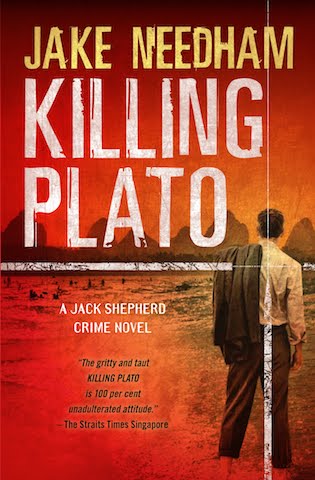
Bangkok, Phuket, Washington noir: Jake Needham's Killing Plato

Hardly anyone seems interested these days in developing a story slowly, gradually tightening the net around the reader. Most crime novels start with violence and keep up a hectic pace. But speed and murder aren't the only way to hold a reader's interest. Another is the employment of brisk writing and interesting characters. Jake Needham's Jack Shepherd novels fall into that category: as I mentioned in my review of the first novel in the series, Laundry Man, the series is in a first-person narrator that is cool, funny, and good company. As with Laundry Man, the second novel in the series, Killing Plato, starts quietly, with an encounter in a bar between Shepherd and an American fugitive who is hiding in plain sight in Thailand in order to avoid prosecution for financial crimes as well as a possible murder. Rather than jumping into the relationship, Jack rejects the offer of friendship and employment, a classic ploy of fiction, the delaying tactic. But instead of being frustrating, we experience the delay as if we're friends of Jack's, sympathetic and happy to see where this will lead.
The novel shifts the Eric Ambler style of spy novel (an outsider gets caught up in the dangerous game is the usual Ambler pattern) into a post-Cold War cynical world of financial crime, casual murder, and spiralling conspiracies. I mention Ambler not only because of the plot but also because of the tone: Needham's prose is never overwrought, Jack's voice is always natural even under stress. His stress in this case flows from being increasingly caught up in the fugitive's web but also in a sad but totally believable subplot concerning his life with Anita, his love interest here and in Laundry Man.
The conspiracies intertwine up to a point where they seem to implicate everyone from the U.S. president to Al Qaida, but after bringing forward (through dialogue with some of the conspirators) the more extreme threads of the overall pattern, Needham narrows ominously down to terrible verisimilitude and a coherence with historical events in the final passages, making the dark conclusion all the more credible. The unresolved threads of the plot trail out beyond the confines of the novel into the reader's daily life (and evening news).
The contrast between the increasing darkness of the story and Jack's lively voice has the dual effect of keeping the story moving and drawing the reader quietly into the depths of corruption, power, and money. There's a new sequel, and I'm anxious to see how Jack scrambles back from the edge of this political and emotional precipice.
Monday, April 02, 2012
Cameo on The Killing & other video reports

Did anyone notice who showed up in the AMC version o The Killing, in the first episode, as a new character (the District Attorney? Three points for guessing (answer below, and it's nothing to do with the image pasted in here, see below also for the photo identification). I found the 2-hour premiere to the new season of The Killing a bit confusing, though they're trying desperately to recover from that disastrous season-ender for the 1st season. The new characters promise a new story arc that overlaps in part with the original Danish Forbrydelsen, and I'll keep watching at least long enough to see if that develops in an interesting way. They've got to win me over, though.
On other fronts: The Italian series Nebbie e Delitti (Fog and Crimes in the subtitled version running now on MhZ Networks in the U.S.) is an excellent adaptation of the Commissario Soneri series by Valerio Varesi, shifted from the novels' Parma to Ferrara (and that series is the source of the image above). Just when it seemed like they were going down the "damaged detective" road, with Commissario Soneri brooding over his dead wife a la the defective detective, Monk, they found a way out of that trap and moved forward. I thought the first episode was very good, the second at least good (and that's where the "wife" plot was dealt with), and the third one excellent. Looking forward to the 4th and hoping that MhZ will pick up the further seasons.
Speaking of MhZ, I see that a limited selection of their imported mystery series are now available at Netflix (apparently only as DVDs, not streaming video). The more available these series are, the better for all of us. If it sounds like I'm boosting that network, I am--it's the only U.S. network with the courage to run subtitled shows, and I wish them the best.
Other series they've run recently or are running now: A Case of Conscience (also Italian) about a crusading lawyer (good but maybe a step below the quality of Fog and Crimes or Montalbano); Those in Power: an excellent Swedish series about women in politics--not a crime series but the best thing I've seen from Swedish TV so far; Don Matteo (a conventional mystery series and not to my taste, but set in Gubbio); East-West 101 from Australia (a police drama about strains between the Muslim and Euro-australian communities); Anno 1790--a Swedish period crime drama that I didn't like much at first but grew on me very quickly; plus reruns of Beck (more on that series another time), Coliandro (likewise--this cop show set in Bologna is a lot of fun), Wallander, etc.
So, who showed up on The Killing? Sofie Gråbøl, doing very well with the English dialogue, with only a few vowels sounding more Danish than English (and not out of place at all, given the large Scandinavian presence in the Seattle area).
Sunday, April 01, 2012
James Thompson, Lucifer's Tears

On the positive side, Lucifer's Tears (the second Kari Vaara novel by James Thompson) drew me in totally. The story, involving several threads that do and don't come together in the end, narrated by the guilt-ridden and troubled central character, moves quickly and kept me turning the pages all the way. On the other hand, by the end, I was a bit disappointed by several aspects of the book.
Vaara is now in Helsinki, following the rural investigation of Snow Angels, a disaster that leaves him with chronic migraines and a constant fear that his now-pregnant wife will miscarry again. The book begins with a very gruesome case that serves mostly to introduce Vaara's new assistant, Milo, an inexperienced but intellectually arrogant young man, and to establish Vaara's low status in the murder squad, to which he'd been appointed at the conclusion of the Snow Angels case. Several mentions of Dante are pertinent to the setting and psychological state of the detective (and the title of the book): the central circle of Hell in The Inferno is frozen rather than boiling hot, an appropriate image for a cold winter in Helsinki and the human horrors that are going on there.
The story really gets moving when the focus shifts to three other cases, the death of a Bettie Page lookalike who is a minor celebrity and the owner of a workout gym; a seemingly minor incident that causes Vaara to assault a young man who's harassing children; and a charge from the Interior Minister to cover up evidence that a national hero from the World War II era is actually a war criminal, implicated in the Holocaust. Along the way, we get a good (and interesting) dose of Finnish history, a subject of which most of the world is woefully ignorant.
In addition, Vaara's American wife Kate announces that her brother and sister will be arriving to help her out before and after the end of her pregnancy. It's essential to the story that Vaara's in-laws are each in their distinctive way extremely annoying. But as a reader, I found them as annoying as Vaara, and by the end of the book they had begun to make the story as irritating as they were themselves.
Thompson finds a unique way of bringing the threads of his story together, but the resolution has little to do with Vaara's investigation. In fact, Vaara and Milo discover a lot about the fitness guru and her husband, enough to know what was probably going on but not effetively enough to do much about with what they know. With Vaara suffering from those headaches constantly, dashing back and forth to help his wife and to deal with the disasters caused by his American visitors, and dealing with the politics of all his cases, there's really not all that much focus on any investigations.
Shortly after finishing Lucifer's Tears, I started two very different books, Jake Needham's Killing Plato (newly available on Kindle, featuring Needham's Jack Shepherd character) and Luiz Alfredo Garcia-Roza's first novel, The Silence of the Rain (which I originally read 10 years ago). Both describe difficult situations and fraught families, but each in its own way is a calm and straightforward story (Plato a thriller anchored in the narrator-hero's personality, Rain a detailed and dogged investigation of what the police assume is a murder and the reader knows is a suicide). Each is tight and atmospheric, the stories complex but essentially coherent, and neither has the tortured central character of Lucifer's Tears. And I'm afraid I find Jack Shepherd and Garcia-Roza's Espinosa better company than Thompson's Vaara, and the stories more satisfying.
Friday, March 23, 2012
From Finland and South Africa: 2 new crime novels

These two books could hardly be more different, but provide a perhaps interesting contrast. Harry Nykänen's Nights o Awe (translated by Kristian London and published by Bitter Lemon) is a police procedural set in cold Helsinki, featuring Finland's only Jewish cop, Ariel Kafka, the first book in a series. Jassy Mackenzie's The Fallen (published by SoHo Crime), more of a thriller, is the fourth novel featuring Johannesburg investigator/bodyguard Jade de Jong, who for this novel is mostly in the hot coastal resort of St. Lucia.
Nights of Awe is a grim tale of murder and conspiracy, with many twists and not a little quirky humor, recognizable from Nykänen's sometimes comic novels featuring hitman Raid. For instance, Kafka' name more often reminds people he meets of a Helsinki pawnbroker of that name than of the famous Czech writer. Kafka is single, but still dealing with family, in the person of his brother who tries to draw the detective back into active participation in the Jewish community (Ariel doesn't deny his heritage, he's just not actively engaged). A murder case that starts with two bodies, possibly Arabs, are found on a bridge and the railway line beneath it. The police hierarchy is quick to evoke terrorism, and Kafka is drawn into a twisted tale of competing allegiances and conspiracies that proves more and more deadly.

There are lots of dead bodies in The Fallen, as well, as well as twists and turns and family complications, but Mackenzie's plot is a bit tighter and more tense, leaving little room for comedy. Jade has invited her sometime boyfriend, Detective Patel, to spend a weekend at a resort that offers Scuba diving, and she discovers as she awaits his arrival that the Scuba lessons she's been taking have uncovered an unanticipated fear of drowning on her part: and she's not used to failure. She's about to experience a bit more of that in her relationship with Patel, though, and amid the personal turmoil, a woman is found dead in the resort. A man lurking in the shadows turns into a direct threat to Jade and others as the plot draws out corrupt cop, environmental conspiracy, and dark sexual and commercial acts.
While Mackenzie's characters are fully believable for the most part, there are a couple of them that seem a bit out of synch: one is a primary villain whose profit-driven, large scale crime is lessened a bit in its impact by the character being a bit sketchy. The other is one of his minions whose sexual proclivities are a bit too completely filled in, in a way that seems tacked onto the main plot, mainly to entrap an innocent incidental character into a salacious horror scenario. Is there a quota on women chained to a bed in a locked room these days, a requirement for at least one in a book? Or a TV show: I noticed a couple of weeks ago that the otherwise excellent TV series Justified (taken from an Elmore Leonard story) puts a woman in that same position, solely (seemingly) to blacken the heart of a character who was already sinister enough.
That said, I enjoyed both Nights of Awe, which draws into its story a lot of cultural and historical framework, and The Fallen, which carries along with its story a rich sense of the history and contemporary reality of post-Apartheid South Africa. On the subject of sexism in fiction and film, a brief word about a feemale character drawn from Valerio Varesi's novels, as translated into film in the new Italian TV series, Nebbie e Delitti (Fog and Crimes). More about the series another time, but for now: Several bloggers and commenters have complained about Angela, the lover of Commissario Soneri in the first book, River of Shadows, because Angela is in that book drawn as hyper-sexual, repeatedly seducing Soneri into having sex in dangerous places. In the first film in the series, taken from the same book, Angela's relationship with Soneri is developed more slowly (she erupts suddently into the book), and she's more fully drawn and more sympathetic. More about the TV series after I've seen the second installment, which runs tonight on the quirky MhZ network in the U.S.
Thursday, March 15, 2012
Cold Comfort, by Quentin Bates

The second in the Sergeant Gunnhildur series by Quentin Bates builds in intensity to the point that, about halfway through and a bit beyond that, it's the best crime-novel evocation of the financial crash in Iceland (and beyond) while simultaneously taking on the Sjöwall/Wahlöö mantle of empathetic social criticism in crime fiction. Alas, the story is so complicated that the energy has dissipated somewhat before the end of the book, and the somewhat anticlimactic climax reinforces that drop-off. Nonetheless, it is overall a very interesting book.
There are perhaps 4 threads to the book, the first being Gunnhildur herself: a flawed cop and mother, but not spectacularly or disastrously flawed, as is the case with a number of series characters. She is quite sympathetic, someone a reader might want to get to know, who is moving on with her life after the death of her husband and as her children grow up and out of the house. She's now working in a violent crimes unit in Reykjavik, where she is the da facto unit leader, in the absence of the official leader, and is thus at the mercy of some higher-ups (some of whom are actually effective police). She also returns to the small town of the first novel in the series, though, since she kept her house there, and both personal and professional events lead back there from time to time. The second thread is the death of a semi-celebrity, a fitness entrepreneur who has some other business going on on the side. She is beaten to death in her own apartment, and the investigation is the main thrust of the novel.
The other two threads are in some ways more interesting (as Barbara Fister has remarked at her excellent Scandinavian Crime Fiction blog). The most interesting is also the one that most suggests Sjöwall/Wahlöö, a man who has lost everything in the crash and blames a few individuals among the host of people (a number of whom feature in the novel in one way or another) who caused the misery but didn't experience the suffering themselves. This man is obviously on a collision course with those individuals and with the police. The final thread, though the one with which the book begins, deals with a nasty piece of work who inexplicably escapes from prison not long before he would have been paroled, and then goes on a violent spree, seemingly settling old scores with violent attacks.
The way these threads intertwine and resolve themselves shares something with the casual and unexpected plotting of Elmore Leonard, mostly to good effect. There's not a sudden epiphany that brings everything together, Gunna (as she is mostly called) plods ahead in her investigation and tries to take advantage of unexpected developments in each of the investigations. The course of the novel is very involving but so complicated that a reader's attention may flag after that middle point that I mentioned. Part of the confusion is unfamiliar and similar-looking Icelandic names, so that some of the men implicated in the crash and in the fitness guru's life are a bit hard to keep separate as Gunna bounces back and forth among them in her investigation (though I suppose with the boom in crime fiction set in Iceland, we should be getting used to Icelandic names by now)..
Overall, I think Frozen Assets, the first novel in the series, is a tighter and more coherent story, with an ending that is frustrating but not as anticlimactic. But Cold Comfort introduces some very interesting characters and develops the setting and stories of Gunna's environment in positive ways, leading me to look forward to the next Gunnhildur book with anticipation.
Friday, March 02, 2012
The Thief, by Fuminori Nakamura

The Thief (by Fuminori Nakamura, translated by Satoko Izumo and Stephen Coates and published by ShHo Crime) is a stripped-down philosophical crime novel, with prose that is sometimes reminiscent of Kobo Abe (more so than the book reminds me of recently translated Japanese crime fiction) or French fiction from Camus to the Nouveau Roman. There are several plotlines in the short book: the narrator-hero is a skillful pickpocket who's showing some signs of a breakdown (he's finding things in his pockets that he doesn't remember stealing); he approaches a mother and son who are shoplifting in a grocery to tell them that a store detective has spotted them, and becomes involved in their lives tangentially; and a crime boss approaches him with an offer he can't refuse, to participate in a series of thefts.
Along the way, the thief remembers key events in his life, all the while with a powerful metaphor hanging over his life (an oppressive tower). The first of these memories is of a master pickpocket who had trained him gets him involved in a caper that will put him in the power of the crime boss who will approach him again later. The second involves a love affair with a married woman whose memory haunts the thief.
As events careen out of the narrator's control, the tone of the novel remains calm, even distant. The reader learns a lot about the art of picking pockets, both in the narrator's interior monologue and in his advice to the young boy/shoplifter, to whom he becomes a sort of mentor (and whose mother also insinuates herself into his life). It's clear that the crime boss is luring him into something beyond his control, just as he is at a crisis point between of overcoming the sense threat represented by the tower and experiencing a sense of loss of control or memory in his activity as a pickpocket. All the threads (in plot and metaphor) come together in a tantalizing climax that hangs on (literally) a coin toss (not in exactly the way that sounds).
If the story sounds heavy, it's not. Its strangeness is in fact the everyday, matter-of-fact quality of the prose, in contrast to what would seem to be extremely stress-enducing events. The bleak plot line, emotional distance, and plain style are aspects that The Thief has very much in common with the classic noir, along with the cold and imposing urban setting. Some hard-boiled aspects of the book will probably seem strange, even comic, to readers like myself who aren't familiar with Japanese daily life (the narrator keeps buying cans of hot coffee from vending machines, for example). The drily philosophical tone and the noir atmosphere combine perfectly, providing a rapid and enjoyable "read" that is nonetheless cool and distant, provoking the reader to think about (as much as experience) the tale.
Thursday, February 23, 2012
A three-fer, from Italy and South Africa

It's not usually a good idea (for me) to be reading three novels at once, but in the case of my past week's reading, it has been interesting to see similarities in Ben Pastor's Liar Moon, James McClure's The Sunday Hangman, and Valerio Varesi's The Dark Valley (translated by Joseph Farrell from the Italian original, Le Ombre di Montelupo). Not that the three books are much alike in plot, characterization, or the crimes portrayed.
What they share is that they all progress by means of dialogue. In the cases of Varesi and Pastor, the effect is rather melancholy, but in McClure's book it is oddly comic. Varesi's book even gives the reader a dramatic climax in terms of second-hand conversation (it's an interesting effect), and most of the rest of the book is converstations among Commissario Soneri, a captain and a Maresciallo of the Carabinieri, and various inhabitants of a small town in the mountains near Parma. Varesi's first novel to be translated, River of Shadows, shares a similar approach, and each novel is embedded in a group aging men and in the politics of the conflict between partisans and fascists at the end of World War II (portrayed more subtly and to better effect than the war reminiscences of Marco Vichi's Inspector Bordelli, though, in my opinion). The only women in The Dark Valley are Soneri's girlfriend Angela (who's rather more sympathetic a character here than in the first book) and a woman who, with her husband, runs the small inn where Soneri has taken refuge from the city. The result is a rather one-sided buzz of conversation and gossip that is nevertheless interesting for its gender limitation. The solitary walk in the woods of the book's cover is a true portrait of the book in one way, but gives an ideal rather than an actual sense of what the book is about and how it progresses.
Soneri falls into the crimes associated with the failure of a mountain town's main source of jobs and income, a salame factory where in fact Soneri's father was once employed as a bookkeeper. Soneri's memories of his father become entwined (as well as reconsidered) with what is going on as the whole town faces collapse. The denouement is very interesting in the way it is revealed, through conversation that holds the horrifying nature of the central crime somewhat at arm's length and therefore more bearable.

McClure's Sunday Hangman (the most recent of his novels being brought back into print by SoHo Crime) portrays a closed world as well, but one that is so jarring that it's almost like reading science fiction. The racism and cultural violence of the apartheid era in South Africa is assumed, given to the reader in all its nastiness with no respite or commentary. McClure's contemporaries understood the satirical and critical import of his style of writing very well, though readers today may have some difficulty getting past the race-hatred (and fear) embodied in the characters' language and behavior. The style of writing is also a bit indirect, relying on dialogue and a narrative that reads almost like dialogue, with much unspoken and hinted at rather than given directly. But the rewards of persisting with McClure's Tromp and Zondie books (the former being an Afrikaan's lieutenant and the latter a Zulu sergeant in the South African Police) are considerable not to mention the historical value of getting such a direct portrait of life in that era. And not to mention the considerable humor, not least in the relationship of the two main characters, constantly struggling across cultural and racial barriers internalized by them both.
In Hangman, the plot is also very oblique and odd. A criminal on the run after a bank robbery in which Zondi was shot in the leg (and is still suffering from the wound) seems to have hanged himself along the road. But the medical examiner and Tromp think it was murder. The investigation winds around and around until it reaches a bizarre (but in the context o McClure's story, entirely believable) conclusion.

Ben Pastor, who is an Italian woman writing in English about a German World War II officer called upon to investigate crimes as well as to conduct his part in the war. Much of the conversation in this second "Martin Bora" novel is between the now-Major Bora and an Italian policeman, Guidi, pulled together to investigate the murder of a local plutocrat in Verona in late 1943. Bora seems at times like the German officer played by Erich von Stroheim in Jean Renoir's wonderful Grand Illusion: as the film progresses, von Stroheim has lost more and more body parts, until he's practically a cyborg. Bora has, just before the novel begins, been the victim of a partisan bomb and has lost a hand and almost lost a leg.
The quality of the dialogue in the book forces us to see Bora as a person, rather than a Nazi stereotype, in spite of his stiff German attitude and the willingness with which he seems to support atrocities perpetrated by his army. As the novel progresses we learn a bit more about his role in the atrocities that may (as the series progresses) change how we see Bora (there was little hint of any mitigation in the first Bora novel, Lumen. Bora is somehow both unlikable and sympathetic, and it will be interesting to see how he develops as a character through what is characterized as an ongoing series. Liar Moon, considered on its own, is a very interesting and unconventional portrait of a complex era of italian history (now that Bora has been sent to northern Italy after the Polish setting of Lumen), and the conclusion, reached after much digression in action and conversation, includes an interesting double-reverse and depends on the correct interpretation of the book's title, whose basis in folklore is finally explained.
I would have said that reading three novels based on indirect conversations rather than narration and action would have been frustrating and confusing--but Pastor, Varesi, and McClure are in their very different ways very good writers, and their tales are rewarding whether considered together or separately.
Tuesday, February 14, 2012
Puerto Vallarta noir: Lisa Brackmann's Getaway

Getaway, the second thriller from Lisa Brackmann, is the kind of book that Eric Ambler used to do so well, an ordinary person caught up in extraordinary events and forces way beyond his job description. Except that instead of spies and international intrigue, Michelle Mason is caught up in something she isn't able to figure out at all. Is it police corruption, drug gangs, the CIA, or something even stranger?
Michelle's husband killed himself, after revealing that he has been keeping secret from her the impending financial disaster that is about to engulf her life. She escapes her woes with a brief trip from Los Angeles, where she's now homeless, to Puerto Vallarta on Mexico's west coast for a last getaway before the reality of her new life sets in. A chance encounter with an attractive man and several margaritas on the beach leads to her hotel room, unwelcome night visitors, and ultimately to jail and the loss of her passport.
The mysterious Daniel (from the beach) disappears and an even more mysterious Gary appears, saving her from jail but proposing a devil's bargain: he'll help her, even pay off her overextended credit cards, if she contacts Daniel and keeps tabs on him. He won't say who he is, who Daniel is, or what's going on. What ensues is a puzzling series of encounters (violent and not) as Michelle spirals down into murky waters, including glimpses into horrific violence and horrible poverty, as well as the life of rich and not-so-rich locals and emigre Americans who are more or less permanent Puerto Vallarta residents.
Getaway is a faster ride than Brackmann's previous Rock Paper Tiger, with clearer threats and more violence, but it has some of the earlier books twisty indirection. Michelle is likable and pleasant for a reader to spend some time with, but she keeps stepping in it rather than getting her problems sorted out. To give her her due, she shows her nerve when it's called for and she has no way to know who to trust: the biggest threat in a very threatening atmosphere is her status as an isolated foreigner whose bubble of tourist-untouchability has been totally shattered.
Though the atmosphere and setting of Rock Paper Tiger were more exotic, and more up-to-date concerning art and technology, Getaway was for me a more convincing book, pulling me along with the story in a more compelling way, with more tangible threats and consequences coming down upon Michelle and other characters along the way. Not to give anything away, but the ending fulfills several strands of the book without totally wrapping up others. It almost suggests the ending of the Tony Scott film, veering off into a half-fairy tale, half metafictional other world: Getaway's ending is more believable than that of True Romance, but it's open-ended and contains elements of wish-fulfillment in the same sort of way.
Altogether, Getaway, due from Soho Press in May, is an interesting and entertaining update on the damsel-in-distress story (from the damsel's point of view) as well as the Ambler-esque spy thriller.
Tuesday, February 07, 2012
South African crime satire

As far as I can tell, Zakes Mda's Black Diamond is only available in South Africa, published as it is by Penguin Books (South Africa). Mda is a widely published author, whose books are generally available throughout the English-speaking world, but perhaps other publishers have been unwilling to pick up this 2009 novel because it is a merciless satire of life in the "new South Africa," a phrase repeated over and over again in the book.
There have been previous satirical crime novels from South Africa, published outside of (and in previous years, ONLY outside South Africa), particularly James H. McClure's Tromp & Zondi novels from the 70s and 80s and Tom Sharpe's hilarious early '70s Riotous Assembly and Indecent Exposure (mentioned here previously). More on McClure in a later post, since his novels are finally being reprinted, by Soho Crime in the U.S.
Black Diamond, though, is a post-Apartheid satire, with more in common, perhaps, with the very funny South African political cartoonist Zapiro than with McClure or Sharpe. The title of the book refers to the rising (and risen) black middle class and oligarchs today, particularly in Johannesburg (where Black Diamond is set) and Cape Town. Don Mateza is a bodyguard and security consultant whose former-model wife expects him to achieve more, to become the Black Diamond that she sees in him. Just as he is about to be a possible candidate for CEO of VIP Protection Services, a magistrate, Kristin Uys, is threatened by a petty criminal whom she has sentenced to jail time for contempt of court. The criminal, Stevo Visagie, gets his brother and mother and former nanny to agitate for his release, including threats to Kristin and even her cat.
There's a standard love triangle (and even a screwball comedy å la Hollywood in the '40s) there, and Mda doesn't hesitate to go there. But swirling around that part of the story is the very complex racial situation in South African society, exploited here to great advantage. Every aspect of the culture comes under Mda's scrutiny and ridicule, even the traditions of resistance (Stevo's nanny adopts the tactics of Mandela and the ANC, as she sees them, to get her boy out of jail in some of the more merciless comic passages. But Mda never dehumanizes his characters. While the characters of satire aren't typically the fully rounded characters we expect in the best crime fiction, Mda manages to convey the humanity of everyone involved in his cultural portrait.
There are some detours in the plot that suggest some of Tom Sharpe's more vicious comedy of Apartheid, but Mda keeps things moving along without getting bogged down in the more sensational (or embarrassing) elements, and the story ends up with everyone if not in their proper place, at least in a suitable position for a screwball noir of the new Republic. Mda's touch is here a bit less folkloric and sympathetic than in his wonderful Ways of Dying or The Heart of Redness, though neither of those uses the conventions of the crime novel (which Mda does for good effect in Black Diamond). I would say to publishers that on the one hand the rest of the world is familiar enough with the new South Africa to understand Black Diamond, and on the other hand, the book is itself a comic guidebook to that culture—more people should be able to read it.
Subscribe to:
Posts (Atom)