Thursday, July 29, 2010

foreign forgotten friday: Apartheid comedy and crime


We've heard a good bit about the pioneering novels of James McClure lately, and his stories include a good deal of brittle, even bitter comedy. But there's another pair of novels featuring Apartheid era police that broadens that comedy into laugh-out-loud fun, believe it or not. Maj Sjöwall said in an interview that the subtitle to all the crime novels she wrote with Per Wahlöö, "The Story of a Crime," refers to the crimes of the welfare state at least as much to the crimes the police investigate in the stories. Tom Sharpe's two South African novels take that idea several steps further: his stories of the police in "Piemburg" are a farcical vision of social crimes before the fall of white supremacy there. Perhaps less farce or satire than lampoon: The books are very violent and violently funny, perhaps the funniest crime novels ever, and two of the funniest books of any sort that I have ever read. With the added "frisson" that Sharpe's opinions so offended the government that Sharpe was imprisoned and then deported. Called to the scene when an upper-class white woman murders her Zulu cook, Kommandant Van Heerden (who thinks of himself as an English gentleman), trigger-happy Konstable Els, and paranoid security man Lieutenant Verkramp have to deal with miscegenation, S&M, a Bishop who is sentenced to be hanged, and a Keystone Kops police action that is unbelievably funny.

The same crew appears in Indecent Exposure, but against the background of porn films meant to invoke chastity, counter-espionage in a bird sanctuary, and a sort-of safari, all violent, racist (in a Modest Proposal way), and violently funny. I'm actually not a fan of Sharpe's later and better known English novels, in spite of their comic reputation, but these two South African books will reward any search that you have to make to find them.

This post is a little short, since I've been struggling against a total lack of electricity at my house since last Sunday afternoon, hampering reading as well as on-line time--back on the power grid today, but busy throwing out everything in the refrigerator...

"Historical" fake police raid, etc.


Reading the scenes in Guillermo Orsi's No-One Loves a Policeman in which he dramatised a fake police raid (staged only for P.R. purposes and actually facilitating the illegal arms trade rather than hindering it--I reviewed the novel here yesterday) reminded me of a story that John Cotten, who was my father's age and knew my family's history, told me many years ago, in Atlanta (*the photos attached here are unrelated to my story, except to illustrate a couple of the elements in it—they’re historical images plucked from the web and aren’t related to Atlanta or my story, directly). The numbers racket was very big in Atlanta before World War II (it was the unofficial, and illegal, precursor to today's official lottery). You would buy a number, called a "bug." from the guys who ran the racket. The man who came around the shops at 13th Street and Peachtree Street, where my family had a flower shop, selling numbers was called "The Bug Man" by his regular customers. From time to time, during the 1930s, the Atlanta police and the "bug men" would stage a chase down Peachtree Street from a few blocks north of the Loew's Grand Theatre downtown to the 10th Street strip, near the Peachtree Art Theatre and our flower shop. Everyone knew when the chase would take place, and people would come out of the shops along the way to watch, as if it were a parade or a scene from a movie, and when the cars had all arrived at the north end of the chase, the "bug men" and the cops would all go out for a drink together. One of distant relatives was a police sergeant who didn't know how to drive a car: his specialty was standing on the running board of a police car (which he got my father to drive when my father must have been 16 or 17) during the chase, brandishing his pistol, and jumping to the running board of one of the racketeers' cars as if he were making an arrest (shades of John Dillinger or the Untouchables). A few years later, in 1939, the Loew's Grand was the scene of the premiere of Gone With the Wind, and Mr. Cotten (who was just starting a career on the railroad, as a Pullman Porter) and my father both got jobs parking cars for the premiere. Ten years later, Margaret Mitchell, author of Gone With the Wind, stepped off the curb in front of the Peachtree Art Theatre and was run over by a taxi.

Wednesday, July 28, 2010

Guillermo Orsi's darkly comic No-One Loves a Policeman


Guillermo Orsi’s No-One Loves a Policeman is the latest Argentine Crime novel to make it into English, and perhaps the lightest in tone (in spite of the very dark events and the equally dark melancholy of the main character). The narrator is Gotán (a nickname based on back-slang for his former favorite activity, tango), a former cop and currently a salesman for a bathroom fixture company. The setting is December 2001, on the verge of a coup. In the middle of the night, a friend calls to ask him to come to the southern beach town of Mediomundo and without asking questions Gotán leaves his Buenos Aires apartment and heads for the south. When he gets there, his friend is dead on the floor, pitching Gotán into a morass that includes his friend’s daughter and current and former wives, the local police, a medical examiner, the collapse of the national government, a revolutionary organization, gun running, corruption, the press, and his own longing for his former lover and tango partner (who left him when she found out he’d been a member of the “National Shame,” the national police force. There’s a lot of movement back and forth from Buenos Aires to Patagonia, from one gang of thugs to another, all told in Gotán’s laconic, comic, and entertaining voice. The voice, in fact, is what holds the novel together: the plot doesn’t so much progress from one event or revelation to another as shift back and forth from a disastrous encounter in one town to a disastrous event in another. The ending includes some surprises, though, as well as a comic take on the heroic ending of many a thriller (and Western), with the ragtag gang of “heroes” appearing to save the day (sort of, and a little late). Argentina’s politics and history pervade the narrative and underlie the sardonic tone of Gotán’s language, as politics and history also underlie another recent crime novel from Argentina, Ernesto Mallo's Needle in a Haystack, but Orsi's novel is (while equally dark) less elgaic and more comic, perhaps more humane and definitely exhibiting a spark of optimism within the gloomy realities.

Saturday, July 24, 2010

CBS Cancels The Bridge


The Bridge may not have been the best ever TV cop show, but it was ambitious and very well written and acted. CBS waited a year after originally buying the show (produced by Canada's CTV network) to run it, then only let 2 episodes run. There are two other Canadian cop shows running on U.S. TV, Rookie Blue on ABC and Flashpoint on CBS, but OK, but both formulaic and episodic. The Bridge was a continuous story arc concerning a detective who becomes head of the police union in Toronto. No sexy 20-year old cops, the cast was age-appropriate and believably diverse (Aaron Douglas, pictured, was the central character). CBS parked it on Saturday night and did no promotion, and then was surprised when it didn't do well. If anybody has any suggestions for how to get acccess to the Canadian feed of this very good show, please let me know. If anybody has access to CBS, please let us know who to complain to (though it's not likely to do much good). I believe that the excellent Canadian crime writer John McFetridge was one of the writers on The Bridge, an indication of the excellence of the scripts. Too good for broadcast TV, The Bridge should probably have been on cable to start with, and its numbers would have been respectable there. Oh well, another good one bites the dust...

Thursday, July 22, 2010

Noir meets real life in Argentina: foreign forgotten friday


I'm reading the latest of the recent translations of crime novels from Argentina, Guillermo Orsi's No-One Loves a Policeman, so I thought I'd recommend a forgotten (or at least not well-enough-known in crime fiction circles) Argentine novel, Ricardo Piglia's Money to Burn (filmed as Burning Money or Burnt Money). Piglia's 1997 novel was published in English translation by Amanda Hopkinson in 2003. Money to Burn brings to the fore noir fiction's relation to the underbelly of everyday life by combining fiction with the documentary reconstruction of a real event, which took place between September November 6, 1965. Two friends are recruited to join an armored car robbery in Buenos Aires, and the crew brings off the heist and heads for Uruguay. Holed up in a Montevideo apartment, they're discovered and a 15-hour siege by 300 police ends with the crew burning the cash to keep it from lining the pockets of the police or making its way back to the bank--and then mostly getting killed (or getting mostly killed). the public seems to turn against the almost mythic thieves because they burned the money, a modern sacrilege, but the act involves the thieves sense of themselves as anti-establishment urban guerrillas. Jonathan Bryant at nthposition.com compared the novel to "a heist film made by Richard Linklater" as well as invoking Borges, Chandler, and Capote. What came to my mind when re-reading it was the doomed-outlaw theme of much noir fiction, from Paul Cain to Jim Thompson to contemporary crime fiction. the style is not straightforward, shifting from stream of consciousness to newspaper and TV reports and from the criminals to the police. But no novel I know conveys the descent from criminal success to deadly stand-off as effectively as Money to Burn. The reviews of the movie emphasize the homosexual relationship between the two friends at the center of the story, and the movie seems to have been shown on U.S. TV only by the Logo cable channel, but the novel emphasizes the social themes, the crime, the drugs, and the lives of people on the run rather than focusing on the relationship between Dorda and Brignone (called Nene and Angel in the movie). Piglia is known for criticism and novels that are very literary in form and closer to sci-fi than to crime fiction. Money to Burn stands alone in his work for its close attention to real life, its colloquial language, and its accessibility as a pure story. And it stands alone in crime fiction in its effective and entertaining combination of noir and documentary. The cover of the English translation, published by Granta, is also an effective evocation of the novel's cool, violent, and doomed story.

Thursday, July 15, 2010

foreign forgotten friday: Irish police procedural


I'm posting a "forgotten book" a little earlier (but hey, it's Friday somewhere!). John Brady’s The Going Rate is not so much a forgotten book as an overlooked one. Published in 2008 by his Canadian publisher, McArthur & Co., I saw nothing at all about the existence of the book until, in my regular (but obviously not regular enough) search for anything new by Brady, I discovered a couple of weeks ago that The Going Rate, his 10th crime novel and the 9th in the series featuring Dublin Garda Detective Matt Minogue, was published two years ago. Brady’s forte is voices: the dialogue among the police crackles with the officers slagging one another and speaking obliquely about the matter at hand (as people do speak when they work together, not needing to explain everything). The cops are working in Dublin but mostly from somewhere else in the country, and they often trade insults about the country versus the city and various stereotypes about the regional characteristics of the Irish.

The Going Rate is, for my taste, one of Brady’s best books. It shares a bit of plot and setting with Declan Hughes’s recent City of Lost Girls (both deal with old friends involved in the film business, meeting in Dublin pubs to discuss their past and their hopes for future projects), but (again, to my taste) The Going Rate is a better book. It deals with very concrete, individual relations and crimes, whose consequences are presented vividly in their effect on families and suspects, and with an established but struggling screenwriter trying to pitch a TV series, where City of Lost Girls is involved in international cinema personalities and an international serial killer. Nothing wrong with oversized and self important personalities or with globe-hopping serial killers, but I’m more inclined toward stories of regular folks and ordinary crimes.

The two narrative threads of The Going Rate, which takes place at the cusp of the collapse of the Celtic Tiger, follow Minogue, now promoted off the streets and into an international liaison office, and Dermot Fanning, the struggling screenwriter, whose wife supports the famiy (including a toddler) by teaching school. Fanning has made contact with Minogue’s former partner, Tommy Malone (now in the drug squad) and with a petty gangster named Murph, in order to get details to add realism to his script for a series about the Dublin underworld (The Wire is mentioned in passing as a possible model). Murph takes Fanning to a dogfight, where they come to the attention of the sinister Cully (who sometimes talks like a Dubliner, sometimes like a Londoner), who “takes over” Fanning from Murph.

Meanwhile, Minogue has become involved in the investigation of the beating death of Polish immigrant (and there’s a great deal of material about immigration and its consequences for Irish society). A group of teenagers becomes involved, and the interrogation of these 4 uncooperative kids (and what they did or didn’t do to the dead Pole) is an important part of the story, along with Minogue’s involvement with the detectives at the Garda station assigned to the crime. There is also some carryover here from the previous Minogue book, Islandbridge, concerning the disgrace of Minogue’s colleague and mentor, Superintendent Kilmartin, but it’s possible to catch up with that plot element without having read the previous book.

There’s always an element of the comic in Brady’s books, particularly in the dialogue (and a reader has to pay attention to the subtext of the dialogue to get the humor and even the point of the conversation). But as the two segments of the plot move toward one another (and the Fanning plot begins to take up more of the space of the story) a subtle but pervading sense of tragic inevitability darkens the novel, reminding me of some of Graham Greene’s crime stories: you know that Fanning is in over his head, tempted not only by the promise of a “genuine” tone for his TV script but also by the danger and thrill of the underworld, and you know that Cully is somehow wrong, but the reader has to infer a lot of what is to come by the lapses in their dialogue, the refusals of one of them to answer the other’s questions and of Fanning to allow his common sense to pull him out of the relationship. The climax is sudden and shocking, the story is ultimately resolved quietly, in conversation among detectives, partly as they intrude upon a crime scene where they have no business being: the subtlety perfectly sets off the violence and tragedy of what has gone before.

Brady is very good at giving a reader a vivid visual and auditory scene without dwelling on the more obvious plot (which is often occurring “off-camera”). That technique focuses the reader’s attention on the characters and their interrelationships (and conversations). The result, particularly in The Going Rate (whose title resonates with several aspects of the book’s overt plot and social subtexts), is a very good crime novel that copiously deserves a wider readership.

I don’t know if the fact that Brady emigrated from Ireland to Canada (though he still spends considerable time in Ireland) has limited his inclusion in the attention currently being paid to Irish crime writing, but he is one of the unsung pioneers of the high level of crime fiction in and about Ireland. His skill in indirect storytelling and engaging dialogue (as well as drawing his characters and the country into a wider social context) has continued to grow since his first novel appeared in 1988, and it would be a shame if his books were limited, because of his residence or the location of his publisher, to only a Canadian readership can appreciate the newest Minogue book (or the new one, apparently titled The Coast Road) scheduled to be published by McArthur & Co. later this year.

Sunday, July 11, 2010

Bologna noir by Barbara Baraldi


The publisher of the newly translated (by Judith Forshaw) The Girl with the Crystal Eyes, by Barbara Baraldi, pitches the novel as the story of a female Hannibal Lecter, and the novel itself includes a sly mention of Carlo Lucarelli's female cop in Bologna, but Baraldi's novel bears little resemblance to Lecter or Lucarelli's books. It's a book that will disappoint anyone expecting a realistic and straightforward crime novel, but it will reward anyone willing to go along with Baraldi's impressionistic, allusive tale.

Someone is murdering men who have attacked or threatened women, and we see some of the crimes from the point of view of the unnamed woman committing the crimes. Other chapters follow two women, Eva and Viola, one of whom is a shy young single woman working in an ad agency and the other is kept at home by her mostly absent fiance, as well as the point of view of a detective working on the murders. The tale is told in very short chapters with extremely short paragraphs (frequently single sentences), with some dialogue (though not a lot) and little evocation of Bologna (except for mention if the city's arcades).

The puzzle is as much "what's going on" as "who's the murderer," and the reader's sympathy is with the killer more than the victims. A reader will most likely have figured out the "who" before the end, and the "what" also gets clearer, but there are some surprises remaining at the end, as the detective has gotten a result that he doesn't much believe in.

There's a genre of crime fiction more typically European than U.S.-U.K., an approach to fiction that is psychological and metaphorical rather than gritty and realistic. Though this style is not my usual cup of tea, The Girl with the Crystal Eyes kept my attention, partly through keeping me interested in how the murderer got to the point of becoming a serial killer, and partly from the appealingly cynical attitude of the narrator, who floats above events with an omniscient, jaundiced eye. The characters, too, sketchily but effectively drawn, are not so much likable or individualized as sympathetic in their representation of recognizable social situations. Baraldi skilfully lays out her story in short brushstrokes, skilfully guaging her appeal to the reader's interest at every stage, and skilfully keeps the story moving rapidly forward.

It would be interesting to know what Baraldi's other works are like (she's evidently a well-established crime writer in Italy), if anyone has any inside knowledge. Based on The Girl with the Crystal Eyes, she's a quite different voice in Italian crime fiction than the noir and policier writers that we have previously had access to in the English-speaking realms.

Friday, July 09, 2010

foreign forgotten friday: Sydney noir


Most of the Australian crime fiction that's showing up in the U.S. lately is in the police procedural mode, from Garry Disher, Peter Temple, and Adrian Hyland. One of the early titles in Serpent's Tail's Mask Noir series, though, was full-fledged hard-boiled noir, frequently reminiscent of Jim Thompson but as frequently reminiscent of Ken Bruen (also first published in Mask Noir): John Dale's Dark Angel. I frequently flashed back on Thompson in the way that Dale evokes low-rent neighborhoods and narrates tough-guy dialogue; and Dale's quirky use of language frequently rises to a poetic phrase, suggesting the kind of gritty poetry that Bruen is famous for (plus the bouncer's handicapped son suggests a theme in the earlier Bruen books).

Set in Sydney's tough underground, Dark Angel features a big but not very aggressive bouncer, a tough-girl heroine and her gay, rent-boy brother, and a Chinatown gang connection. Jack Buturov leaves work on the door of a casino and almost without thinking saves Damian, the rent-boy, from a brutal beating, and Damian persuades himself into Jack's bed. One of the interesting aspects of this novel is Jack's willingness to accept Damian's advances in spite of being at least mostly heterosexual, and another interesting theme is Jack's relationship to Angela Frick, Damian's sister, who shows up after her brother is murdered and persuades Jack to help her find the killers (since the police isn't very interested). Angela is the aggressive one in this partnership, rather than being a typical noir dame tempting the detective into action.

As the plot develops, there are elements of the California noir of Raymond Chandler and Ross MacDonald: dirty cops, political chicanery, and rich but broken families (very broken, in the mode of some of the most famous L.A. noir stories). With bent cops and Triads chasing him, Angela pushing him onward, and two children (his own and Angela's) threatened, the story propels forward toward a conclusion that, like some of Jim Thompson's, is a bit ambiguous and not very optimistic about the possibilities for an individual to make changes in a rotten system. In fact, the conclusion resonates with events of today, in local and national politics around the world.

Dale wrote one more novel in the pulp-noir mode, The Dogs are Barking, also published by Serpent's Tail in the U.K., and he won Ned Kelly Awards for both (so he's not really forgotten, in Australia at least). He has a couple of true-crime books and a new, non-crime novel, but the two crime novels deserve to be revived and back in print: They uphold meritoriusly the tradition of noir from Cain to Thompson to Bruen, Pelecanos, and Guthrie.

Thursday, July 08, 2010

New South African noir by Jassy Mackenzie


There's a lot of violence and several false leads in Jassy Mackenzie's first "Jade de Jong" investigation, Random Violence, recently published in the U.S. by Soho Press. Mackenzie also gives us a vivid portrait of post-apartheid Johannesburg, including suburban houses walled in against the violence, crumbling cityscapes, property speculation, some neighborhoods and townships flourishing while others descend into poverty, gangs, and neglect. The plot concerns Jade's return from self-imposed exile after 10 years working as a private investigator abroad.

What brings her back is the release from prison of a man against whom she has sworn revenge, in connection with the murder of her policeman father. Her father's protege, David Patel, asks Jade for help with a difficult case (a murder/carjacking), not knowing that she will also be colluding with a petty gangster who has promised to help her with her revenge (and who has helped her with a previous revenge incident). The revenge plot carries forward into a plot twist while the murder gets more complicated (not random violence at all), and Jade's gender adds an interesting gender-twist to the noir tale, not only in the tough-girl as central character but also in the twist on the damsel-in-distress at the end.

As she draws closer to an answer to the puzzle, David is suspended (when his boss discovers Jade's other agenda), the gangster-collaborator is sidelined, and Jade is left alone to face a killer that we have already seen graphically and gruesomely murder a couple of people. Given the extreme violence depicted (and also promised in the villain's musings as presented in the narrative), I found the conclusion a bit flat—not that I was hoping for more hyper-violence but given the villain's plans and prior actions, the denoument seems a bit quick and a bit contrived. Nevertheless, Random Violence is not only a detailed and involving portrait of a struggling, hopeful, and violent culture, but also a new take on the rapidly developing field of South African noir and a good read.

Monday, July 05, 2010

Cold Swedish Noir: Leif GW Persson


Pantheon Books very kindly sent me an advance copy of Between Summer's Longing and Winter's End, subtitled The Story of a Crime, which is to published in the U.S. in September. The subtitle suggests Sjöwall/Wahlöö, and the novel does share some of the perspective and style of the Martin Beck novels (though not the focus on a single detective unit). The story also shares some common ground with the last two volumes of the Millennium Trilogy, in that one thread of the plot deals with the Swedish secret police, though from a far different perspective, and also in the blatant presentation of misogyny in the culture in general and among the police in particular (and even more blatantly in one of the characters' private life).
In fact, a reader can perhaps learn more about life in Sweden from Persson's book (the first installment of a trilogy) than from most other Swedish crime novels, including the Millennium series: the story occurs just before and after Christmas, 1985 (with a bit of explanatory material from earlier decades)—and as with a viewer of the charming first section of Ingmar Bergman's film Fanny and Alexander, a reader will learn a lot about Swedish holiday celebrations, from the 1980s in this case rather than the earlier 20th century, and as in the Bergman film, the holiday season is merely the foreground to a darker tale.
Persson's novel combines a bit of Catch-22 with a bit of Le Carre and some suggestion of The Day of the Jackal: his trilogy explores the cultural milieu of an event that Swedes would immediately recognize from the date of the novel's story, the murder of Olaf Palme. But unlike Jackal, we're not presented with a methodical assassination plot, and unlike a Beck novel, we're not shown a coherent if frustrating police procedure. And there's considerable humor (very dark comedy) in the story, the characters, and the sometimes repetitive language (repetition for effect, usually with phrases that Persson shows to be common police language, usually terms they use to refer to themselves). There's also a good deal of carefully handled poetic language, presented in a self-deprecating way, as with the title of this book, its chapter titles, and at least one of its sequels, referring to a poetic paragraph frequently described as ambitious but amateurish.
Summer's Longing/Winter's End begins with the apparent suicide of an American journalist who has fallen from the 16th floor of a Stockholm student dormitory, where he has been staying. The several clusters of police who are called to the scene are portrayed in Joseph Wambaugh style, warts and all, each of them given a voice and a distinct point of view and all of them thoroughly embedded in the cynical and insular world of cops. Gradually, a few of the characters become more prominent, particularly Inspector Johansson, who becomes the lead in one of the two major threads of the story. A second thread begins somewhat later, featuring two secret policemen, Berg and Waltin, who have collectively and individually been conspiring to inflate the secret police budget and to create layers of internal and external activity to justify their existence and their budget.
The two threads are on different, converging time tracks, with frequent digressions in both (and many digressions from the main plot, in Persson's careful characterizations of the main characters, their private and personal lives, and their sometimes flagrant foibles. There are many twists along the way, sometimes in a realization that a character described by one set of characters is actually someone we have been introduced to in another context (and frequently the realization is a bit ominous).
The humor and the overall tome of Summer's Longing/Winter's End is very dark, and not just in the cynicism of the police. The operations of the secret police are sometimes right out of comic opera, but with severe consequences to innocent (and not-so-innocent) citizens, and the regular police force is mostly incompetent to the point of parody (the head of the national police in particular). But Persson knows whereof he speaks: he in fact briefly refers to an event in which he himself took part, as a whistleblower, while employed by the police in the decade before his story, and he is both a lecturer for the National Police Board and a nationally recognized psychological profiler. The operations of regular and secret police are vivid and credible, as well as frequently inept and comic.
The pull of the story comes not from a pell-mell rush toward the assassination, since we don't hear anything about it until it happens. Instead, the narrative interest comes from the twists and turns of the two sets of characters as they try to deal with the suicide and its consequences (first of all, its consequences for the cops themselves, and then to the nation). One of the most interesting aspects of the book, for a non-Swede, is the skewed, Swedish point of view in the Cold War. To be seen to have cooperated with the CIA is no less damning than to have cooperated with the Russians, and the secret police have to approach their American cousins through German intermediaries. Swedish politics, as presented here in its '80s version, is fascinating and nuanced, rather than simply presented as a single point of view on the welfare state (pro or con).
Persson's novel is large, about 550 pages in the translation (which was done by Paul Norlen), but the story never flags. It's plainly not "the next Stieg Larsson," for its aims are more subtle as well as having more cultural weight. Summer's Longing/Winter's End is more chilling, for its realism, than Larsson's novels: thrilling though they may be, and anchored as they are in social criticism, they have a fantasy (almost Nintendo) quality, particularly in the character of Lisbeth Salander. Persson has given us something very different, though no less entertaining (to my mind, anyway): a vibrant tale of conspiracy, espionage, murder, comedy, and abuse of state power, a tale that resonates with our own time and beyond Sweden, while also giving a brightly rendered view of Swedish life and a fascinating set of characters.
One word of caution: It's not so much the violence in the story as the misogyny (consciously portrayed rather than simply assumed as given, which is the case in too many thrillers and crime novels) that is shocking, in its pervasive quality and in its particular manifestations. The murky, vindictive, power-hungry world portrayed is a male realm, and as presented it's a regime primed for an overthrow that one might assume (as an outsider) to have begun with the shock to the system to which this novel refers. But if that sounds a bit heavy, I can assure readers that right up to the last page, there are twists that will make you both cringe and smile.

Saturday, July 03, 2010

The last of Mick Herron's Zoe Boehm stories


Mick Herron wrote 4 detective novels featuring Oxford private detective Zoe Boehm--though the first one delayed Zoe's entrance until near the end, and in the last one, Smoke and Whispers, she appears on the first page as a corpse floating in the Tyne River in Newcastle. Zoe is present in most of the book through the memory of the main character in Down Cemetery Road (the first Zoe book), Sarah Tucker, who was also a minor character in The Last Voice You Hear, the second. Smoke and Whispers also features the serial killer from The Last Voice, whom Sarah suspects of Zoe's murder, and one from Cemetery Road, Gerard, the hilariously annoying dinner guest. If that sounds like the series is tied together by ongoing threads of character and plot, it is, but each novel is also independent.
Sarah travels to Newcastle, stays in the same hotel where Zoe stayed (and from where Zoe had sent her a postcard), identifies her body, and speaks with two police detectives. But instead of continuing to work with the police, she follows lines of coincidence that she begins to find, not least the presence of Gerard in the hotel. And Gerard leads her down another plotline connected to Cemetery Road, an orphanage that may have been involved in criminal activity. Beyond describing Sarah's investigation and the orphanage subplot, I can't say much about the story without giving too much away—though Herron is less twisty here than in Cemetery Road or the excellent Slow Horses, both of which exhibit abrupt and entertaining changes of direction. In fact, the biggest surprise in Smoke and Whispers is one that is telegraphed in advance by Sarah's voice in the internal dialogue that takes up a good part of the narrative, though a reader is encouraged to question her judgment all along by Sarah's own doubts about what has happened or is happening.
Smoke and Whispers is sometimes comic, though not as funny as the beginning of Cemetery Road, and is also pervaded by a sense of mortality, though not in quite as moody (almost morose) a fashion as Last Voice. It's also lighter than either of those books, both in tone and in the thriller aspects of the plot, but as with all of Herron's writing, Smoke and Whispers is always interesting and entertaining, and anyone who starts the Zoe "tetralogy" will be rewarded by continuing with the series (the third volume, Why We Die, is a very entertaining U.K. "take" on a genre that in its U.S. manifestations can be called "redneck noir"). I only discovered Herron with his latest book, Slow Horses, and it says something about his skill that I have quickly worked through his whole output and expect to seize the next one whenever it appears.

Thursday, July 01, 2010

foreign forgotten friday: French writer, East European crime


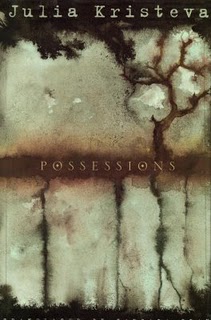
It's not all that unusual to find credentialled French intellectuals writing crime fiction: recent examples include Fred Vargas and Dominique Manotti, two of the most successful French crime writers. But I was surprised to discover recently that one of the most famous of all French intellectuals, the Poststructuralist-feminist-psychoanalytic theorist Julia Kristeva, has also written crime novels, three at least (three have been translated anyway). They feature journalist and amateur detective Stephanie Delacour, music-loving police detective Northrop Rilsky, and a fictional country, Santa Varvara, that resembles Kristeva's own birthplace, Bulgaria, after the fall of the Wall (and the corruption and instability of post-Soviet Eastern Europe is a theme in the books). The first of the three stories, The Old Man and the Wolves, deals with werewolves and myth, also the themes of one of Fred Vargas's novels: and if Kristeva's is not exactly a conventional crime novel, neither is Vargas's. The second of Kristeva's murder is Possessions (more on that in a minute). The third Delacour novel, Murder in Byzantium, deals with a serial killer, a cult, and Byzantine history—Kristeva has called it her anti-DaVinci Code. Possessions was for me the most accessible of the three, both in terms of the story and in terms of my ability to get the book for a reasonable price. It deals with the murder and decapitation of a translator, Gloria, who is a friend of Stephanie's, during the night after a dinner party attended by Stephanie and several hangers-on in Gloria's Santa Varvaran circles (her deaf son's speech therapist, a couple who are in the perfume business, etc.). Gloria's dead husband is posthumously a famous painter and her current husband (in London at the time of the party) has achieved financial success in dealing the painter's work. The novel alternates between fairly straightforward sections (such Rilsky’s rather Agatha Christie-esque interviews the dinner party guests, who are naturally the prime suspects) and more digressive meditations in which Stephanie and others think or talk about headless Gloria, psychotherapy, philosophy, feminism, etc. But these digressions are far from dull, and though given in poetic language that is not always lucid, they're suggestive, interesting, and actually do relate to the crime at hand, as well as to the genre of crime-writing (including the fact, exploited by others in the field, that in a murder mystery, the essential event has already occurred at the beginning—and in this case the discovery of the murderer or murderers is not the conclusion of the story, which ultimately hinges on the decapitation rather than the death). The primary themes of both the rational sections and the more emotional and digressive ones are dichotomies of deafness and vision, speech and painting, music and language, the "logical landscape of Paris" and the murky dreamscape of Santa Varvara, and a primary topic is sexuality (presented in graphic as well as more intellectual terms). While neither the novel as a whole nor the conclusive but also allusive ending would satisfy all readers of crime fiction, Kristeva's Possessions is not less successful within the genre than a number of other, more recent novels that bend and stretch the rules of the field. And Kristeva doesn't condescend to the genre: if her writing is perhaps more philosophical in tone than most crime writers, she and other writers have established beyond doubt that it's possible to write crime fiction without pitching to the lowest common denominator of the reading public. Kristeva expects a reader to understand some cultural references (though none are particularly obscure) and to follow her at least part of the way into her philosophical themes, but Possessions is a fully realized and innovative mystery novel.

Thursday, June 24, 2010

foreign forgotten friday: Czech noir circa 1968


One of the staples of contemporary crime writing is the detective struggling against a police hierarchy that will not allow him to solve a case, because of sensitive social or political issues, usually concerning people who are for various reasons above the law (sometimes "national security," sometimes social prominence or political clout). Two examples I can think of are the forthcoming Collusion by Stuart Neville, wherein the "special branch" of the Police Service of Northern Ireland (though no longer called the special branch) will not allow Inspector Lennon to investigate what's actually happening because of the lingering power of certain parties formerly at war in the Troubles. In almost all of Donna Leon's Brunetti novels, the detective is unable to bring the criminal to justice not because he doesn't know what happened but because the villain is too well connected socially (to prominent citizens or the government) or criminally (to the Mafia). In today's "foreign forgotten friday" entry we can see another version of the theme: Repeatedly, Lieutenant Boruvka of the Prague police, in 1968, cannot bring murders to justice because Communist Party members are untouchable or the crimes committed reveal truths that are politically untenable. Josef Skvorecky wrote the stories that make up the four books featuring Boruvka in the years just before and just after his emigration from Czechoslovakia to Canada in 1968. The last book (The Return of Lieutenant Boruvka) deals with the detective after he has himself fled the Eastern Bloc, and the first two books, Sins for Father Knox and The Mournful Demeanor of Lieutenant Boruvka, are collections of entertaining puzzle mysteries with social and political overtones. The End is a collection of stories that collectively add up to be a novel, concerning the days just before and after the Soviet invasion that closed off the Prague Spring in '68, not from the point of view of political activists, students, etc., but from the point of view of a melancholy civil servant, a cop, who retains enough humanity to be dismayed by the obstacles thrown in his way by those who would conceal what really is happening. The stories frequently feature Boruvka's young daughter Zuzana, a who is, at the beginning of the book, pregnant and unwilling to name the father but is at the point of marrying someone who isn't. The cases concern a prostitute who has overdosed on an unlikely drug, a missing-person cold case that is revived when a body appears, two teenage girls shot with a military weapon, a murdered delivery driver who came up against corrupt colleagues, and the death of a retired bureaucrat who may have been investigating "anti-state activity." Boruvka isn't brilliant but he's dogged and humane, qualities that might serve him well in other circumstances but here cause him grief. He provides an entertaining if melancholy glimpse into the crimes committed by individuals and by governments in a previous time, as well as the personal tragedies and small triumphs that a humane person may suffer. Maj Sjöwall says that the subtitle of all the Martin Beck novels she wrote with Per Wahlöö, The Story of a Crime, refers to the social welfare system of Sweden in the 1970s, not to the crimes committed by characters in the novels. Skvorecky tells the story of a different crime, that of the Soviet-imposed Communist government and bureaucracy of Czechoslovakia in the 1960s, told, as with the Beck novels, through the filter of the ordinary crimes that Boruvka has to deal with. Skvorecky has used the detective form elsewhere (notably in The Miracle Game), but never with as light a touch as in the Boruvka stories, a lightness that is a perfect foil for the heaviness of the interference Boruvka experiences and the gloominess of the social milieu.

Tuesday, June 22, 2010

Shamini Flint's Inspector Singh at home in Singapore


Shamini Flint's new Inspector Singh Investigates: The Singapore School of Villainy is the third in her Southeast Asia series that in previous episodes has visited Malaysia and Bali. Actually it was also the first: I reviewed her first novel, Partners in Crime, some time ago, and she has rewritten that story partly to make it consistent with the now-developed series (and she told me that she wished she'd just written an altogether new story, since it was more effort to rewrite the existing one that it would have been to start over). But the new version is an improvement on the original, which occasionally veered toward a romance rather than a crime novel, with the most central character being not Inspector Singh but one of the lawyers in a firm with a large office in Singapore, Annie Nathan. Now Flint has turned the whole plot over (in some ways that I can't suggest without spoilers), and though much of the material from Annie's point of view remains, the focus is more in the short, portly Sikh detective, who's a more promising focus for what is becoming a long-running crime series. Annie's partners in the law firm are a true nest of vipers, each a criminal (in some sense) in his or her own right. When the senior partner is murdered in his office after hours, it's the partners who are the primary suspects because the office requires key-card access. But one of the cards is missing, and several characters, including both the murdered man's current and ex wives, have good motives. Whereas Partners in Crime relied on an Agatha=Christie-esque confrontation to reach a resolution, the new one calls more upon Singh's instincts (though the original confrontation scene is still there, in altered form, as one of many red herrings. Overall, The Singapore School of Villainy is a good detective story, an enlightening glimpse into the corners of a prosperous but highly controlled city state (and not a tourist-board whitewash), and an investigation of the many forms in which one may besmirch one's own character and reputation. High marks on all counts. Plus we get to see Singh on his home turf, with a great deal more of his wife, his boss, and his fellow cops, fleshing out the portrait of Singapore murder squad and life in the city state. And for anyone who has access to Partners in Crime, it's interesting to see a writer at work, turning a story into quite something different, while retaining much of the interest of the original.

Sunday, June 20, 2010

Stuart Neville: Collusion


A good writer can find a story in what seems like there's not one: Stuart Neville's The Ghosts of Belfast (known in the U.K. as The Twelve) ended with little hint that there was more story to tell, but Collusion is indeed a fully realized sequel as powerful as the first novel. The threads that Neville pulls from the ruins of Gerry Fagen's life at the end of The Ghosts of Belfast include the eerie connection that he has established with young Ellen McKenna, as well as Gerry's promise to Marie, Ellen's mother, when he leaves her with a cell phone number for him. Also, readers of Ghosts will remember that Ellen's father, who abandoned Marie before his daughter's birth, was (as a policeman) the cause of Marie's estrangement not just from her family but from her entire community. The father, Jack Lennon (as a Catholic who enlisted in the police when it was still a bastion of Protestant Loyalism) suffered the same loss, and he's still an odd man out in the newly reorganized police of Northern Ireland. The other central character who remains from Ghosts is Bull O'Kane, one of a few survivors from Gerry's rampage. O'Kane, now in a nursing home he has eerily taken over entirely, has hired an assassin, known only The Traveller (implying a never-verified link to the outcast community of Travellers), and a good deal of the new novel follows his own rampage, echoing Gerry's in many ways. Gerry is now illegally in the U.S., though we know that, like Adrian McKinty's Michael Forsythe in The Bloomsday Dead, he will be pulled back home to protect someone who has no real claim on him. There's a dimension of Collusion that goes beyond Bloomsday Dead, related to the setting of Neville's novels in the North: the Collusion of his title refers to relations among British Army, the police, the Loyalists, the IRA, and so on, during the long violence so recently becalmed.
Both Michael and Gerry were gangsters of a sort, but Gerry was political, and also, thanks to his ghosts, has nightmares if not exactly regrets about his career. Now that he has satisfied his ghosts, his nightmare now is psychological and perhaps psychic vision that hovers over the whole story like a premonition. When the violence (and this is a very violent story) begins to escalate, there's an element of two famous movies in the story: the first Terminator and the great Grand Illusion (if you know those movies you'll probably guess the grim comedy that Collusion shares with them--if not, let me know and I'll post the answer). And as the violence and also the pace escalates the novel becomes more and more compelling, the more so because as it moves along there are twists that take the story beyond the obvious directions. The first and more ambiguous of the two covers posted here is apparently the U.S. design, and the other, plainly showing a gunman and one of the novel's scenes, is the U.K. version. I think I like the hazy U.S. one better than the pulp-y U.K. one in this case, though both are evocative. One of the sites on-line that advertises the release of Collusion suggests that one of the characters who survives the novel may be the center of yet another unlikely sequel: once again, perhaps, Neville will (fortunately for readers) find a great story in the ashes of the current one. I for one will be waiting impatiently: Collusion is a disturbing, unrelenting, and vivid trip into the nightmare aftermath of social, criminal, and personal death and destruction.

Friday, June 18, 2010

Foreign Forgotten Friday


At Patti Abbot's suggestion, I'm starting a "foreign forgotten friday" series of posts on forgotten or too-little-known crime novels from outside the U.S. (and mostly outside the U.K. too). First, I want to acknowledge a couple of presses who published some of the books I'll be talking about: it's too infrequently noted that Serpent's Tail Press and SoHo Crime were carrying the banner for translated and non-U.S.-U.K. crime fiction for years before the field caught on with the wider reading public, and years before some of the now-prominent small presses in the fiels came to be (Bitter Lemon, Europa, etc.)--that is to say, long before the mainstream publishers discovered or acknowledged that there's great stuff out there beyond the Atlantic-crossing between New York and London. The first book I want to offer in the series is one from Serpent's Tail that is apparently now unfortunately out of print (though there should be a number of second-hand copies floating around in book stores and the internet ether). I've talked about it briefly before: Pieke Biermann's Violetta, featuring Berlin police detective Karin Lietze, published in its German original the year after the fall of the Wall. Biermann's detective is caught up in several murder investigations that involve racism, a serial killer, a band of vengeful feminists, and other denizens of an apocalyptic, millennial Berlin. The novel is a satirical and kaleidoscopic view of Berlin street life just as the Soviet bloc was coming apart but before the fall of the Wall, is amusing and entertaining, and I wish more of her work were available in English. Violetta is a self-conscious "novel," in the sense that there is literary as well as social satire, and the point of view jumps all over the place, but the surface level of the narrative itself is always lively, frequently funny, and at the same time very dark. Biermann's novel is in a way a meta-noir, a commentary on the form, as well as having some nostalgic looks backward toward the Berlin of Christopher Isherwood's famous stories. Violetta is a lot of fun to read, and shares a bit (in the detective's point of view, mostly) with Alicia Gimemez-Bartlett's Petra Delicado novels from Spain: both have a comic tone (though Violetta is darker and perhaps more decadent) and where Petra is (at least at first) hesitant and inexperienced, Karin Lietze is at the world-weary peak of her career. Once again, I wish that there were more of Bierman's work available in English, and perhaps at least that Violetta will find enough buzz on-line to encourage Serpent's Tail to bring it back into print. One further comment about "foreign forgotten friday": is anybody interested in a challenge? Look for forgotten crime fiction from beyond your own borders (and language) and let us know what you find.

Tuesday, June 15, 2010

Toronto Noir: John McFetridge's Let It Ride/Swa


John McFetridge's third crime novel is called Swap in Canada and Let it Ride in the U.S. It's a sequel, of sorts, to the first two (Dirty Sweet and Everybody Knows This is Nowhere)--and perhaps Let it Ride/Swap is not the place to start with McFetridge (though I would definitely recommend reading him, starting from the beginning). McFetridge is telling a story with a big canvas, not with a single main character but with a complex and shifting cast of characters that flows from one book to another. And Swap/Let it Ride provides both a new story and some amplification and background to what happened in the first two books. It's also even more cinematic in the style, with narrative that sticks to the point of view of the person "on camera" at any particular moment, and elliptical, sometimes street-slangy dialogue that's very realistic, once your ear (and eye) gets used to it (some is in quote marks, some not, sometimes there's "he said" and sometimes not): the style moves very fast, shifting among the characters in short sections headed with the names of the characters who're at the center of that section, within the longer chapters. There's also no introduction to the characters, old or new: but trust me, go with the flow and it will all start to come into focus, moving unpredictably toward an unconventional end, rather like Elmore Leonard (to whom McFetridge is favorably but perhaps too often compared, since his voice is distinctively his own even though he pays homage to the Detroit master in several ways in the new book). The main threads of Let it Ride/Swap are: the continuing saga of the biker gang that has moved west from Montreal and is taking over all the crime action in Canada; Get, a young U.S. Army vet from Detroit, who has come to Canada to meet with J.T., a Canadian Afganistan vet that he contacted while overseas (both using their service to set up networks for importing drugs and guns (J.T. is about to become a "full patch" in the biker gang); Maureen McKeon, a city cop who doesn't really want to go home at night to her house-husband and new, colicky baby; Sunitha, a "rub and tug" sex worker of Indian descent who moonlights as a female "Omar" (if you remember The Wire), stealing from massage parlors and straight businesses, and dreaming of a bigger and more dangerous score); mobsters of the biker and Italian varieties; several characters from the previous books, gangters and not; and a few others. There's no artificial "clockwork" plot bringing all of them together: instead, it's character that drives the story forward, through dialogue, toward several conclusions that only seem inevitable once you've reached them. There's a lot of background to the biker gangs in Canada, explaining much of what was assumed in the earlier books and moving the gang's story forward into a new phase. The violence and the power of the gangs (and the powerlessness of the cops to do much about them) might seem to give a dark, pessimistic tone to the story, but instead, there's a strange positive attitude for at least the survivors of the events: you might not want to meet any of these people (cops or bad guys) in dark (or even bright) alleys, but they're very engaging in McFetridge's telling of the tale. Among Canadian crime writers, McFetridge is the one who's next book I'm most looking forward to, and his on my A-list of international crime as well.

Monday, June 14, 2010

Michael Stanley's Second Kubu Bengu novel


I usually save the discussion of covers for the end of a review, but the contrast in cover and title of the U.S. and U.K. versions of the new "Michael Stanley" novel, A Deadly Trade in U.K. (published by Hodder Headline) and The Second Death of Goodluck Tinubu in U.S. (published by Harper Collins) editions is particularly stark. I think I prefer the photographic evocation of the African landscape (though the title is actually a bit of a red herring) of the Headline version, but the Harper/Collins version's graphics are definitely suggestive of African art, and the U.S. title has a certain Pirandellian ring to it that evokes the central mystery (and the overall tone) of the book in an interesting way. Thoughts? Michael Stanley is of course the pen name of the writing team Michael Sears and Stanley Trollip, South African natives and long-time friends whose writing career began with a provocative idea for getting rid of a corpse (ultimately resulting in A Carrion Death and the creation of their main character, Kubu, whose name means Hippo in Setswana, the language of Botswana where the books are set, and whose name describes his physique). A Deadly Trade, to use the more compact version of the 2nd novel's title, begins with a murderous night in a safari camp in northern Botswana, to which local cop Tatwa Mooka is called and, feeling the need of more senior assistance, calls his friend and superior officer Kubu, who comes up from the capital, Gaborone. The set-up is rather like a locked-room mystery, and many aspects of this series resemble traditional mysteries and cozies: Kubu's family life is rather sweeter than one might find in the case of a noir detective, and many of the secondary and incidental characters are drawn with almost the same assumption of basic goodness as one finds in the Botswana novels of Alexander McCall Smith. But within those characteristics, A Deadly Trade is essentially a police procedural, hammering away at a crime that grows more complex as it is investigated, rather than simpler. And the placid home life of Kubu is disrupted by threats and kidnappings as the spreading disorder pushes in. It's not just the murders and the villains (actual and suspected) that deepen the tone of the novel, there's also (as the mysteries begin to be solved by Kubu and Tatwa) a portrayal of southern African realpolitik, in the relations among the governments and police forces of the region and also in the "traffic" at the heart of the novel (I can't get more specific without giving too much away). The contrast among the political complexities, murderous crimes, and positive (rather than gloomy and flawed) main characters create a whole that will probably be interesting and enjoyable for McCall-Smith fans as well as procedural and noir fans (maybe stretching the limits that each group has set for itself, in terms of genre boundaries). The portrait of Botswana gives a sense of culture and countryside but also a sense of a peaceful, almost innocent, people caught between larger and more dangerous forces on all sides. Perhaps someone knowledgeable about the country can offer an opinion about the accuracy of Michael Stanley's portrait of the country and its residents, but from the outside it seems rather accurate and certainly sympathetic and believable.

Tuesday, June 08, 2010

Giuttari, Downing, and Jungersen


I suppose everyone goes through patches where everything you pick up to read disappoints, and I'm on a string of those. Not that they're bad books, necessarily, they just don't hook me in. I started reading Christian Jungersen's The Exception last week and just haven't been able to get into it: it's about 4 women who work for a genocide information organization in Denmark--but the book isn't about genocide, for the most part, it's about the tension that develops among them in the workplace. The premise is actually brilliant, an investigation of evil and of the structure of personality (are we all multiple personalities?) boiled down to the intimate level of people who work together and mutually irritate one another. There are also death threats (from outside the group), kidnapping, heroism, and eventually murder: but mostly it's the four characters being irritated and irritating. Maybe I've been in too many workplace situations like that, but I just couldn't take the atmosphere in this fictional workplace. The Exception is very well written and flows along smoothly (though it's a bit long), and there are some nice twists along the way, some of them having to do with the title and the possibility of doing evil, a very interesting topic, and a fruitful one for crime fiction. I just couldn't stay with the characters. I've started David Downing's Stettin Station several times and just end up putting it down every time. It's well written and very evocative of World War II era Berlin, already at war but since the Americans haven't entered the war yet, the main character, who carries a U.S. passport, can remain on in the city as part-journalist and part-double agent. I'm not a huge fan of historical mysteries, particularly anti-Nazi ones, but what keeps stopping me is that this particular book is about movie stars (in Nazi films, rather like the plot of Inglorious Basterds, which I though was an awful movie) and top brass in the hierarchy, more than about the grim everyday life (which was the strength of Philip Kerr's Berlin Noir books, in my opinion). I'm sure most readers will disagree, maybe I'm just getting up on the wrong side of the book cover lately. The most recent of my string of bad reads was Michele Giuttari's The Death of a Mafia Don, which I also started and dropped several times before making it all the way through. The best part of this book is that Giuttari's main character, Chief Superintendent Michele Ferrara of the Squadra Mobile of Florence, is offstage a lot more than usual. The book is more interesting when the other characters, even the mafia ones, are at center stage instead of the pompous, self-impressed Ferrara (plainly based on the author, a former Florentine cop). The book is (like the others in the series) so earnest, too, without any leavening of cop humor or any side interests on the part of the main characters. And I kept getting a sense of déjà vu about the plot--I realized that a lot of the plot overlaps a great deal with seasons 6 and 7 of the Italian TV drama about the Mafia, La Piovra, even in terms of settings (the demolished town of Gibbelina for one--though to be fair this earthquake-destroyed town with it's center paved over in a cement cap like a nuclear accident--is too good to pass up). La Piovra ends rather differently, though, with little of Ferrara's ultimate success in bringing anyone to justice. Millions of readers worldwide can't be all wrong, though, I guess--I'm just being dyspeptic again, probably. I do enjoy riding around Florence with Ferrara and the other characters: a bit of nostalgia-by-crime-novel that's very pleasant.

Tuesday, June 01, 2010

Crime in Argentina


Ernesto Mallo's Needle in a Haystack (translated by Jethro Soutar and published by Bitter Lemon Press) uses unconventional means to tell a difficult story. There are two threads to the tale, one beginning with Detective "Perro" Lascano, who is dispatched to a site where two bodies have been discovered, and finds instead that there are three bodies, showing evidence of two different crimes. One of the crimes is political (this is the era of the "disappeared" and the dirty war, with the military freely attacking dissidents in the interests of power and ideological purity). The political crimes can, of course, not be investigated. but Perro takes the third body as a personal project, along with his friend the medical examiner. Along the way, he also discovers a young radical woman on the run who resembles his deceased wife, and who disrupts his comfortable but empty life. The other thread deals with Amancio, a privileged but feckless young man who can't support his lifestyle or that of his wife and has resorted to money-lenders (giving rise to a good deal of anti-Semitism, since the loan shark is a Holocaust survivor). Amancio has recourse to a school friend who is now an Army officer as well as to the loan shark's greedy younger brother as he digs himself further into debt and approaches financial and social ruin. Along the way, many aspects of 1970s Argentina are explored, including the expropriation of the children of the disappeared and the moral justifications indulged in by the power structure for this and other atrocities. There is a time gap between the two alternating sections of the tale that narrows toward the end, when the stories collide. Building up to that point, the novel seems less like a crime novel than a philosophical tale, but the investigation and the crimes reach a fever pitch in the last half of the book. The unconventional structure of the dialogue (sections of italic text with no indication of who is speaking, or where one speaker stops and another starts) are a little distracting at first, but go with the flow and you'll quickly adjust to the technique and have no trouble telling once voice from another. There are numerous literary references (to Joyce, Borges, etc.) but they don't distract from the forward motion of the narrative. Needle in a Haystack deals with difficult material but never bogs down into tendentious hectoring. Mallo was himself a member of a revolutionary movement, but his narrator carefully maintains a focus on each of the characters without tilting the bias toward the revolutionaries, the military, or those who are simply coping as best they can with the situation. This vivid and humane novel is the first of a series (though at the end you will wonder how Mallo manages to do a sequel), and also the basis of some movies. I find myself anxiously awaiting translation of the sequels (much as I was anxious for the subsequent volumes of the very different De Luca series by Carlo Lucarelli).