Thursday, February 23, 2012

A three-fer, from Italy and South Africa


It's not usually a good idea (for me) to be reading three novels at once, but in the case of my past week's reading, it has been interesting to see similarities in Ben Pastor's Liar Moon, James McClure's The Sunday Hangman, and Valerio Varesi's The Dark Valley (translated by Joseph Farrell from the Italian original, Le Ombre di Montelupo). Not that the three books are much alike in plot, characterization, or the crimes portrayed.

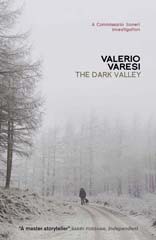
What they share is that they all progress by means of dialogue. In the cases of Varesi and Pastor, the effect is rather melancholy, but in McClure's book it is oddly comic. Varesi's book even gives the reader a dramatic climax in terms of second-hand conversation (it's an interesting effect), and most of the rest of the book is converstations among Commissario Soneri, a captain and a Maresciallo of the Carabinieri, and various inhabitants of a small town in the mountains near Parma. Varesi's first novel to be translated, River of Shadows, shares a similar approach, and each novel is embedded in a group aging men and in the politics of the conflict between partisans and fascists at the end of World War II (portrayed more subtly and to better effect than the war reminiscences of Marco Vichi's Inspector Bordelli, though, in my opinion). The only women in The Dark Valley are Soneri's girlfriend Angela (who's rather more sympathetic a character here than in the first book) and a woman who, with her husband, runs the small inn where Soneri has taken refuge from the city. The result is a rather one-sided buzz of conversation and gossip that is nevertheless interesting for its gender limitation. The solitary walk in the woods of the book's cover is a true portrait of the book in one way, but gives an ideal rather than an actual sense of what the book is about and how it progresses.

Soneri falls into the crimes associated with the failure of a mountain town's main source of jobs and income, a salame factory where in fact Soneri's father was once employed as a bookkeeper. Soneri's memories of his father become entwined (as well as reconsidered) with what is going on as the whole town faces collapse. The denouement is very interesting in the way it is revealed, through conversation that holds the horrifying nature of the central crime somewhat at arm's length and therefore more bearable.

McClure's Sunday Hangman (the most recent of his novels being brought back into print by SoHo Crime) portrays a closed world as well, but one that is so jarring that it's almost like reading science fiction. The racism and cultural violence of the apartheid era in South Africa is assumed, given to the reader in all its nastiness with no respite or commentary. McClure's contemporaries understood the satirical and critical import of his style of writing very well, though readers today may have some difficulty getting past the race-hatred (and fear) embodied in the characters' language and behavior. The style of writing is also a bit indirect, relying on dialogue and a narrative that reads almost like dialogue, with much unspoken and hinted at rather than given directly. But the rewards of persisting with McClure's Tromp and Zondie books (the former being an Afrikaan's lieutenant and the latter a Zulu sergeant in the South African Police) are considerable not to mention the historical value of getting such a direct portrait of life in that era. And not to mention the considerable humor, not least in the relationship of the two main characters, constantly struggling across cultural and racial barriers internalized by them both.

In Hangman, the plot is also very oblique and odd. A criminal on the run after a bank robbery in which Zondi was shot in the leg (and is still suffering from the wound) seems to have hanged himself along the road. But the medical examiner and Tromp think it was murder. The investigation winds around and around until it reaches a bizarre (but in the context o McClure's story, entirely believable) conclusion.

Ben Pastor, who is an Italian woman writing in English about a German World War II officer called upon to investigate crimes as well as to conduct his part in the war. Much of the conversation in this second "Martin Bora" novel is between the now-Major Bora and an Italian policeman, Guidi, pulled together to investigate the murder of a local plutocrat in Verona in late 1943. Bora seems at times like the German officer played by Erich von Stroheim in Jean Renoir's wonderful Grand Illusion: as the film progresses, von Stroheim has lost more and more body parts, until he's practically a cyborg. Bora has, just before the novel begins, been the victim of a partisan bomb and has lost a hand and almost lost a leg.

The quality of the dialogue in the book forces us to see Bora as a person, rather than a Nazi stereotype, in spite of his stiff German attitude and the willingness with which he seems to support atrocities perpetrated by his army. As the novel progresses we learn a bit more about his role in the atrocities that may (as the series progresses) change how we see Bora (there was little hint of any mitigation in the first Bora novel, Lumen. Bora is somehow both unlikable and sympathetic, and it will be interesting to see how he develops as a character through what is characterized as an ongoing series. Liar Moon, considered on its own, is a very interesting and unconventional portrait of a complex era of italian history (now that Bora has been sent to northern Italy after the Polish setting of Lumen), and the conclusion, reached after much digression in action and conversation, includes an interesting double-reverse and depends on the correct interpretation of the book's title, whose basis in folklore is finally explained.

I would have said that reading three novels based on indirect conversations rather than narration and action would have been frustrating and confusing--but Pastor, Varesi, and McClure are in their very different ways very good writers, and their tales are rewarding whether considered together or separately.

Tuesday, February 14, 2012

Puerto Vallarta noir: Lisa Brackmann's Getaway


Getaway, the second thriller from Lisa Brackmann, is the kind of book that Eric Ambler used to do so well, an ordinary person caught up in extraordinary events and forces way beyond his job description. Except that instead of spies and international intrigue, Michelle Mason is caught up in something she isn't able to figure out at all. Is it police corruption, drug gangs, the CIA, or something even stranger?

Michelle's husband killed himself, after revealing that he has been keeping secret from her the impending financial disaster that is about to engulf her life. She escapes her woes with a brief trip from Los Angeles, where she's now homeless, to Puerto Vallarta on Mexico's west coast for a last getaway before the reality of her new life sets in. A chance encounter with an attractive man and several margaritas on the beach leads to her hotel room, unwelcome night visitors, and ultimately to jail and the loss of her passport.

The mysterious Daniel (from the beach) disappears and an even more mysterious Gary appears, saving her from jail but proposing a devil's bargain: he'll help her, even pay off her overextended credit cards, if she contacts Daniel and keeps tabs on him. He won't say who he is, who Daniel is, or what's going on. What ensues is a puzzling series of encounters (violent and not) as Michelle spirals down into murky waters, including glimpses into horrific violence and horrible poverty, as well as the life of rich and not-so-rich locals and emigre Americans who are more or less permanent Puerto Vallarta residents.

Getaway is a faster ride than Brackmann's previous Rock Paper Tiger, with clearer threats and more violence, but it has some of the earlier books twisty indirection. Michelle is likable and pleasant for a reader to spend some time with, but she keeps stepping in it rather than getting her problems sorted out. To give her her due, she shows her nerve when it's called for and she has no way to know who to trust: the biggest threat in a very threatening atmosphere is her status as an isolated foreigner whose bubble of tourist-untouchability has been totally shattered.

Though the atmosphere and setting of Rock Paper Tiger were more exotic, and more up-to-date concerning art and technology, Getaway was for me a more convincing book, pulling me along with the story in a more compelling way, with more tangible threats and consequences coming down upon Michelle and other characters along the way. Not to give anything away, but the ending fulfills several strands of the book without totally wrapping up others. It almost suggests the ending of the Tony Scott film, veering off into a half-fairy tale, half metafictional other world: Getaway's ending is more believable than that of True Romance, but it's open-ended and contains elements of wish-fulfillment in the same sort of way.

Altogether, Getaway, due from Soho Press in May, is an interesting and entertaining update on the damsel-in-distress story (from the damsel's point of view) as well as the Ambler-esque spy thriller.

Tuesday, February 07, 2012

South African crime satire


As far as I can tell, Zakes Mda's Black Diamond is only available in South Africa, published as it is by Penguin Books (South Africa). Mda is a widely published author, whose books are generally available throughout the English-speaking world, but perhaps other publishers have been unwilling to pick up this 2009 novel because it is a merciless satire of life in the "new South Africa," a phrase repeated over and over again in the book.

There have been previous satirical crime novels from South Africa, published outside of (and in previous years, ONLY outside South Africa), particularly James H. McClure's Tromp & Zondi novels from the 70s and 80s and Tom Sharpe's hilarious early '70s Riotous Assembly and Indecent Exposure (mentioned here previously). More on McClure in a later post, since his novels are finally being reprinted, by Soho Crime in the U.S.

Black Diamond, though, is a post-Apartheid satire, with more in common, perhaps, with the very funny South African political cartoonist Zapiro than with McClure or Sharpe. The title of the book refers to the rising (and risen) black middle class and oligarchs today, particularly in Johannesburg (where Black Diamond is set) and Cape Town. Don Mateza is a bodyguard and security consultant whose former-model wife expects him to achieve more, to become the Black Diamond that she sees in him. Just as he is about to be a possible candidate for CEO of VIP Protection Services, a magistrate, Kristin Uys, is threatened by a petty criminal whom she has sentenced to jail time for contempt of court. The criminal, Stevo Visagie, gets his brother and mother and former nanny to agitate for his release, including threats to Kristin and even her cat.

There's a standard love triangle (and even a screwball comedy å la Hollywood in the '40s) there, and Mda doesn't hesitate to go there. But swirling around that part of the story is the very complex racial situation in South African society, exploited here to great advantage. Every aspect of the culture comes under Mda's scrutiny and ridicule, even the traditions of resistance (Stevo's nanny adopts the tactics of Mandela and the ANC, as she sees them, to get her boy out of jail in some of the more merciless comic passages. But Mda never dehumanizes his characters. While the characters of satire aren't typically the fully rounded characters we expect in the best crime fiction, Mda manages to convey the humanity of everyone involved in his cultural portrait.

There are some detours in the plot that suggest some of Tom Sharpe's more vicious comedy of Apartheid, but Mda keeps things moving along without getting bogged down in the more sensational (or embarrassing) elements, and the story ends up with everyone if not in their proper place, at least in a suitable position for a screwball noir of the new Republic. Mda's touch is here a bit less folkloric and sympathetic than in his wonderful Ways of Dying or The Heart of Redness, though neither of those uses the conventions of the crime novel (which Mda does for good effect in Black Diamond). I would say to publishers that on the one hand the rest of the world is familiar enough with the new South Africa to understand Black Diamond, and on the other hand, the book is itself a comic guidebook to that culture—more people should be able to read it.

Monday, January 30, 2012

Glasgow and Paris:Two dark tales


I haven't been posting much lately, since I've gone through several books recently that I found disappointing enough that I wasn't inspired to write anything about them. Then I got started reading two books simultaneously, which slowed me down a bit, and also provided a contrast that didn't necessarily do one of the books any favors. The two books were Denise Mina's new The End of the Wasp Season and Cara Black's Murder at the Lanterne Rouge, set in Glasgow and Paris respectively.

Both books are from a series, though Mina's is a new one (this is the second book in the series featuring DS Alex Morrow) and Black's is the most recent of the 12 Aimée Leduc series (Leduc is a security consultant who acts like a private detective). Mina's book surprises at every turn: when we think she's writing one kind of story, we discover that it's actually something else entirely. Black's book is a dependable entry in a good series, in this case continuing a theme begun in her last book, in which the story follows the unfortunate love life of the two strongest minor characters in the series, Morbier and René.

It's partly that contrast between the unpredictable and the dependable that made Black's novel less rewarding for me, when experienced in parallel with Mina's. Aimée once again explores for us a quartier of Paris that we, as tourists, wouldn't be able to experience, in this case several distinct Chinatowns, each, though, tied up in the same illegal-immigrant-and-snakehead problem. The villains are mostly offstage, and mostly just what you would expect them to be.
a onblur="try {parent.deselectBloggerImageGracefully();} catch(e) {}" href="https://blogger.googleusercontent.com/img/b/R29vZ2xl/AVvXsEiApjQZ-uTsd-mRkNPBKNt8CJNQHycBKscpRiYsox4rpZXoMoFI86V8Icy88B1ko7dcn0nYgccExu3Av1g7KrQfWJ_z9GPEBf4l3AzmtLmSSALKC3Ufqg8qmufSXRjrl8s8E7i1/s1600/51pBPPaeNsL._SL500_AA300_.jpg">
Mina's book, though, follows a case concerning a young woman brutally murdered in the house of her recently deceased mother. We see the build-up to the murder and then the police investigation after the fact, but not the act itself. Then we follow several parallel threads, including Morrow's investigation, the life of a former friend of hers who gets caught up in the investigation, and a teenager who was involved in some way that seems clear, then not so clear. It's that narrative concerning the teenager that keeps surprising the reader. I was getting ready for a young-thug-from-a-slum narrative, and it's not that at all—the polar opposite in fact (yet not quite the spoiled rich brat either). Toward the end, we think we know what has happened, and then a coda twists us back to the beginning, to rethink the whole crime (I found myself rereading the first chapter with new eyes).

Mina's prose is clear, if her narrative style is somewhat indirect in a way that's usually interesting. Morrow is an unconventional detective in an unusually realistically drawn squad. She's pregnant with twins, so she'll be on maternity leave soon. The squad is caught up in a power struggle that isn't about rank (in fact, the culture of the squad enforces an interest in not gaining rank, only in protecting their current positions). Morrow's own social background is problematic, for a cop (not too different from that of the central characters in her other series, so her tale is not a total shift away from her own previous books). But she is livelier, more present in the story, somehow, than in the previous book, though she's offstage a lot of the time. And the story is full of nice images and parallels (such as the life cycle of wasps) that bring together the whole novel in a satisfying way that reinforces not only the telling of the story but its significance for the reader as well. Some books undermine the whole "genre" business separating crime fiction from "mainstream" or "literary" fiction, which I suppose Kate Atkinson does from one direction and Mina certainly does from another.

Mina's book is in one way a straightforward example of a series novel about a police detective, and in another way it's simply a novel about the damage that families do to one another, and how some people escape and others don't. Though if I saw that description (from an author I didn't know and with no mention of the books genre structure) I would almost certainly not have picked it up from the library (where I got the copy I read). It would have been my loss.

So I can recommend Murder at the Lanterne Rouge to Cara Black fans, even to newcomers to the series, without being able to say too much about it. And I can recommend End of the Wasp Season to anyone who's interested in the more advanced (in terms of both the writing and the story) end of crime fiction.

Thursday, January 12, 2012

Korean and American: Mr. Kill, by Martin Limón


One of the pleasures of reading international crime fiction is the glimpse of other cultures through the stories of crime, criminals, police, etc. martin Limón's series featuring George Sueño and Ernie Bascom, detectives with the 8th Army CID in Korea in the post-Korean-War era, offer insights into two cultures: South Korea and the U.S. Army. Sometimes one predominates in a particular novel, sometimes the other. The new Mr. Kill is a balance between the two.

A Korean woman is raped on a train by what appears to have been an American soldier, and the detectives are called in, without much enthusiasm on the part of the brass because they want to downplay any possible U.S. involvement. At the same time, Bascom & Sueño are ordered to investigate the theft of equipment from an all-female Country & Western band touring Korea for the USO. The detectives shuttle back and forth between the two assignments throughout the book, with the band offering Bascom plenty of opportunity for philandering, one of the primary aspects of his character.

But at the same time, Sueño is particularly horrified by the crime on the train and a subsequent even more brutal assault, in both cases in front of a young mother's children. His sympathy and determination are major drivers of the plot (and of a reader's interest). The addition of a Korean detective, whose name (Gil) sounds like "Kill" to an American ear, giving rise to his nickname and the title of the novel) is also very interesting, since Kill is both effective on his own and a big support for the detectives when the Army hierarchy is resisting their investigation.

All the shuttling back and forth across South Korea (as the band travels the USO circuit and the detectives pursue leads concerning GIs that may have been off base during the crimes) gives perhaps a better overview of Korean society than any of the previous Sueño/Bascom books. I was not totally convinced by some of the plot twists late in the book, when the story shifts to hot pursuit of the rapist, and there's a third subplot that seems to be there mostly to set up the next novel in the series. I would also have liked to see more of Mr. Kill (and it seems he may have a role in the sequel. But overall, it was a brisk and interesting read, and the Army CID elements are a consistently interesting twist on the police procedural/detective story model.

Sunday, January 08, 2012

Declan Burke's new novel and anthology


The trope of fictional characters having a life of their own has a considerable precedent, from Flann O'Brien to Raymond Queneau (whose fictional author left the MS by the window and a breeze blew the characters into the street), to Felipe Alfau (whose characters hang out in a cafe awaiting employment by authors), to Gilbert Sorrentino (who acknowledged his considerable debt to O'Brien), to the experimental writer Christine Brooke-Rose and the Italian crime-writing duo of Fruttero & Lucentini (and even back to the second half of Don Quixote). We can now add to that estimable list a further entry, Declan Burke's Absolute Zero Cool (and one of the virtues of Burke's book might be to send fans of his comic fiction back to some of the lesser-known purveyors of characters independent of their authors).

A writer who shares some biography with Declan Burke is ensconced in a writers' colony, trying to meet a deadline for the delivery of a new novel, when a character from a manuscript he had earlier abandoned shows up demanding attention. Not shows up in his imagination, shows up in his living space. Karlsson, who now insists his name is Billy (and is sometimes referred to simply as K), wants to be liberated from limbo and begins to collaborate with the author on the completion of the novel.

Karlsson's story involves blowing up a hospital, and also the editorial process of "killing babies" (cutting out passages, characters, etc., from a novel in progress). As the author tries to work on his new novel (and also conduct his life with his wife and young daughter), he gradually becomes implicated in Karlsson's story and Karlsson's narrative becomes more dominant as he takes over authorship. Who is writing whom becomes unclear, with disastrous, even tragic, results.

The narrative thus shifts between the author's ordinary life to Karlsson's rambling monologue, peppered with quotations that suggest a broad deep acquaintance with Western philosophy (or perhaps, as the story suggests, a judicious use of Google). Karlsson's voice itself begins to suggest another associate suggested by the author, Patricia Highsmith--not only in her a-moral Ripley stories but also some of her stand-alone novels featuring sociopathic or at least gloomy characters. Among the many crime fiction references, it's Highsmith that resonates most with Absolute Zero Cool (for me).


The tale is comic in its structure, though frequently dead serious in its monologues and in its violent conclusions (the final one being a more or less absolute denial of a continuation of the story's telling). It is to Burke's considerable credit that he keeps the reader's interest without pandering to our craving for thriller plots or compromising in the depth of K's philosophical ramblings. It's in part the characters who keep our interest, not only K and the author but also K's love interest, Cassie, and the author's family.

Burke has also recently edited a valuable anthology on Irish crime fiction, Down These Green Streets, which mixes interesting commentary with new stories, all by practitioners and critics of a genre that has become one of the country's important exports. Between the valuable anthology and the innovative novel, Declan Burke has cemented his central position in the current wave of neo-noir and contemporary crime fiction.

Monday, January 02, 2012

Jake Needham, Laundry Man


I've reviewed a couple of Jake Needham's books (The Amassador's Wife and The Big Mango) but Laundry Man is the first of his Jack Shepherd series that I've gotten my hands on. Needham's books have mostly been available only in Asia, though his current publisher, Marshall Cavendish, is now making some of them available in the U.K., including Laundry Man, and several of the books are also available as e-books.

Laundry Man is a caper novel (sort of) about money laundering. The unique device of Laundry Man is that the caper is going on offstage while the narrator-hero struggles to figure out what's going on and why everybody thinks he's involved. Jack Shepherd is a banking specialist who moved from the Washington DC area to Bangkok and has a teaching job (and a wife who's a respected painter) there. A supposedly dead voice from his past calls him and asks for a meeting, setting in motion a wild ride through international banking scams featuring a colorful panoply of Asian and Western characters. There are, in fact, a lot of characters, but Needham does a good job of keeping them straight for the reader.

Another thing the author does well is explaining the technical details of banking and money laundering, which he does in Needham's voice as well as in conversation with several members of the legal and illegal establishment of Bangkok. In addition, the novel gives a very good portrait of the city (as well as glimpses of Phuket and Hong Kong). No other Bangkok novel I've read gives as vivid view of the Thai capital.

The story is, for the first 3/4 of the novel, mostly Jack stumbling around in the dark, exploiting his various contacts to try to figure out what's going on. Then some of his contacts start turning up dead, and the story shifts into thriller gear. But Jack (thankfully) does not suddenly transform from a banker and professor into a neo-Rambo. When he ends up with a gun in his hand, it's with reluctance and without the amazing shooting technique that mars some other ordinary-guy-in-extraordinary-circumstances sort of book.

Also, unlike some o.-g.-i.-e.-c. stories, Jack's narrative voice is consistent and entertaining, whether he's talking to his wife, his students, a guy who claims to be FBI, a top Thai cop, or any of the other spectrum of characters (and whether he's facing an offer of information or a threat of violence). It's Jake's voice, in fact, that is the key to the novel's entertaining quality, and the quality that will send me to the other Shepherd novels, when I can get hold of them (in fact, I already have a digital copy of the next one, Killing Plato, in my tbr virtual pile).

Sunday, January 01, 2012

Night Rounds, by Helene Tursten


After a protracted gap, SoHo Crime has begun issuing more of the novels in Helene Tursten's Swedish crime series featuring detective Irene Huss of Göteborg. The TV series based on the novels, produced for Swedish television but made available with English subtitles by the independent public television station MhZnetworks in the U.S., has run past the previously published Huss novels, so that in fact I had see the film of Night Rounds before I had access to Laura Wideburg's translation, forthcoming next month from SoHo.

Reading the book after seeing the movie was quite interesting. The TV version accented some aspects of the story (a ghost story, though fairly prominent in the text, is highlighted by its visual presentation in the film). Some of the changes veer toward TV cliche and because of that, I'd recommend the novel over the movie, if you have to choose. There are several more cops in the team in the original book, giving some opportunities for interactions (positive and negative) not possible with the more limited crew in the film (though the characters that do survive the transition are very true to their literary forebears).

Two plot elements central to the story were changed, though. One takes a passing attraction that Irene feels toward one character, a doctor who is also the owner of the hospital where first one nurse and then another is found dead, and turns the attraction into an almost-affair that I found untrue to Irene's character even before reading the book.

The other big change is in a backstory that, in the film, combines the history of that doctor with that of a homeless woman, transforming these threads of the tale into a new character in the film, a mentally challenged caretaker at the hospital. The change lessens the impact of the doctor in the story, leaving him to be mostly a failed administrator and a womanizer rather than a more interesting figure. There's also a denoument in the film that transforms a believable struggle in the doctor's home in the book into a melodramatic scene in the spooky hospital attic in the movie.

Back to the book itself, though: Night Rounds takes advantage of the author's medical background to create an interesting scenario around a private hospital, giving an interesting window onto the Swedish medical system and class structure. The plot closely follows the police procedural format, mostly but not totally focused on Irene, with a sidetrack regarding the detective's family (a chef-husband and two twin, but seemingly not identical, daughters) that's interesting in itself and gives the author the opportunity to show another (not totally honest or legal) side to Irene's character.

The Huss series was one of the earliest of the Swedish crime series to appear in English, thanks to SoHo, and the publisher deserves praise for continuing to translate Huss's novels. Night Rounds shares a supernatural aspect with another Swedish writer, Johan Theorin, but with a lighter and more urban flavor that is less spooky but more contemporary (not a slam on either author, just a different approach).

Sunday, December 18, 2011

Johan Theorin, The Quarry


Johan Theorin's third novel to be translated into English (by Marlaine Delargy, for Doubleday U.K.--it's not available in the U.S. yet) is the third novel in a trilogy organized around the seasons and set on the Swedish island of Öland. It's spring on the island and Theorin's running character, Gerlof, is moving out of the assisted living home that he moved into in earlier novels. He's moving back to his cottage near the island's quarry, to live alone but in proximity to an interesting group of the island's part-time, warm(er) weather residents.

Theorin continues here to pull off an unusual structure (for a crime novel at least). Among the Scandinavian crime novels to have appeared in ever larger numbers in English, Theorin's are perhaps the most focused on ordinary people's ordinary lives. There is what I have elsewhere called a "dailiness" about the books, with no hint of criminal conspiracies, international incidents, or big-time mobsters. Yet, on the other hand, there is a supernatural element, also told in the most ordinary way, as if the elves and trolls who are a very palpable presence in this novel are among the ordinary residents of modern Öland.

The other constant in the series (apart from Gerlof, who is in any case not a central character in the novels' mysteries) is the overlay of the past and the present. In The Quarry, it's the past of Gerlof's marriage, the youth of a spring/summer resident of the island, Vendela Larsson, and another part-time resident, Per Mörner. Vendela was raised on the island, but in peculiar circumstances and with frequent interaction (in her imagination at least) with elves who seem to be granting her wishes when she places offerings on a stone with a mysterious presence.

Per's past on the other hand, invokes a subject that was the international profile of Sweden in the 1970s and '80s but as far as I know not the subject of any of the other Scandinavian crime novels to have appeared (at least in translation): the porn industry. It's the decline (for various reasons) of the porn business that provides the tensions that finally shift this novel of ordinary live into high gear thriller territory (at least, almost).

There are many other elements going on in this novel stuffed with ordinary (rather than high pressure) incidents and emotions. Per's daughter is mysteriously ill. Gerlof has found his wife's diaries, which speak of an odd "changeling" who had visited her only when she was alone. Vendela is descending into a dangerous psychological state and is stuck in a marriage with a manipulative egotist. Ordinary lives, but with extraordinary twists.

Theorin is one of the least conventional of all the translated crime writers, and although his books are certainly not everyone's cup of tea (being probably as far from that Tattoo series as it's possible for two series in the same genre to be), his distinctive writing deserves close attention. Some reviewers have expressed some disappointment in The Quarry, given the high expectations that Theorin's first two novels created. I found it to be a valid continuation of the series, with a bit less tense a tone overall, and with a less intense presence of both nature and the supernatural. It's a further development of his style, though, and unfailingly interesting.

Friday, December 09, 2011

Jo Nesbø, Headhunters


Headhunters, published recently by Vintage Crime/Black Lizard in Don Bartlett's translation, isn't a Harry Hole book and is in fact quite different from that famous series. First, it's fairly short (and the Hole books are real doorstops). Second, the main character is a somewhat unreliable narrator named Roger Brown (he's Norwegian, but his father was English). Roger is a corporate headhunter (though other kinds of headhunters do crop up) and he's very impressed with himself and his record of getting businesses to hire his candidates (in fact, his only shortcoming, in his eyes, is that he is indeed short, by Norwegian standards).

Roger has the perfect job and the perfect wife (the only fly in the ointment being that he has refused her request that they have a child). His reason is that he doesn't want to share her with anyone, not even his own child (and the flaw in that reasoning comes back to bite him). She runs an art gallery, and during a private viewing for a new show she introduces Roger to the perfect candidate for a job he (and several other headhunter agencies) is trying to fill.

So far so good--but warning: spoilers ahead. I hate the blurbs on the backs of paperbacks, because they frequently (and in this case) give away what would have been, for an un-forewarned reader, a pleasant discovery in the story. So my recommendation is: Don't read the back of the paperback, don't read the blurb on Amazon or elsewhere. Come to the book as unprejudiced as possible, to best enjoy the twists and turns (of which there are many). Before going on, I should only warn prospective readers that there is some disgusting stuff in the book, not so much violence (of which there is some, but less than in the Hole books), and more scatology of various sorts (disgusting aspects of human bodies).

So: on to the story. Roger has a hobby. He gets his clients to tell him, during interviews, what sort of art they own, and if he finds what he hears desirable, he steals it. His partner in crime works for an alarm agency frequently used by Roger's clients, and he arranges for his partner to turn off the alarms and cameras at convenient times. But Harry's day job, his night job, and his marriage all come clashing together and create a mess that it doesn't seem like he can crawl out of (a bit of the mess is telegraphed in the prologue to the book, in which Roger and several others are trapped in a wrecked car, upside down in the woods).

Setting aside the disgusting parts, Headhunters is very cleverly plotted and a fun read. Roger is not a nice person, but as a narrator he's good company, and he withhholds just enough information to allow the reader some surprises (only a very alert reader will catch some of them in advance). So for Harry Hole fans and others who haven't discovered Harry or don't fancy him, Headhunters is highly recommended. There's supposed to be a movie coming out, but so much of the book is in Roger's head, it's hard to imagine what might be preserved of the pleasures of the story (leaving only the action, including the nasty bits).

Monday, December 05, 2011

Different kind of crime novel from Ireland


An Irish Solution, a crime novel by Cormac Millar (pseudonym of Cormac Ó Cuilleanáin, a translator and a professor at Trinity College Dublin) was published by Penguin in 2005, and is little acknowledged among the current generation of Irish crime novels and novelists. Millar, who is the son of the late Irish author Eilís Dillon, frustrates all expectations with An Irish Solution: it's impossible to talk about the book without giving something away. Even the pitch made by the publisher, that it's about Seamus Joyce, newly appointed head of a new Irish Drug Enforcement Agency (iDEA) is misleading. And it seems to be the beginning of a crime fiction series, but that isn't quite true either.

Millar manages to constantly twist the plot away from cliche and into surprise, right up to the ending. At the beginning, a reader may think he/she is reading one sort of book, only to discover after a few chapters that it's really another sort of book, centered upon different characters than at first seemed central to the story. I kept trying to find comparisons with other recent Irish crime writing, but the closest I could come would be a mash-up of Alan Glynn's Winterland and M.S. Power's Children of the North trilogy (though Millar's book is more complicated and more cynical than the former and less mystical than the latter, and also without the latter's focus on Ulster and the Troubles).

Seamus Joyce is indeed newly appointed as head of the iDEA, but he's a bureaucrat, not a policeman. The police under his nominal command are into a great many things that he doesn't know about. Also featured are a pair of schoolgirls moonlighting in a pub, a hapless former schoolteacher, a few drug dealers, a senior nun, an international Institute of vague principles, and Seamus's hospitalized wife (and we can't be confident even in the stability of this last-mentioned character with relation to Seamus and others).

The book is often quite funny, in both turns of phrase and twists of plot. It's also quite enjoyable, once you leave your expectations at the door. Allow yourself some time to get into the book and you'll see whatI mean. There's a sort of sequel that I'm trying to get hold of now, and if it's half as good it will be well worth the trouble

Thursday, December 01, 2011

Another Swedish noir discovery?


Has anyone run across The Girl With The Sturgeon Tattoo, by Lars Arffson? Published by St. Martin's Griffin in the U.S., it features hacker Lizzy Salamander and blogger Mikael Blomberg. I suppose it was inevitable (and purportedly it's pretty funny). Anyone seen it yet? It includes references to a new novel called The Vices, by American author Lawrence Douglas, whose image bears a striking resemblance to the photo of Lars Arffsen on the Sturgeon Tattoo...

Thursday, November 24, 2011

A Vine in the Blood, Leighton Gage


The fifth Mario Silva novel by Leighton Gage is a cracker. Each of his books takes on a different segment of Brazilian society, and in this case it's a middle class enclave inhabited by sports stars and lesser humans as well.

I'm not a fan of football/futbol/soccer, and the fact that A Vine in the Blood is based on the kidnapping of a football hero's mother (apparently to put him off his game just before a World Cup prelim match against arch-rival Argentina) gave me a little pause--but I needn't have worried. The book is in part about the social phenomenon of football, but not really about the game (in the same way that Vazquez-Montalban's olympic book isn't really about the Olympics).

Silva's crew is pressured on all sides to find the mother before the kidnappers kill her. The kidnappers aren't revealed until the end, but when the plot is finally detailed, it's a heist-story in itself (I can't reveal any details). There's only a brief glimpse of the kidnapped mother in captivity, and the rest of the story is with the cops, chasing one false lead after another.

When the final break comes, it's a perfectly believable insight rather than the strained coincidence that we sometimes see in crime fiction. All in all, the Silva series just gets better and better.

Monday, November 21, 2011

Budapest Noir


Budapest Noir, by Vilmos Kondor, is a Hungarian novel that is scheduled to be published in English translation next year (I received a digital copy via NetGalley). The central character is Zsigmond Gordon, a crime reporter in Budapest in the 1930s. At the same time as the prime minister is being eulogized (having died while out of the country), a young woman is found dead on the street in a rough area of town. But the girl seems to be from a high class background and is carrying a Hebrew prayer book, and Gordon glimpses a nude portrait of the girl in a powerful policeman's desk drawer (while snooping). All in all, Gordon suspects that there is more to the story than a casual murder of a prostitute.

But no one else seems to care, not the police and not her family (when he finds them, he discovers that they've disowned her--and the motives for that act are at the center of the story). But as Gordon digs further, he stirs a hornet's nest in the underworld, and brings violence and threats upon himself, his artist girlfriend, and his grandfather (a retired cop who retired to Budapest and took up the making of fruit preserves).

The time frame, the underworld dealings, and the East European setting suggest a comparison with Marek Krajewski's excellent series set in pre-war Breslau, but Kondor avoids the downright strange storytelling and structure of Krajewski's series (though that's no slam on Krajewski, whose weirdness is extremely compelling). Unlike Krajewski's detective, Kondor's reporter has positive relationships with both his girlfriend and his grandparent, and though there's plenty of kink in the tale (among the brothels and in the city) it's more a straightforward thriller and crime novel (while Krajewski's books are more like nightmares).


There's a lot of classic noir in Budapest noir, in fact. Kondor gets it right without striving for exact equivalence to the American noir ambience. His Budapest is striking and his story is compelling, dealing with ordinary human venality as well as heightened versions of it that will become more virulent in the years just after this book's timeframe (though distinctly forshadowed in the story of the young Jewish girl, whose murder, though, takes the reader less in the direction of Nazi horrors than into the noir territory of Ross MacDonald and (more recently) Declan Hughes. The distinct strains of noir continue to intertwine in the hands of talented writers like Kondor (or Krajewski, for that matter) who are finding new vitality in the genre.

I'm pasting in the U.S. cover as well as a small image of the Italian translation and the Hungarian original. All in all, I think I like the Hungarian one best: more atmospheric.

Monday, November 14, 2011

Death and the Olive Grove, by Marco Vichi


I haven't read the first of Marco Vichi's Inspector Bordelli novels, Death in August, and beginning with the second book in a series is frequently not a good idea, I realize. There have been frequent references to Agatha Christie in the p.r. and reviews of the Bordelli books, but at least in the second book, Death and the Olive Grove, any reference to Christie could only be useful to mark Vichi's novel as "cozy" rather than "noir", though perhaps neither sobriquet actually applies. The novels are set in Florence, not quite a big city but certainly larger than a country village, and most of the crime novels set in Florence do have a lighter tone than other Italian and Italian-set mystery fiction, and the setting is mid-20th-century rather than more contemporary times.

Death and the Olive Grove doesn't feature much mystery-solving, and much of the narrative is about Bordelli's personal life and in particular his World War II experiences (according to the review, there's a lot of World War II in Death in August as well). Bordelli is an interesting character, and lively enough to be around—though I personally got a bit tired of the constant reference to the War, rather like being stuck at a dinner table next to someone who can't talk about anything other than his war experiences.

Death and the Olive Grove is really not a police procedural either: Bordelli doesn't really figure out what's going on, he stumbles on facts or is presented them on a silver platter by one or another of the numerous (and somehow quaint) underworld figures that he has cultivated, and whose crimes Bordelli is inclined to overlook.

The case begins with a corpse (reported to the Inspector by a dwarf who is one of those informants) that has vanished by the time Bordellii gets to the scene (the olive grove of the title). That's an interesting beginning, along with the hazards that Bordelli and his temporary sidekick encounter in the grove, but the book is really about a series of child murders. Bordelli and his partner, a Sardinian (whose father Bordelli knew in, wait for it, the War) pursue leads and lock onto a prime suspect, but that suspect is under surveillance during the later murders, thus provided with an ironclad alibi.

So there's plenty of mystery, as well as mayhem, but the pace is very leisurely, frequently interrupted by Bordelli's reminiscences, depictions of his own and his partner's love lives, and the cooking of various of Bordelli's acquaintances among the restaurateurs and criminals of Florence. There's a curious parallel in Bordelli's private life with the plot of Temporary Perfections, the most recent Guido Guerrieri novel by Gianrico Carofiglio: Both Bordelli and Guerrieri have a friendship with a former prostitute of their own age, and a sexual relationship with a much younger woman (in Bordelli's case, 30 years younger, a woman involved in Nazi hunting, which becomes a substantial element of the plot). Some reviewers found Guerrieri's behavior to be problematic, to the point of putting them off Carofiglio's books, and I'd be curious to know how readers react to Bordelli's behavior.

I'd be interested to read more of Vichi's books, but his depiction of the criminal class as a misunderstood economic minority is a bit quaint, given what Italian crime already was at the time the novels are set. To be fair, though, some of Magdalen Nabb's excellent crime fiction set in Florence has a similar pattern. And Bordelli's war experiences neatly sidestep the Fascist era of Italy's participation in the war, casting Bordelli as an irregular fighting the Nazis, rather than a soldier fighing for Mussolini. The Florence of Bordelli's day is evocatively described, and I'd prefer to hear more about that setting and less about Bordelli's War.

Wednesday, November 09, 2011

The latest (and first) K.O. Dahl crime novel from Norway


Lethal Investments, recently published in a translation from the original Norwegian by Don Bartlett, is the 4th of the novels featuring detectives Frølich and Gunnarstranda to be published in English but is in fact the first novel in the series. A young woman is murdered in her apartment, just after a man (a one-night stand) has left her. The detectives pursue the one-night stand (identified by a peeping tom across the street from the murdered woman's apartment) as well as her workplace, a decidedly odd software company full of suspicious characters.

What keeps the Gunnarstranda and Frølich novels lively is the conversation and inner monologues of the two detectives (one a short man toward the end of his career and the other a large man at the beginning). Neither detective is a typical crime-fiction policeman, though they share some characteristics with the standards of the genre (Gunnarstranda's wife has died, leaving him alone and lonely, and Frølich's relationship with his lover has its ups and downs), and the book is solidly within the tradition of the police procedural. But the two cops are not cliche partners, their relationship is decidedly spiky, and their dialogue is often realistically indirect and allusive, surely a challenge for a translator, but brought off very well by Bartlett.

What's going on in the software company will be more obvious to a reader now than it might have been some years ago when the book was published, but the story isn't otherwise dated or stodgy (it's just that there have been so many frauds exposed in real life in the past few years). Corpses begin to pile up, and there are some coincidental sightings of suspects as the cops drive around Oslo (on duty and off), but everything is brought off with naturalistic and believable style. The detectives remind me just a bit of the odd couple featured in Roslund and Hellström's Swedish crime novels, but without some of the extremes of those characters and Dahl's plots are more varied and more focused on ordinary crimes and everyday lives of contemporary Scandinavians than is the case with Roslund & Hellstrom's books (which frequently deal with international crimes and prison situations).

K.O. Dahl's novels are among the very best of Scandinavian crime fiction, and the author has a voice that is distinct from the rest.

Thursday, November 03, 2011

The Fatal Touch, by Conor Fitzgerald


The Fatal Touch is the second crime novel set in Rome, by Irish writer Conor Fitzgerald, featuring an American detective in the Italian police. International enough? Someone is mugging tourists, and in the midst of that investigation, the body of an old man is discovered on the street, perhaps murdered. He turns out to be an Irishman known for art forgery and a partner in a dodgy art gallery. Alec Blume, the lead character in the series, is mentoring a woman recently transfered into his department, and her relationship with the other members of the team isn't going very well. On the other hand, Blume is inept in his dealings with everyone, from witnesses to cops to friends.

In fact, Blume is the most difficult personality in Italian-set crime fiction since Timothy Williams's irascible Commissario Trotti, and as in Williams's novels, Blume's character sets the tone. The story is complicated, with frequent digressions into the forger's story as revealed in his journal. Those digressions are in a way a separate story, going back to the old man's youth in Ireland: some readers find the alternate narrative engrossing—to me they were interesting but distracting from the main story, making the book seem longer than it needed to be.

But the plot intricately intertwines this backstory with several threads in the here-and-now, without resorting to cliche in bringing the story toward a coherent conclusion. Fitzgerald is not afraid to deal harshly with some of the series's more interesting characters, a trait he also shares with Williams (whose characters frequently move away from the unnamed setting of the series or get killed). There's also a vivid villain in the novel, in the person of a corrupt and ruthless Carabinieri Colonel who takes over the investigation from Blume and lurks behind everything that happens in the story from that point on.

The spiky central character, eccentric plotting, and the capacity to let bad things happen to good people give the Blume books an authenticity and immediacy that a more reticent writer might not achieve. And the Roman milieu is vividly evoked here, perhaps even more so than in The Dogs of Rome, the first in the series. Plus the reader learns in the new book a lot of fascinating information about the trade of art forgery.

Sunday, October 23, 2011

The Good Thief's Guide to Venice, plus Fatale


Chris Ewan has produced "Good Thief's Guides" to several cities already but the book set in Venice is the first one I've picked up. The books are not, of course, tour guides or thievery guides, but clever crime novels. The two covers illustrated here, from the U.K. and the U.S., illustrate the two halves of this book: the genuine appreciation of the city of Venice and the comic approach to the crime novel (the U.K. cover seems to be designed to capitalize on the cover's blurb from Colin Bateman, in fact).

But Ewan's novel is not as funny as Bateman's books, at their best. It's not so much a comedy as a light-hearted crime novel. Charlie Howard is a professional housebreaker who has sworn off his life of crime to pursue his other profession, writing crime novels featuring a housebreaker. There are a few times when the book becomes "self-conscious" or a "metafiction" in a comic way, but for the most part, the story is told straight, in Charlie's own voice.

Charlie's voice is self-centered but also self-critical, and he's good company. He's wakened in the middle of the night by a female burglar who steals only his prize possession and the magic talisman that keeps his writing on track, a framed, signed first edition of The Maltese Falcon. She leaves clues that lead finally to her challenge: she'll give the book back if he returns a briefcase to the home of a wealthy Venetian count; and he's forbidden from opening the case.

There are surprises and twists in the plot, but the point is not really the danger to Charlie, his agent Victoria (who's staying with him in Venice), the count, the book, or the burglaress, any more than the various threats are the point of, say, The Pink Panther (and Ewan's Guide is in a way a throwback to that sort of comic crime).

Charlie's a bit obtuse about some things, and in some ways hardly seems to rise to the level of "master thief" that is ascribed to him (maybe that's more well established in the earlier books). Charlie's meanderings around Venice are interesting glimpses of the city, and the story is entertaining, while not being either laugh-out-loud funny or serious about the genre. Given the light tone, I found the book to be a little long.

Fatale, on the other hand, is very short. Jean-Patrick Manchette is a revered French crime novelist, two of whose books have already been translated, Prone Gunman and Three to Kill, both of which I liked. Fatale, though, seems artificial or contrived, a thesis novel more than a fully realized fiction. It's about a female hitman with a very complicated way of doing business that's only gradually revealed.

She's the center of the story, but isn't much fun to be around. Her skills are employed ruthlessly until things start to get complicated in her last job, which is mostly the subject of Fatale. But I found it hard to care much about her, the job, or her victims. I have a sense that Manchette didn't intend for us to get too involved: he's not so much telling a story as a fable or parable. I don't know whether this is more obvious here, with a female heroine, than it was in the other two novels, both of which centered on men: I may go back and re-read the others to see if that's the case.

However, it's an intense book in the mode of classic noir, a descent into hell without any redemption. For that alone, the book is well worth reading, and the shortness of the text makes that easier to do. But prone gunman is, as I remember, a more fully rendered hitman story.

Sunday, October 16, 2011

Gianrico Carofiglio's Temporary Perfections


The new Guido Guerrieri novel by Gianrico Carofiglio (translated by Antony Shugaar) is a lot of fun, in spite of the dark-toned plot. I've been mulling over the differences between character-driven and plot-driven crime fiction lately, and Temporary Perfections is decidedly character-driven. Guido is a first-person narrator, and he's clever, introspective, full of interesting digressions, and generally fun to be around. The plot moves slowly forward, frequently interrupted by those digressions, up to a point near the end when suddenly things start to happen, after Guido achieves a particular insight.

The Guerrieri novels are mostly set in Bari on Italy's east coast, but Guido goes to Rome a couple of times in the new book, for a couple of different reasons. So we get a flavor not only for the provincial city but also the capital, both from a legal and a non-legal perspective.

Guido is asked by a friend to help a couple whose college-age daughter has disappeared. The Carabinieri, in charge of the case, have stopped looking and are about to shelve the case, because there aren't any leads and because the daughter is of age and may well have simply decided to disappear.

Guido goes about his usual legal business while also interviewing the detective in charge of the original investigation and several of the daughter's friends, without really breaking any new ground. Along the way, he develops relationships with two women, one close to his own age (the owner of his favorite bar) and the other much younger, one of the daughter's friends. The bar owner's dog will also play an indirect role, but the younger woman begins to take up more and more of Guido's time and interest, along with his deep misgivings about consorting with a woman almost half his age.

Though the mystery is interesting and its solution is complex and moving, the novel stands or falls on Guido's voice, and fortunately he's a delightful character, someone that we'd love to be sitting across a dinner table from. Though there are running characters in the series, it's basically a one-man show. There is a stark difference between Carofiglio's stand-alone novel, The Past is Another Country (made into an interesting film) and the Guerrieri stories, though in fact the stand-alone deals with a lot of the same people and issues as Temporary Perfections. The difference is Guido, who is our window on the dealings of young people veering into crime and vile behavior, while in Another Country, all we have are those same young people. By means of Guido's voice, we have both a clearer view and in the end more sympathy with these people whose behavior eases from self-interest into sociopathy.

There are different publishers and different covers for Temporary Perfections in the U.K. and the U.S. The U.K. cover (the one posted at the top of this review) is both clearer and more specifically atmospheric than the U.S. one (which suggests Rome, an important but after all secondary setting) more than Bari, though I confess some bias toward the U.K. edition's publisher, Bitter Lemon, who brought the Guerrieri series to the world originally.

Monday, October 10, 2011

Outrage from Iceland


Outrage, Arnaldur Indridason's newly translated Icelandic crime novel, is a departure from the series featuring the dour detective Erlendur, while still being part of the series. Erlendur has gone walkabout, in the fjords where his brother was lost, his body never found, in a storm many years before (the event that has marked the rest of Erlendur's life).

In his absence, Elínborg, Erlendur's female colleague, steps to the foreground of the series (Sigurdur Óli, their other colleague, also features in the book, but in a smaller role than Elínborg). Crime writers have often shifted focus from one running character to another, but rarely has it made such a dramatic difference in the mood of a book: Elínborg is not exactly cheerful, but she lacks Erlendur's gloomy outlook, and her family (all of them alive, not so common among fictional detectives) is constantly in her mind.

The case at hand involves rape and roofies (the date rape drug). In a preface we see a young man on the prowl in a club. But when the police arrive at a crime scene (spoiler alert) in the first chapter, it's a man's body that's found, not a woman's, and he's wearing the T-shirt that the predatory male's potential victim was wearing in the preface. In addition to a difficult case, Elínborg is dealing with (in her own family) a hostile teenage son who's a bad influence on a younger son, an exceptionally intelligent daughter, and a foster son who has abandoned the family that took him in.

Elínborg's passion for cooking (noted in earlier books in the series) is also a strong thread in the story, not only in her own home (where she seldom has time to exercise her talent) but also in the case (where subtle odors play a major role). As in the books featuring Erlendur, the shift away from traditional Icelandic culture to a more homogenized modern one is an important theme, but the shift from Erlendur's point of view to Elínborg's provides a less gloomy and reactionary perspective on the phenomenon.

The subject of rape is investigated in some depth, with special emphasis in the damage that the crime does to the victim's life and mental state. Elínborg claims no special insight because she's a woman, but perhaps the author chose to bring her to the forefront in this case because of her more possibly more sympathetic attitude toward the victims. Yet she does not hesitate to pursue the possibility that the victim of the rape at the center of the story may (when she finally finds her) be the perpetrator of the murder. Other actual and potential victims of rape and murder are offered, giving shades of emphasis about the crime, the victims, and the attacker.

It's always puzzled me that Arnaldur (Icelanders actually go by their first names rather than patronymics, a fact that gives the stories an interestingly informal quality) emphasizes Erlendur to the detriment of his other, quite interesting, police colleagues: perhaps he was thinking the same thing, since Elînborg, when given free rein to dominate the book, is indeed quite interesting, fully the equal of other female detectives in Scandinavian fiction (by male as well as female authors). While I'm curious to know what is happening with Erlendur (there a very few clues, none of them very positive, in Outrage), I'd also be glad to read more about Elínborg in the future (Sigurdur Óli seems not quite so interesting: a more impulsive than intelligent detective).

Outrage follows the pattern of the subgenre of police procedurals, though perhpaps less completely than in Dregs, reviewed here recently. There is a mystery at the heart of Outrage for which some clues are supplied to the reader and the detectives, and we may guess at some aspects of the facts of the case (some of which will be upturned by the development of the tale), but still Elînborg's skill is supplemented by her unique insight perhaps more than is the case with William Wisting of Dregs, whose talent is in organizing the investigation and remaining open to new facts rather than in any special insight. Just goes to show that two excellent books in the same sub-set of crime fiction can demonstrate quite different approaches. I hope that it won't be too long before we get another installment in this series, no matter which detective takes the main role.